

What Is a Grand Slam in Tennis?
Learn what a Grand Slam means in tennis, how the four majors differ, and which players have completed the rare calendar-year sweep.
At the 2023 Wimbledon Championships, 20-year-old Carlos Alcaraz defeated four-time defending champion Novak Djokovic in the final to win the gentlemen's singles title. That victory was a Grand Slam tournament title—but it was not a calendar-year Grand Slam. What is the difference, and who has achieved tennis's rare four-major sweep?
What is a Grand Slam in professional tennis?
A calendar-year Grand Slam means winning all four major championships in the same discipline in a single calendar year. The four tournaments are the Australian Open, the French Open, Wimbledon, and the US Open.
However, Grand Slam tournament is also the standard name for each individual major, and winning one is commonly described as winning a Grand Slam title. Context matters: winning a major title and completing the Grand Slam are very different achievements.
Winning all four major championships over the course of a career, but not necessarily in a single calendar year, is called a Career Grand Slam. Holding all four titles at once across two calendar years is a non-calendar-year Grand Slam.
The main Grand Slam terms
- Grand Slam title: A championship won at one of the four majors.
- Calendar-year Grand Slam: All four majors won in the same discipline in one calendar year.
- Career Grand Slam: All four majors won in the same discipline over a career.
- Non-calendar-year Grand Slam: Four consecutive major titles spanning two calendar years.
- Calendar-year Golden Slam: All four majors plus Olympic gold in the same discipline in the same year.
The four majors at a glance
| Tournament | Location | Usual timing | Surface |
|---|---|---|---|
| Australian Open | Melbourne, Australia | January | Hard court |
| French Open (Roland Garros) | Paris, France | Late May–early June | Clay |
| Wimbledon | London, United Kingdom | Late June–July | Grass |
| US Open | New York City, United States | Late August–early September | Hard court |
1. Australian Open

The Australian Open is the first major championship of the year. It is held annually in January in Melbourne, Australia, and attracts top players from around the world.
History
The Australian Open was first held in 1905. It was originally known as the Australasian Championships and was played on grass through 1987, switching to hard courts in 1988.
Venue
Since 1988, the Australian Open has been hosted at Melbourne Park. The main arenas are Rod Laver Arena, Margaret Court Arena, and John Cain Arena, formerly known as Melbourne Arena. All three have retractable roofs.
Surface
The Australian Open uses blue acrylic hard courts supplied by GreenSet, which replaced Plexicushion in 2020. Hard courts offer a relatively consistent bounce, although playing speed depends on the court preparation, balls, and weather conditions.
Tournament structure
The tournament's traditional main categories are men's singles, women's singles, men's doubles, women's doubles, and mixed doubles. It also hosts junior, wheelchair, and legends events. The main singles draws each contain 128 players, meaning a champion ordinarily needs to win seven matches.
Prize money
The Australian Open offers substantial prize money, with equal prize money for corresponding men's and women's events. The men's and women's singles champions receive the largest individual payouts. Prize funds are announced for each edition rather than remaining fixed.
Extreme heat
Being held during the Australian summer, the tournament can experience very hot and challenging conditions. Its extreme heat policy uses environmental measurements to determine when additional breaks or suspension of play are necessary.
Night sessions
The Australian Open is known for its night sessions, which provide a distinctive atmosphere and can offer relief from daytime heat. Conditions may change after sunset, requiring players to adjust their tactics.
Champions
Over the years, the Australian Open has seen many legendary champions, including Rod Laver, Margaret Court, Steffi Graf, Andre Agassi, Serena Williams, Roger Federer, Novak Djokovic, and Rafael Nadal.
The Australian Open is a highly prestigious and widely watched tournament. Although tour events begin before it, it opens the year's major championship schedule.
2. French Open (Roland Garros)
The French Open, also known as Roland Garros, is one of the four Grand Slam tennis tournaments and is widely regarded as the most prestigious clay-court championship in the world. It is held annually in late May and early June in Paris, France.
History
The French championships date back to 1891. Initially reserved for members of French tennis clubs, the tournament opened to international competitors in 1925. Wimbledon and the US championships both have earlier origins.
Venue
The tournament takes place at Stade Roland-Garros in the 16th arrondissement of Paris. Its main courts are Court Philippe-Chatrier, Court Suzanne-Lenglen, and Court Simonne-Mathieu. Philippe-Chatrier and Suzanne-Lenglen have retractable roofs.
Surface
The French Open is the only major played on clay. Its red playing surface is a thin layer of crushed brick over a layered court foundation. Clay generally slows the ball and produces a higher bounce, encouraging longer rallies and rewarding stamina, patient point construction, topspin, and controlled sliding.
Tournament structure
Like the other majors, the French Open includes men's singles, women's singles, men's doubles, women's doubles, and mixed doubles. It also hosts junior, wheelchair, and legends events.
Best-of-five sets
Men's main-draw singles matches are best of five sets, meaning a player must win three sets. This is also true at the other three majors. Women's main-draw singles matches are best of three sets.
Legends of the clay
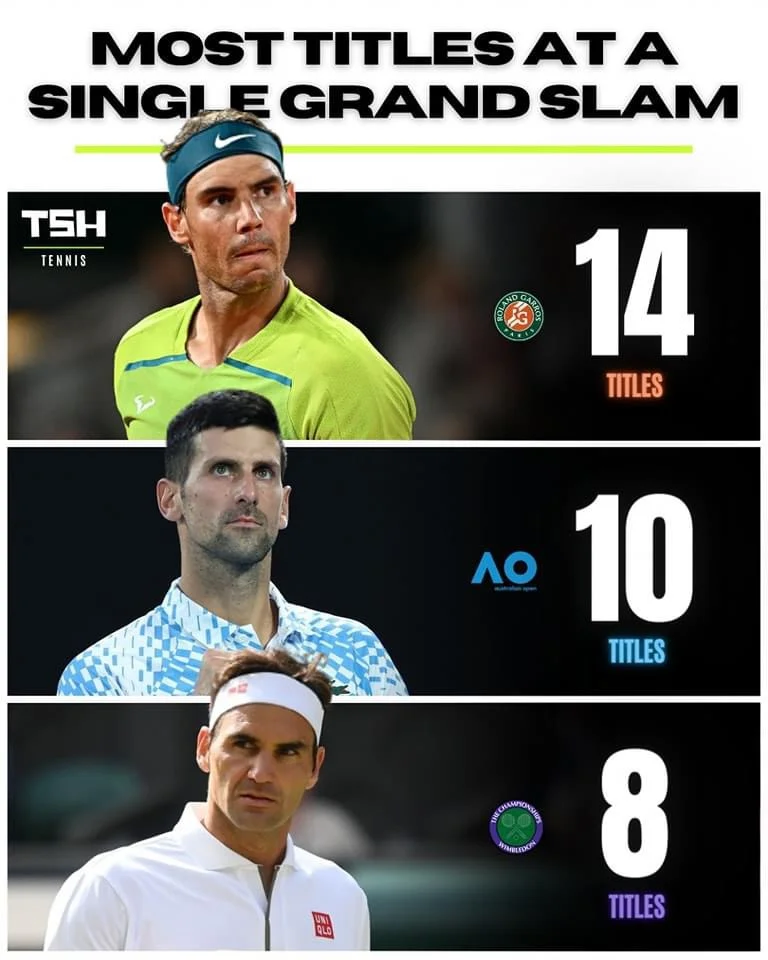
Legendary champions include Bjorn Borg, Chris Evert, Ivan Lendl, Gustavo Kuerten, Justine Henin, Rafael Nadal, and Simona Halep. Nicknamed the "King of Clay," Nadal won a record 14 French Open men's singles titles between 2005 and 2022. Evert holds the women's singles record with seven titles.
Iconic moments
The French Open has witnessed many memorable moments. In 1999, Andre Agassi completed his Career Grand Slam there. In 2009, Roger Federer did the same, winning the title after Nadal's unexpected fourth-round defeat to Robin Soderling.
The tournament's rich traditions, passionate fans, and demanding clay-court conditions make it a distinctive part of the tennis calendar.
3. Wimbledon
Wimbledon is the oldest of the four Grand Slam tournaments and one of the sport's most prestigious championships. It is held annually in London, United Kingdom, usually beginning in late June or early July.
History
Wimbledon dates back to 1877, when the inaugural championship was played at the All England Lawn Tennis and Croquet Club. The club moved to its present Church Road grounds in 1922.
Venue
The tournament takes place at the All England Lawn Tennis and Croquet Club. Its main show courts are Centre Court and No. 1 Court, both equipped with retractable roofs.
Surface
Wimbledon is the only major played on grass. The surface typically produces a lower bounce than clay and rewards effective serving, quick reactions, and strong movement. Serve-and-volley tennis has an important place in its history, although modern baseline players have also enjoyed great success.
Tournament structure
Wimbledon includes men's singles, women's singles, men's doubles, women's doubles, and mixed doubles, alongside junior and wheelchair competitions.
Traditions
Wimbledon is known for its traditions and dress code, which requires players to wear clothing that is almost entirely white, subject to specified exceptions. The Royal Box hosts invited guests, including members of the royal family, but players are not routinely required to greet it before matches.
Best-of-five sets
Men's main-draw singles matches are best of five sets throughout the tournament, just as they are at the Australian Open, French Open, and US Open. Women's singles matches are best of three sets.
Strawberries and cream
Strawberries and cream are a beloved Wimbledon tradition and an integral part of the spectator experience.
Legends of Wimbledon
Many legendary players have left their mark on Wimbledon, including Bjorn Borg, Martina Navratilova, Pete Sampras, Serena Williams, and Roger Federer. Navratilova won nine women's singles titles, while Federer won eight men's singles titles.
Longest match
The 2010 men's singles match between John Isner and Nicolas Mahut remains famous as the longest match in tennis history. It lasted 11 hours and five minutes across three days, with Isner winning the fifth set 70–68.
That score is no longer possible under the current deciding-set rules. Since 2022, all four majors have used a 10-point tiebreak at 6–6 in the deciding set of main-draw singles matches, with a two-point margin required to win.
Wimbledon's heritage, grass courts, and distinctive traditions make it an exceptional event in the tennis calendar.
4. US Open

The US Open is held annually in late August and early September in New York City, United States. It is the final major championship of the calendar year.
History
The US Open traces its origins to the U.S. National Championships in 1881. It was played on grass through 1974, on clay from 1975 to 1977, and on hard courts from 1978, when it moved to Flushing Meadows.
Venue
The tournament is hosted at the USTA Billie Jean King National Tennis Center in Flushing Meadows, Queens. Its main stadiums are Arthur Ashe Stadium, the largest tennis stadium in the world, Louis Armstrong Stadium, and the Grandstand.
Surface
The US Open uses acrylic hard courts supplied by Laykold, which replaced DecoTurf in 2020. Their relatively consistent bounce accommodates a variety of playing styles, from aggressive baseline hitting to attacking net play.
Tournament structure
The tournament includes men's singles, women's singles, men's doubles, women's doubles, and mixed doubles. Junior and wheelchair competitions are also part of its program, although schedules and event formats can vary by edition.
Night sessions
The US Open is known for electric night sessions under floodlights. Matches at Arthur Ashe Stadium draw large crowds and contribute to the tournament's energetic atmosphere.
Prize money
The US Open offers substantial prize money and became the first major to award equal prize money to men and women in 1973. The overall prize fund and round-by-round payouts are announced for each edition.
Retractable roofs
Arthur Ashe Stadium's retractable roof opened in 2016, followed by the roof on the new Louis Armstrong Stadium in 2018. These allow play to continue on the two main stadium courts during rain, although outdoor matches can still be disrupted.
Hard-court swing
The US Open concludes the North American summer hard-court swing, which includes major tour stops in Canada and Cincinnati. It is the year's fourth major, but only the second major played on hard courts. Indian Wells and Miami are important tour events, not Grand Slam tournaments.
Champions
The US Open has seen numerous legendary champions, including Billie Jean King, Jimmy Connors, Chris Evert, Serena Williams, Roger Federer, and Novak Djokovic.
Its New York setting, lively crowds, and night matches provide a distinctive conclusion to the annual Grand Slam schedule.
Who has won a tennis Grand Slam?
Completing a calendar-year Grand Slam requires winning all four majors in the same discipline in the same year. In the traditional men's and women's singles competitions, five players have accomplished this, with Rod Laver doing so twice. This list includes both amateur-era and Open Era achievements; wheelchair tennis has its own Grand Slam champions and records.
1. Men's and women's singles
Don Budge — 1938 (United States): The first player to complete a singles calendar-year Grand Slam.
Maureen Connolly — 1953 (United States): The first woman to achieve the singles Grand Slam.
Rod Laver — 1962 and 1969 (Australia): The only player to complete the traditional singles calendar-year Grand Slam twice. His 1969 sweep came in the Open Era.
Margaret Court — 1970 (Australia): Won all four women's singles majors in the same year.
Steffi Graf — 1988 (Germany): Also won Olympic singles gold that year, completing the calendar-year Golden Slam.
2. Men's and women's doubles
Frank Sedgman and Ken McGregor — 1951 (Australia): Completed the men's doubles Grand Slam as a team.
Maria Bueno — 1960 (Brazil): Completed the women's doubles Grand Slam with different partners: Christine Truman at the Australian Championships and Darlene Hard at the other three majors.
Martina Navratilova and Pam Shriver — 1984 (United States): Won all four women's doubles majors together.
Martina Hingis — 1998 (Switzerland): Won the women's doubles Grand Slam with Mirjana Lucic at the Australian Open and Jana Novotna at the remaining three majors.
3. Mixed doubles
Margaret Smith (later Margaret Court) and Ken Fletcher — 1963 (Australia): Won all four mixed doubles majors together.
Margaret Court — 1965 (Australia): Completed another mixed doubles calendar-year Grand Slam with different partners. The Australian title was shared after the final was not played.
Owen Davidson — 1967 (Australia): Won the Australian title with Lesley Turner and the other three majors with Billie Jean King.
Why is the calendar-year Grand Slam so difficult?
A singles player must sustain championship-level performance across four tournaments, three surfaces, different climates, and many months. In a standard 128-player draw, winning all four majors requires 28 main-draw match victories without a defeat at any of those events.
Neither Novak Djokovic, Roger Federer, nor Rafael Nadal—the "Big Three"—completed a calendar-year singles Grand Slam, although all three achieved a Career Grand Slam. Their overlapping careers made the competition formidable, but rivalry alone does not explain the difficulty of winning all four majors in one year.
Djokovic held all four major singles titles simultaneously after winning the 2016 French Open, completing a non-calendar-year Grand Slam. In 2021, he won the first three majors before losing the US Open final to Daniil Medvedev, finishing one match short of the calendar-year sweep.
One major title versus the Grand Slam
Winning any Grand Slam tournament is a major achievement. Completing the calendar-year Grand Slam means something even rarer: winning the Australian Open, French Open, Wimbledon, and US Open in the same discipline in one year. A Career Grand Slam rewards success across all four events over time, while a Golden Slam adds Olympic gold to the achievement.
Comments
No approved comments yet.
Log in or sign up to join the conversation.