

How to Choose Your First Tennis Racquet: A No-Jargon Guide
Choose your first tennis racquet with plain-English guidance on head size, weight, grip, strings and budget, plus a checklist to take to the store.
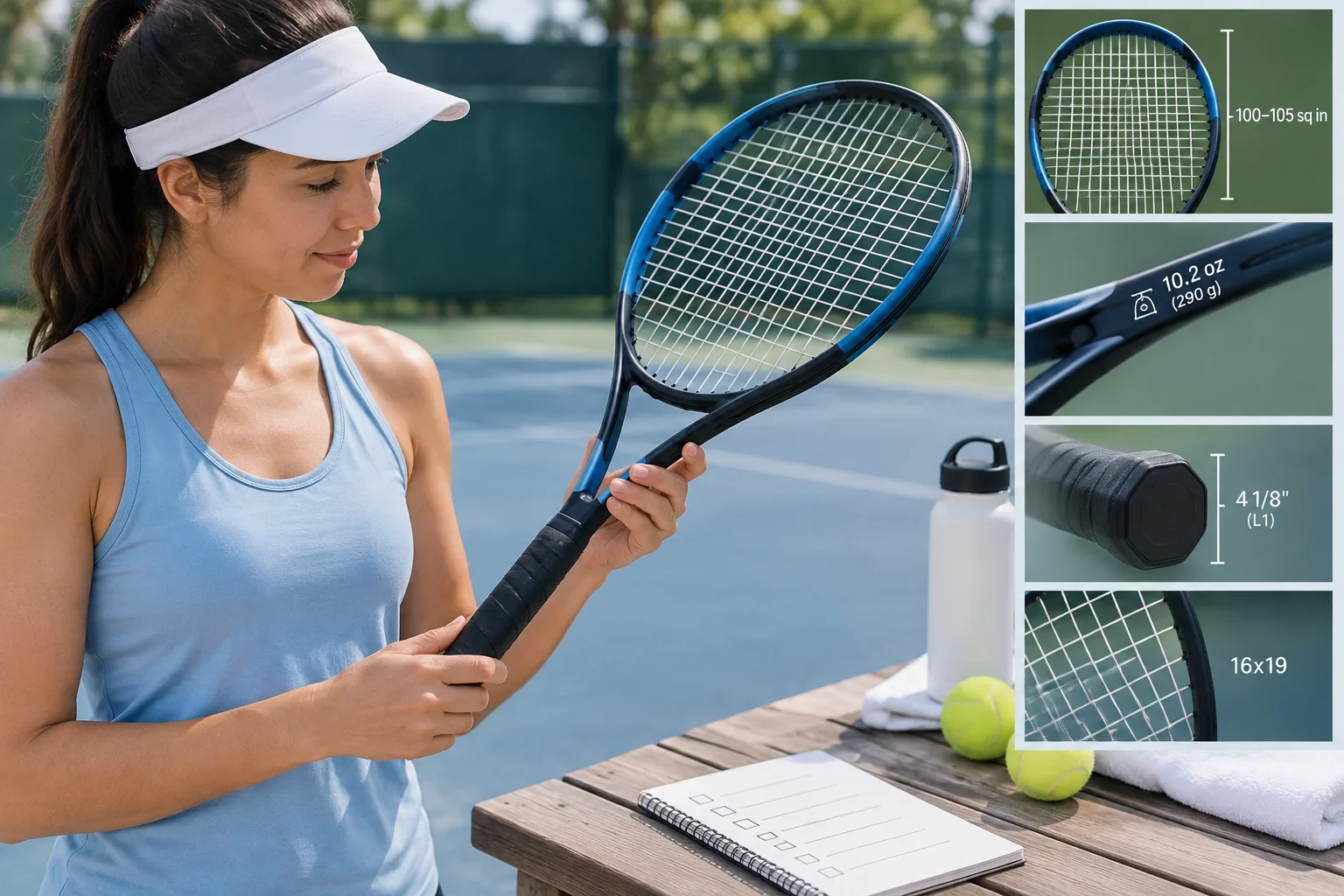
Image credit: ChatGPT
Your first racquet should be light, forgiving and comfortable to hold. Don't pick it for looks, a pro's endorsement or the price tag. For most adult beginners, that means a head size of about 100–105 square inches and a strung weight of about 9.5–10.5 oz (270–300 g), in a grip size that fits your hand.
The racquet won't make you a good player. A bad fit can make learning harder, though, and can lead to sore elbows, mishit balls and frustration. This guide explains each spec in plain English and tells you which ones matter. It ends with a checklist to bring to the store.
The short answer
If you're an adult beginner and only want the numbers, look for these specs on the racquet frame or the product page.
| Spec | What to look for | Why |
|---|---|---|
| Head size | 100–105 sq in | Bigger sweet spot, more forgiving on off-center hits |
| Strung weight | 9.5–10.5 oz (270–300 g) | Easy to swing, but not so light that it rattles |
| Balance | Even to slightly head-light | Feels stable and easy to maneuver at the net |
| Grip size | Measured to your hand (usually 4 1/8" to 4 3/8" for adults) | Too small or too big strains your forearm |
| Length | 27 in (standard) | Longer racquets are harder to control |
| Stiffness (RA) | Under about 68 | Kinder to your elbow and wrist |
| String pattern | 16x19 | Easier spin and a bit more power |
| Price | About $80–$200 USD | Real adult frames, not toy-store racquets |
Prices are approximate as of 2026 and vary by region and sales.
Head size: how big the hitting area is
Head size is the area of the string bed, measured in square inches. A bigger head gives you a bigger "sweet spot." That's the zone where the ball comes off cleanly instead of twisting the racquet or buzzing your hand.
| Head size | Who it suits | Trade-off |
|---|---|---|
| 95–98 sq in (midsize) | Advanced players with consistent swings | Small sweet spot; punishes mishits |
| 100–105 sq in (midplus) | Most beginners and intermediates | The sweet spot for learning: forgiving and still controllable |
| 107–115+ sq in (oversize) | Older players and those with short, compact swings | Lots of free power, but harder to control on big swings |
In plain terms, start at 100. Go up to 105–110 if you want extra help getting the ball over the net. Smaller heads are for when you can hit the center of the strings most of the time.
Weight: easy to swing vs. solid on impact
Aim for 9.5–10.5 oz (270–300 g) strung. Lighter racquets are easier to swing and get ready faster. Heavier racquets feel more stable and absorb more of the ball's shock, so less of it reaches your arm.
The common beginner trap is buying the lightest racquet in the store. Very light frames, under about 9 oz (255 g), feel great in the shop but shake on impact. That pushes the shock into your wrist and elbow.
Check which number you're reading:
- Unstrung weight is the frame alone. Most brands list this one.
- Strung weight is the frame with strings, about 0.5 oz (15 g) heavier. It's what you actually swing.
A quick test is to hold the racquet out in front of you and do 10 slow practice swings. Your forearm should feel fine afterward. If it burns, go lighter. If the racquet feels flimsy or whippy, go a little heavier.
Balance: where the weight sits
Balance tells you whether more of the weight sits in the head or in the handle. Beginners do best with an even balance or one slightly toward the handle ("head-light").
- Head-heavy racquets feel powerful on groundstrokes. They're often paired with very light frames, and the combination can strain your arm.
- Even balance is a good all-round choice for learning.
- Head-light racquets are quick at the net and easy to maneuver. Most players' frames are set up this way.
Spec sheets list balance in points, such as "4 pts HL" for 4 points head-light, or in millimeters from the butt of the handle. You don't need to decode it. Avoid racquets that are both under 9.5 oz and marked strongly head-heavy.
Grip size: the spec that matters most for comfort
Grip size is the distance around the handle. It's the one spec you can't fix with technique. A grip that's too small makes you squeeze harder. A grip that's too big makes the racquet hard to turn. Both can lead to tennis elbow.
To measure it:
- Hold your hitting hand open, fingers together.
- Find the middle crease of your palm (the second line down from your fingers).
- Measure from that crease to the tip of your ring finger, in inches.
- That number is roughly your grip size.
| US size | European size | Typical fit |
|---|---|---|
| 4 in | L0 | Juniors, small hands |
| 4 1/8 in | L1 | Smaller adult hands |
| 4 1/4 in | L2 | Most common adult size |
| 4 3/8 in | L3 | Medium-to-large hands |
| 4 1/2 in | L4 | Large hands |
You can also do the finger test. Hold the racquet with a normal handshake grip. You should just fit the index finger of your other hand in the gap between your fingertips and your palm.
If you're between sizes, pick the smaller one. An overgrip (a thin wrap that goes over the handle, about $2–3 each) adds roughly one size. Making a handle smaller is much harder.
Specs you can mostly ignore (for now)
These show up on spec sheets and in reviews. They matter more as you improve, so a quick rule for each is enough.
- Length: Stick with the standard 27 in. Extended racquets (27.5 in and up) add reach and power but are harder to control.
- Stiffness (RA rating): A higher number means a stiffer frame, more power and more vibration. Under about 68 is kinder to your arm. Under 65 is better if you've had elbow or wrist trouble.
- String pattern: This is the number of strings running up and down and across, such as 16x19 or 18x20. Choose 16x19, the open pattern, for easier spin and a larger sweet spot.
- Beam width: A thicker frame adds power. Anything in the 23–26 mm range is fine for beginners.
- Strings and tension: Most beginner racquets come pre-strung with a basic synthetic gut. That's fine. When you restring, ask for a soft multifilament at mid-range tension (about 50–55 lbs). Avoid stiff polyester strings until your swing is consistent.
Which racquet fits you
Not every first-timer is the same. Find your row:
| Player | Head size | Strung weight | Notes |
|---|---|---|---|
| Adult beginner, athletic | 100 sq in | 10–10.5 oz (285–300 g) | Room to grow; you won't outgrow it in a season |
| Adult beginner, casual or smaller build | 100–105 sq in | 9.5–10 oz (270–285 g) | Prioritize comfort and easy swinging |
| Returning player (played years ago) | 98–100 sq in | 10–10.8 oz (285–305 g) | Modern frames are lighter and more powerful than old ones; demo before buying |
| Senior or arm/elbow issues | 105–110 sq in | 9.5–10 oz (270–285 g) | Low stiffness (RA under 65), soft strings, lower tension |
| Teen with adult frame | 100 sq in | 9.5–10.2 oz (270–290 g) | Move up from junior when they're about 4'11" (150 cm) or taller |
Kids need junior racquets, sized by height, not age. Rough guide: 19 in for under 3'4" (100 cm), 21 in up to 3'11" (120 cm), 23 in up to 4'5" (135 cm), 25 in up to 4'11" (150 cm), 26 in above that. A quick check is to stand the racquet on the ground beside your child. The handle should reach their fingertips with their arm hanging straight down.
Budget and where to buy
Plan to spend about $80–$200 on the racquet. Add about $15–30 for an overgrip, a can of balls and, if needed, a restring.
| Price range (USD, approx.) | What you get |
|---|---|
| Under $50 | Aluminum "recreational" frames from big-box stores. Fine for a one-off hit, but they vibrate and are usually oversized and very light. |
| $80–$150 | Graphite frames from major brands, often last year's model on sale. The best value for most beginners. |
| $150–$250 | Current models used by club and tour players. Worth it only if the specs fit you, not for the name. |
| Used ($40–$100) | Good value if the frame has no cracks. Budget for fresh strings and an overgrip. |
Where to buy:
- Local pro shop or club. They'll measure your grip, string the racquet properly and often let you try before you buy.
- Online tennis retailers. Many run demo programs: you pay a small fee to test 2–3 racquets for a week, often credited toward your purchase.
- Friends and coaches. Borrowing a racquet for a session or two is the cheapest demo there is.
If you can, demo before you buy. Ten minutes on court tells you more than any spec sheet.
Common first-racquet mistakes
- Buying your favorite pro's racquet. Tour frames are usually heavy, with a small head and stiff strings. They're built for swings you don't have yet.
- Going as light as possible. Ultra-light frames feel easy in the store and shaky on court, and they're hard on your arm.
- Guessing your grip size. Measure it. This is the spec most tied to elbow pain.
- Choosing a grip that's too big. You can always build a grip up with an overgrip. You can't easily shrink it.
- Ignoring the strings. Old, dead or very stiff strings can make a good frame feel bad. Restring at least once a year, or as many times a year as you play per week.
- Overspending before you know you'll stick with it. A $100 racquet that fits beats a $250 one that doesn't.
- Buying two racquets right away. That can wait until you're playing matches regularly and breaking strings.
FAQ
How long will my first racquet last?
The frame can last for years if you don't crack it. Most players upgrade after 1–3 years, once their swing changes. The strings need replacing much sooner.
Should I buy a racquet "for my level" or one I can grow into?
Pick one that fits you now, with a 100 sq in head and middle-of-the-road weight. That range covers beginners through solid intermediates, so you won't outgrow it quickly.
Do racquets come strung?
Most beginner and mid-priced racquets do. Many premium frames are sold unstrung, so check the listing and budget about $25–45 for strings and labor.
Does brand matter?
Not much. The major brands all make good beginner frames. Compare specs, not logos.
I already have elbow pain. What should I change?
Choose a larger head (105+ sq in), a low-stiffness frame (RA under 65), soft multifilament strings at lower tension, and check your grip size. Then see a doctor or physiotherapist, and a coach for your technique.
Can I use a padel or pickleball paddle-style racquet instead?
No. They're different sports with different equipment. A tennis racquet is the only legal option for tennis.
Checklist before you buy
- Measured my grip size (or did the finger test in the shop)
- Head size is 100–105 sq in (105–110 if I want extra help or have arm issues)
- Strung weight is about 9.5–10.5 oz (270–300 g)
- Balance is even or head-light, not ultra-light and head-heavy
- Stiffness (RA) is under about 68
- String pattern is 16x19
- Confirmed whether it comes strung, and what string
- Swung it or demoed it, and it felt comfortable
- Picked up an overgrip and a can of balls
- Found someone to play with and a court to play on
Comments
No approved comments yet.
Log in or sign up to join the conversation.