

Tennis Doubles Formations: Standard, Australian, I-Formation and Two Back
Learn the main tennis doubles formations, when to use the Australian, I-formation and two-back setups, and how to signal them with your partner.
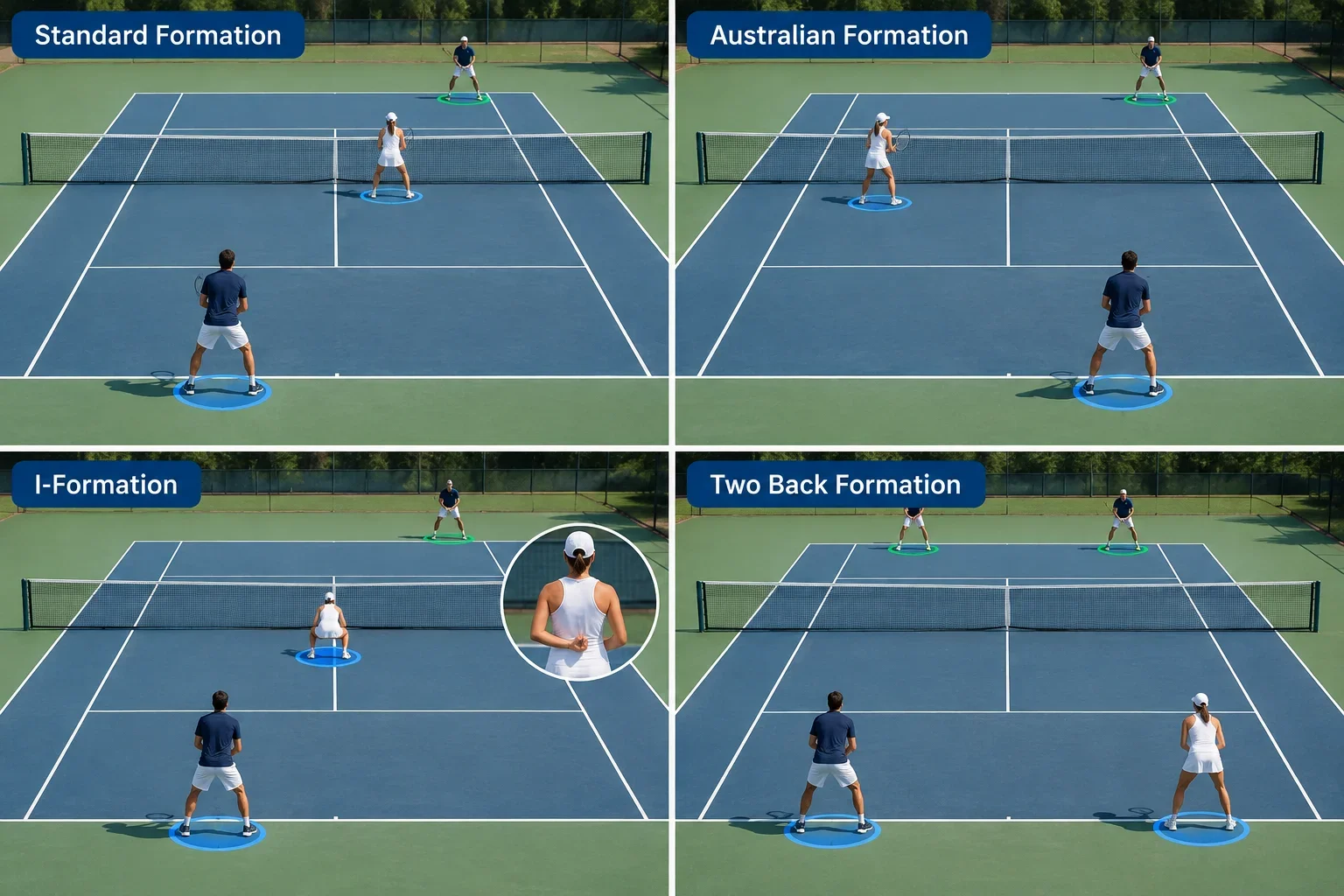
Image credit: ChatGPT
Most club doubles teams play the same formation every point: one player up, one player back. That works, but changing formation is one of the easiest ways to disrupt a returner who is grooving their returns. The I-formation, the Australian formation and the two-back formation each solve a specific problem.
This guide explains each formation, when to use it and how to communicate it with your partner.
The formations at a glance
| Formation | Where the server's partner stands | Use it to |
|---|---|---|
| Standard (one up, one back) | At the net on the opposite side from the server | Play a balanced, normal point |
| Australian (tandem) | At the net on the same side as the server | Take away the crosscourt return |
| I-formation | Crouched near the center line, in front of the server | Hide which way the net player will move |
| Two back | Both players at the baseline | Defend against strong returners or net players |
Standard formation
The server stays at the baseline (or comes forward), and the partner stands at the net on the opposite side, roughly in the middle of the service box. The returner usually aims crosscourt, back to the server, away from the net player.
It's the most balanced formation. Use it as your default, and switch when the returner is comfortable crosscourt. See Tennis Doubles Strategy for positioning in the standard formation.
Australian formation
The server's partner stands at the net on the same side as the server. The server serves from close to the center mark, then moves to cover the open side.
- Why use it: it blocks the returner's favorite crosscourt return, and forces them to hit down the line, often to their weaker side.
- When: against a returner with a strong crosscourt return, especially a big crosscourt forehand from the ad side.
- Watch out for: a good down-the-line return, which goes to the side the server has to cover.
I-formation
The net player crouches low near the center line, in front of the server. The server serves from near the center mark. Before the serve, the team agrees which way the net player will move, and the server covers the other side.
- Why use it: the returner doesn't know which way the net player is going, which causes hesitation and errors.
- How to signal: the net player shows a hand signal behind their back, such as a fist for "stay" or an open hand for "switch."
- Watch out for: getting hit by the serve. The net player must stay low and still until the ball passes.
Try the I-formation for a few points when you're broken or when the returner is in a rhythm. Even if you don't win every point, the uncertainty it creates often lasts for several games.
Two back
Both players stay at the baseline, usually on the return when facing a big server or very strong net players.
- Why use it: it reduces the number of easy volleys aimed at your net player, and gives you more time.
- When: against powerful serves, or when your net player is getting picked off.
- Watch out for: drop shots and angles. Move forward together when you get a short ball.
How to communicate formations
- Before the point: decide on the formation and the net player's movement (stay, switch or fake).
- Use simple signals: hand signals behind the back, or quick words between points.
- Keep the server in charge of the serve placement, and the net player in charge of movement.
- Review after a few games: what's working, and what isn't?
Practicing formations
- Practice each formation for a set in practice matches, so it feels natural in league play.
- Practice the I-formation movement without a returner first, so both of you know where to go.
- Use one formation consistently for a whole game, so you learn how opponents adjust.
FAQ
Are these formations legal?
Yes. The rules only control where the server stands. The server's partner can stand anywhere on their side, as long as they don't interfere with the serve.
Which formation is best for beginners?
Standard formation. Learn it well first, then add the Australian formation, which is the simplest variation.
Do these apply to mixed doubles?
Yes. See Mixed Doubles Strategy for more.
Keep learning
- Formations work best with good volleys. See Volleys for Club Players.
- Find a regular doubles partner in our player directory.
- Join a league to put it into practice. See League or Ladder?
Comments
No approved comments yet.
Log in or sign up to join the conversation.