
Tennis Basics: Rules, Scoring, Equipment and How to Play
Learn the basics of tennis, including court lines, equipment, serving, scoring, essential shots and the differences between singles and doubles.
Tennis is a racket sport played on a rectangular court divided by a net. It can be played as singles, with one player on each side, or doubles, with two players on each side. Doubles uses a wider playing area than singles.
Players use tennis rackets to hit a ball over the net and into the opponent's court. After the serve, a player may hit the ball before it bounces or after one bounce, but must return it before a second bounce. The objective is to win points by making a valid shot that the opponent cannot return, or by forcing an error.
Modern lawn tennis developed in England in the 19th century, with roots in earlier racket games. Today, amateur and professional players enjoy tennis worldwide. The four major tournaments, known as the Grand Slams, are the Australian Open and US Open on hard courts, the French Open on clay courts, and Wimbledon on grass courts. Tennis is also an Olympic sport.
Key Takeaways
- Tennis can be played as singles or doubles; doubles uses the outer sidelines.
- Scoring progresses through points, games, sets and a match.
- A serve must land in the diagonally opposite service box, and the receiver must let it bounce.
- During a rally, the ball may bounce no more than once before being returned.
- A ball touching the correct boundary line is in.
The Tennis Court
A standard tennis court is 78 feet (23.77 meters) long. It is 27 feet (8.23 meters) wide for singles and 36 feet (10.97 meters) wide for doubles. The net is 3 feet (0.914 meters) high at the center.
- Baseline: The line at each end of the court. Players serve from behind it.
- Singles sidelines: The inner side boundaries used for singles.
- Doubles sidelines: The outer side boundaries used for doubles. The strips between the singles and doubles sidelines are called doubles alleys.
- Service line: The line parallel to the net that marks the back of the service boxes.
- Center service line: The line dividing each side's service area into two boxes.
- Center mark: The small mark at the middle of each baseline, used to identify the two serving sides.
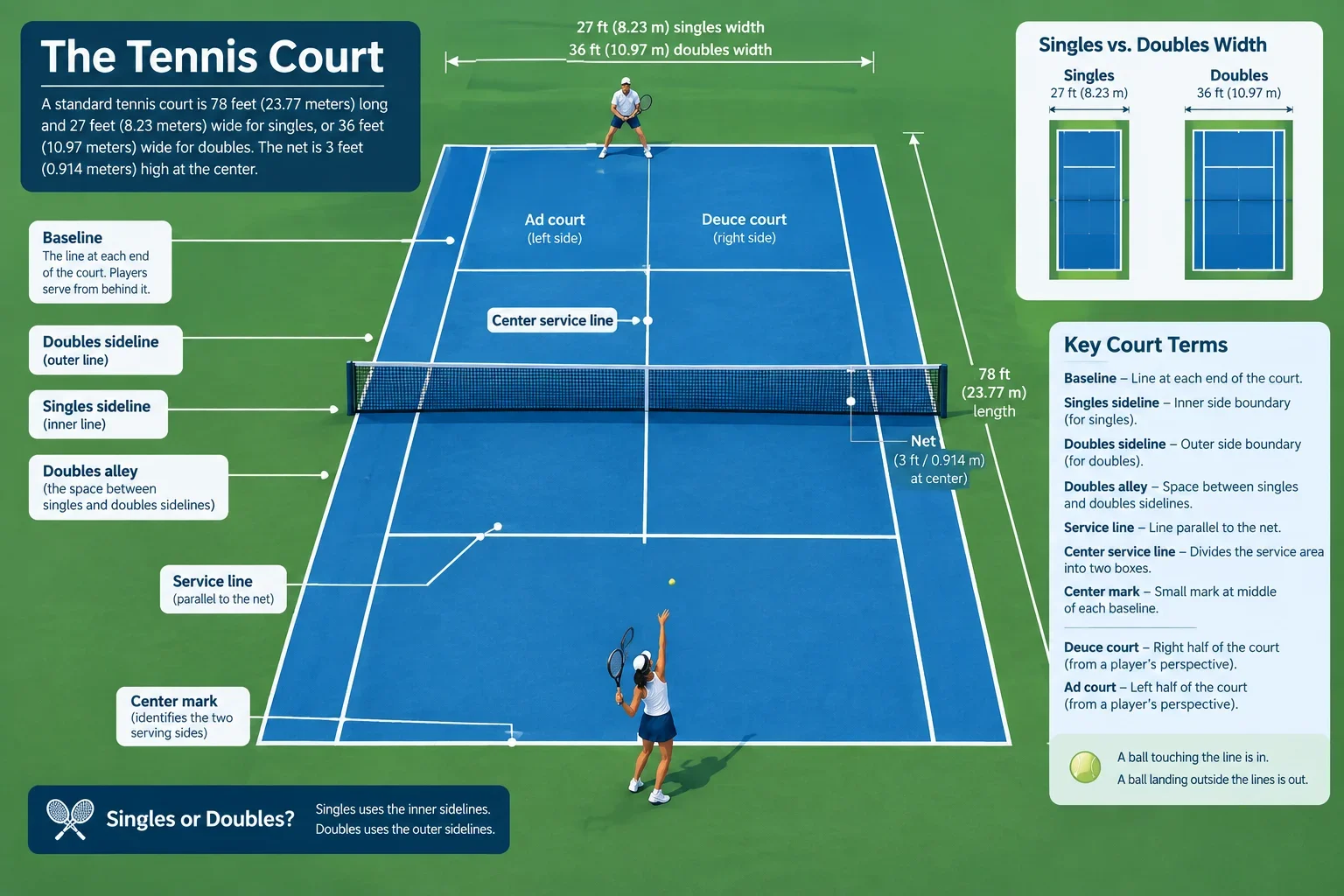
The deuce court is the right half of the court from a player's perspective when facing the net. The advantage court, often called the ad court, is the left half. These names refer to court positions, not whether a player is hitting a forehand or backhand.
Common Court Surfaces
| Surface | Typical Playing Characteristics |
|---|---|
| Hard court | Usually offers a relatively predictable bounce. Speed varies with the surface coating and conditions. |
| Clay court | Generally produces a higher bounce and slower play, encouraging longer rallies. |
| Grass court | Generally produces a lower bounce and faster play, although conditions can vary. |
Equipment You Need
To start playing, you need a racket, tennis balls, suitable shoes and access to a court.
- Racket: Choose one with a comfortable grip size and a weight you can swing without strain. Junior players should use a racket suited to their height and strength.
- Tennis balls: Standard balls suit regular play. Slower red, orange or green balls can make learning easier for children and adult beginners.
- Tennis shoes: Court shoes are designed for lateral movement. Choose soles suitable for the court surface and follow the facility's footwear rules.
- Clothing and essentials: Wear clothing that allows free movement and bring water. For outdoor play, consider sun protection.
Rules of Tennis
Although singles involves two players and doubles involves four, the general rules are similar. These are the main rules beginners should know.
Tennis can be played by two people in singles or four people in doubles.
Singles uses the inner sidelines, while doubles uses the outer sidelines during rallies. Both formats use the same service boxes.
Scoring progresses through points, games, sets and a match. Under standard advantage scoring, a game requires at least four points and a two-point margin.
A standard set is won by reaching six games with a margin of at least two games. Many formats use a tiebreak at 6–6, but the exact rules depend on the competition.
A match is commonly best of three sets or best of five sets. The first player or team to win two or three sets respectively wins; not every scheduled set needs to be played. Recreational players may agree to play one set or a shorter format.
Players or teams alternate serving each game. A coin toss or racket spin can decide who chooses to serve, receive or select an end; the winner may also defer the choice.
The server starts each game from the deuce side, then alternates between the deuce and ad sides after every point.
The serve must land in the diagonally opposite service box. The server has two attempts: if both are faults, the receiver wins the point. The receiver must allow the serve to bounce before returning it.
During a rally, a ball that lands outside the relevant court boundaries is out, and the player who hit it loses the point.
A ball that touches a relevant boundary line is considered in.
While the ball is in play, a player loses the point for touching the net or its posts with their body, racket or clothing, or touching the opponent's court.
A player cannot deliberately hit the ball twice or catch and carry it on the racket. An accidental double contact during one continuous stroke is allowed.
Normally, a player must wait until the ball crosses the net before hitting it. An exception applies when a ball bounces on the player's side and spins or blows back over the net: the player may reach over to hit it without touching the net or the opponent's court.
A player must return the ball before it bounces twice. After the serve has been returned, hitting the ball before it bounces is allowed.
How to Serve
Start behind the baseline, between the center mark and the appropriate sideline. For the first point of a game, serve from the right-hand, or deuce, side into the receiver's diagonally opposite service box.
A typical serve involves tossing the ball upward and striking it overhead. An underarm serve is also legal. When serving, do not step on the baseline or into the court before striking the ball, and do not step outside the permitted serving area. Breaking these positioning rules is a foot fault.
A serve that misses the correct service box, fails to clear the net or otherwise breaks the service rules is a fault. Two consecutive faults make a double fault, which loses the point.
If a serve touches the net and then lands in the correct service box, it is normally a service let, and that serve is replayed. A first-serve let does not use up the first serve; a second-serve let leaves the server with a second serve. During a rally, a ball that clips the net and lands in the correct court remains in play.
Tennis Scoring
Tennis scoring is organized into points, games, sets and a match.
Point: The smallest unit of scoring. In a standard game, the score progresses from love (0) to 15, 30, 40 and game. The server's score is always announced first.
Game: A player or team must win at least four points and lead by two points. At 40–40, the score is deuce. The next point gives one side advantage; winning the following point wins the game. Losing it returns the score to deuce. Ad in means the server has advantage, while ad out means the receiver has advantage.
Set: A player or team normally needs at least six games and a two-game lead, such as 6–4 or 7–5. In a standard tiebreak set, a tiebreak is played at 6–6, and the winner takes the set 7–6.
Match: The winner is the first player or team to win the required number of sets. Best-of-three matches require two sets; best-of-five matches require three.
A Simple Scoring Example
If the server wins the first point, the score is 15–love. If the receiver wins the next point, it becomes 15–15. If the server then wins three consecutive points, the score moves to 30–15, 40–15 and game.
How a Tiebreak Works
A standard seven-point tiebreak uses ordinary numbers: 0, 1, 2 and so on. The first player or team to reach at least seven points with a two-point lead wins. At 6–6 in points, play continues until someone leads by two.
The player whose turn it is to serve delivers the first point from the deuce side. The opponent then serves two points, starting from the ad side. Players continue alternating two serves each. They change ends after every six points.
Some competitions use different formats, including ten-point deciding tiebreaks and no-ad games. In no-ad scoring, a single deciding point is played at deuce. Check the format before starting.
Basic Tennis Shots
- Forehand: A shot played on the racket-hand side of the body, usually after a bounce.
- Backhand: A shot played on the opposite side, using one or two hands.
- Serve: The shot that starts each point.
- Return: The receiver's response to the serve.
- Volley: A shot struck before the ball bounces, often near the net.
- Overhead: A shot hit above the head, commonly used to attack a high ball.
- Lob: A high shot intended to travel over an opponent, particularly one near the net.
- Drop shot: A softly hit shot intended to land close to the net.
Topspin makes the ball rotate forward, helping it dip into the court. Slice uses backspin and often produces a lower bounce. Beginners should focus on reliable contact and controlled placement before trying to generate heavy spin or power.
Singles and Doubles Basics
In singles, you cover the court alone. A useful starting strategy is to hit safely over the net, aim away from the sidelines and recover toward a position that helps you cover the opponent's likely reply.
In doubles, teamwork is essential. Partners should communicate about who will take balls down the middle and whether to move forward or stay back. A common formation has the server near the baseline and their partner near the net, although other formations are allowed.
Doubles partners establish a serving order at the start of each set and keep that order throughout the set. The receiving team also establishes who receives on the deuce and ad sides for that set. Once the serve has been returned, either partner may hit subsequent shots.
Changing Ends and Court Etiquette
Players change ends after the first, third and every subsequent odd-numbered game of a set. Tiebreaks have their own end-change schedule. Changing ends helps balance conditions such as sun and wind.
In recreational matches without an umpire, players generally call balls on their own side of the court. Make calls promptly and clearly; if you are unsure whether a ball was out, treat it as in. Announce the score before serving to prevent confusion.
Wait until neighboring points finish before crossing behind another court or retrieving a ball. If a loose ball enters an active court, alert the players so they can stop safely.
Practical Tips for Your First Session
- Warm up with easy movement and gentle hitting before playing points.
- Begin with short rallies inside the service boxes, then gradually move back.
- Use a balanced ready position with knees slightly bent and the racket in front.
- Aim for large targets with comfortable net clearance rather than the lines.
- Practice a dependable serve before prioritizing speed.
- Agree on the scoring format before starting and call the score aloud.
Getting Started with Tennis
You do not need powerful shots or perfect technique to enjoy tennis. Start by learning the court boundaries, serving into the correct box, keeping a rally going and understanding the score. With regular practice, you can build the movement, control and confidence needed to enjoy both singles and doubles.
Comments
No approved comments yet.
Log in or sign up to join the conversation.