

10 Tennis Rules Most Club Players Get Wrong
From line calls and net touches to service lets and accidental double hits, learn 10 tennis rules that commonly confuse club players.
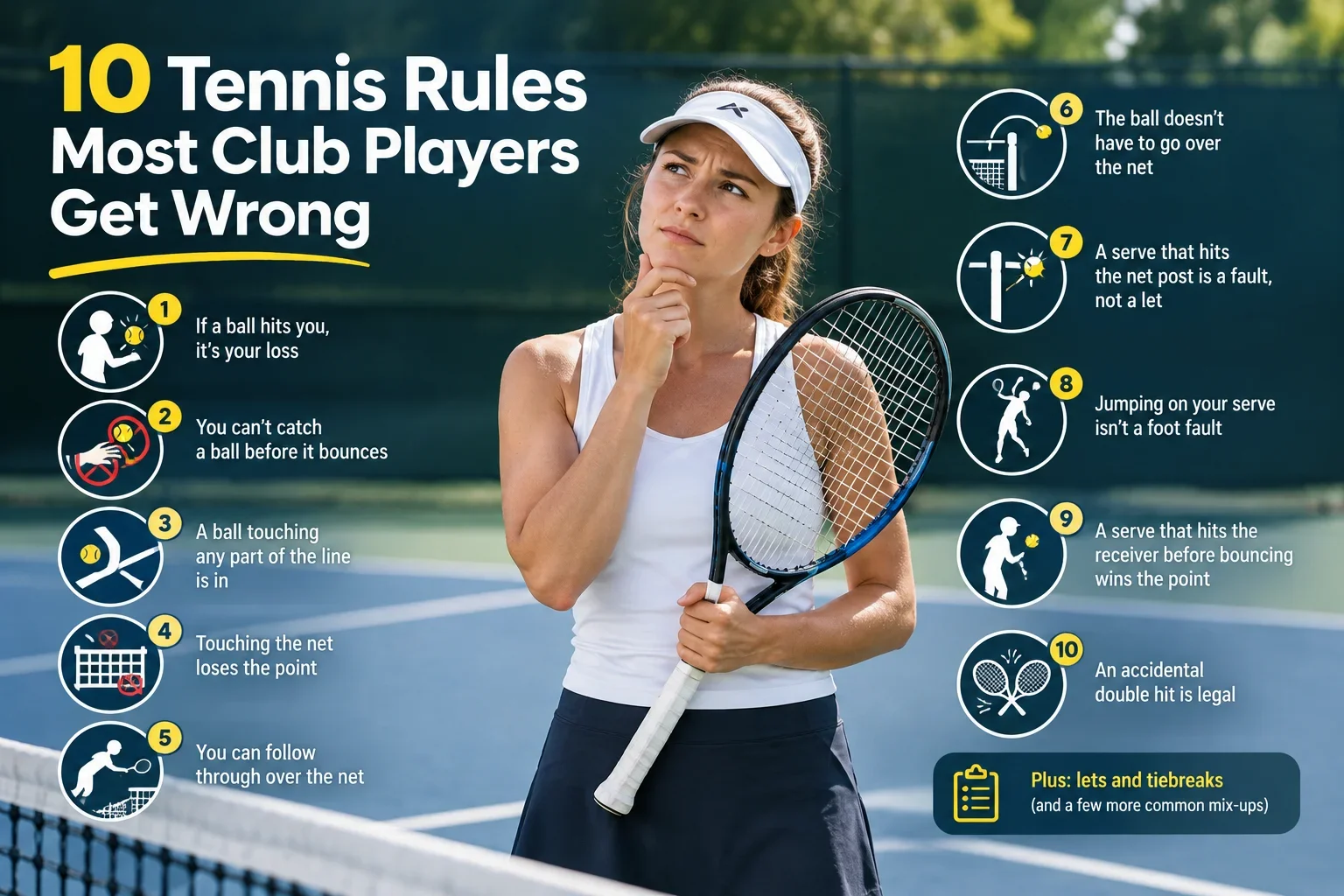
Image credit: ChatGPT
Most club players learned the rules from other club players, not from the rulebook. That's how myths spread: someone says "that's a let" with confidence, and soon the whole club plays it that way.
This article covers 10 rules that recreational players get wrong most often, based on the ITF Rules of Tennis, which apply to most matches worldwide. Each one comes up in real matches, and knowing the correct answer can save you a point, or an argument.
The 10 rules at a glance
| # | What many players think | The actual rule |
|---|---|---|
| 1 | If a ball hits you and it was going out, it's your point | You lose the point, wherever you're standing |
| 2 | You can catch a ball that's clearly going out | You lose the point |
| 3 | A ball that's mostly outside the line is out | Any contact with the line is in |
| 4 | Touching the net is fine once you've hit the ball | You lose the point if you touch the net while the ball is in play |
| 5 | You can never reach over the net | You can follow through over the net, and reach over in some cases |
| 6 | The ball must go over the net | Going around the net post is legal, even below net height |
| 7 | A serve that hits the net post is a let | It's a fault |
| 8 | Jumping during the serve is a foot fault | Jumping is legal; touching the baseline or court before contact isn't |
| 9 | A serve that hits the receiver before bouncing is a let | The server wins the point |
| 10 | Any double hit is illegal | An accidental double hit in one stroke is legal |
1. A ball that hits you is your loss, even if it was going out
This is the most common myth in club tennis. If the ball touches you, or anything you're wearing or carrying other than your racquet, before it bounces, you lose the point. It doesn't matter if you're standing well behind the baseline or the ball was obviously going out.
The ball isn't out until it lands out. Until then, it's in play.
2. You can't catch a ball before it bounces
This follows from rule 1. Catching a ball on the full, even one sailing toward the back fence, means the ball touched you while in play. You lose the point.
The habit is common in friendly hits. In a match, step aside and let the ball land.
3. A ball touching any part of the line is in
Lines are part of the court. If any part of the ball touches any part of the line, the ball is in, even if most of the ball landed outside.
This matters for line calls. A ball that "looked out" may have just clipped the line, especially from across the court. If you're not sure, the ball is in.
4. Touching the net loses the point while the ball is in play
You lose the point if you, your racquet or your clothing touch the net, the net posts or your opponent's side of the court while the ball is in play. That includes after you've hit a winner, if the ball hasn't bounced twice or gone out yet.
Once the ball is dead, it doesn't matter. Running into the net after the ball has bounced twice on your opponent's side is fine.
5. You can follow through over the net
You can't hit the ball before it crosses to your side of the net. But once you've hit it on your side, your racquet can follow through over the net, as long as you don't touch the net.
There's one more exception: if the ball bounces on your side and spin or wind carries it back over the net, you can reach over to hit it.
6. The ball doesn't have to go over the net
A shot that goes around the outside of the net post is legal, even if it's below the height of the net, as long as it lands in. You'll mostly see this on very wide balls where a player is pulled far off the court.
The ball can also hit the net post or net cord during a rally and still count, if it lands in.
7. A serve that hits the net post is a fault, not a let
A let only happens when the serve touches the net, the strap or the band at the top of the net and then lands in the correct service box. If the serve hits the net post, or a singles stick, it's a fault, even if it then lands in.
This is the opposite of what happens in a rally, where hitting the post and landing in is a good shot.
8. Jumping on your serve isn't a foot fault
A foot fault happens when either foot touches the baseline or the court inside it before you hit the ball. It also covers walking or running into the serve, and stepping over the imaginary extension of the center mark or sideline.
Jumping is legal. Most good servers leave the ground during the serve, and landing inside the court after contact is fine. In a match without officials, the receiver can call a foot fault only if it's clear and repeated, and usually after warning the server first. Check your league's rules.
9. A serve that hits the receiver before bouncing wins the point for the server
If a serve hits the receiver, or their doubles partner, before it bounces, the server wins the point. It doesn't matter where the receiver was standing, or whether the serve would have landed in.
The only exception is if the serve clipped the net first. Then it's a let, and the serve is replayed.
10. An accidental double hit is legal
If the ball hits your racquet twice during a single, continuous swing, play on. The rules only penalize deliberately hitting the ball twice, or deliberately carrying or catching it on the strings.
Accidental double hits usually happen on mishits near the frame or on rushed volleys. If your swing was one motion, the shot counts.
Bonus: lets and tiebreaks
A few more rules cause regular confusion at club level:
- There's no limit on service lets. If your serve clips the net and lands in, you replay that serve, as many times as it happens. A let on your first serve doesn't use up your first serve.
- A stray ball replays the whole point. If a ball from another court rolls onto yours during a rally, call a let right away. Under ITF rules, the whole point is replayed, starting with a first serve.
- Tiebreak serving goes 1, 2, 2. The player due to serve serves the first point. Then players alternate, serving two points each.
- Change ends every 6 points in a tiebreak. Players switch sides after every 6 points played, for example at 4–2 or 3–3, not just at the end of the tiebreak.
Local rules can differ. For example, some leagues use no-ad scoring or a 10-point match tiebreak. Check the format before you start.
FAQ
Can I hit the ball before it crosses the net if it's coming back to my side?
No. You can only reach over the net to hit a ball that bounced on your side and was carried back over by spin or wind.
Is it a let if a ball falls out of my pocket during a point?
The first time, your opponent can call a let and the point is replayed. If it happens again, it counts as a hindrance, and you lose the point.
What if my opponent isn't ready when I serve?
The receiver must play at the server's reasonable pace. But if they make no attempt to return the serve because they weren't ready, the serve is replayed. If they try to return it, they were ready.
Do these rules apply in casual matches?
Yes. The rules are the same whether it's a league match or a friendly. Recreational players often play friendly variations, but agree on them before you start.
Where can I read the official rules?
The ITF publishes the Rules of Tennis each year, and the USTA publishes Friend at Court, which includes the rules and The Code for matches without officials.
Comments
No approved comments yet.
Log in or sign up to join the conversation.