
How to Choose a Pickleball Paddle: Weight, Core Thickness and Surface Explained
Learn how paddle weight, core thickness, surface, shape and grip affect your game, with spec comparisons, budget guidance and a practical demo checklist.
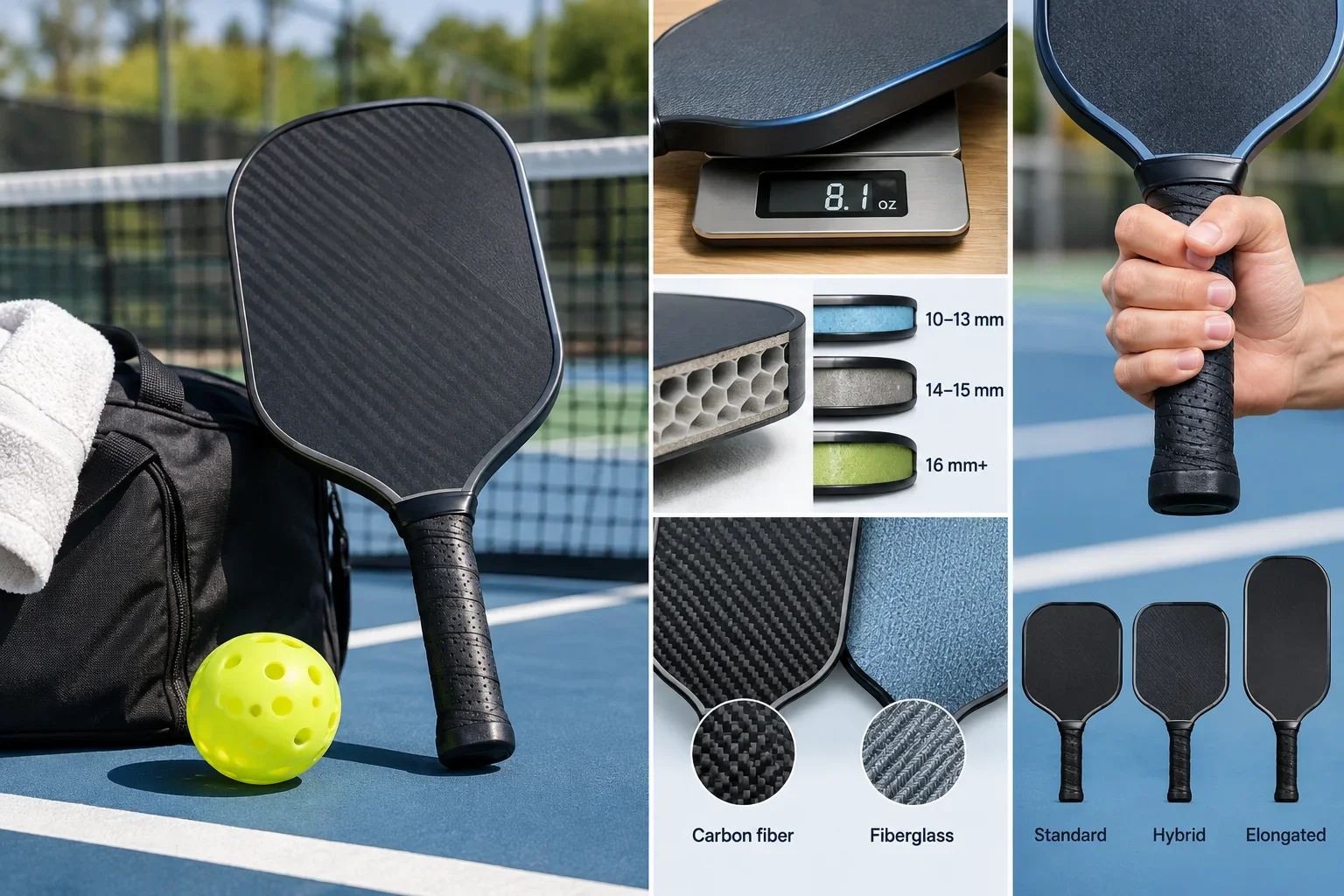
Image credit: ChatGPT
The right pickleball paddle is one you can swing comfortably for two hours, with a face that matches how you like to win points. For most new and intermediate players, that means a midweight paddle of about 7.8–8.4 oz, a 14–16 mm core and a textured carbon or fiberglass face, in a grip that fits your hand.
Paddle marketing is loud. Every model promises more power, more spin and more control at the same time. In practice, three specs do most of the work: weight, core thickness and surface. This guide explains each one in plain English, shows how they trade off, and ends with a checklist to use before you buy.
The short answer
If you only want the numbers, look for these specs on the product page or the paddle's spec sheet.
| Spec | What to look for | Why |
|---|---|---|
| Weight | 7.8–8.4 oz (220–240 g) | Quick at the kitchen line, stable enough to block hard drives |
| Core thickness | 14–16 mm | Softer feel and more control; 16 mm is the most forgiving |
| Surface | Textured carbon fiber or fiberglass | Carbon for control and spin, fiberglass for extra pop |
| Shape | Standard or hybrid (about 16 x 8 in or 16.25 x 7.75 in) | Bigger sweet spot than elongated paddles |
| Grip circumference | 4 1/8–4 3/8 in for most adults | Too big or too small strains your forearm |
| Handle length | About 5–5.5 in | Longer (5.5 in+) if you hit a two-handed backhand |
| Approval | On the current USA Pickleball approved list | Required for sanctioned tournaments and many leagues |
| Price | About $60–$150 USD | Real composite paddles without paying for pro-level tech |
Prices are approximate as of 2026 and vary by region and sales. Paddle weights are usually listed as a range, such as 7.9–8.2 oz, because individual paddles vary slightly.
Want a shortlist instead? The paddle advisor asks a few questions about your game and suggests specs to start from.
Weight: maneuverability vs. stability
Weight is the spec you'll feel first. Pickleball has no weight limit, but almost every adult paddle falls between about 7 and 9 oz. A few tenths of an ounce make a bigger difference than you'd expect, because you swing the paddle hundreds of times a session, often in quick hands battles at the net.
| Weight | Feels like | Trade-off |
|---|---|---|
| Light: under 7.8 oz (under 220 g) | Fast hands at the kitchen, easy on the shoulder over a long session | Less stable on hard drives; you supply all the power; more vibration reaches your arm |
| Midweight: 7.8–8.4 oz (220–240 g) | Balanced: quick enough at the net, solid enough on blocks and drives | The sensible default for most players |
| Heavy: 8.5 oz and up (240 g+) | Plows through the ball, absorbs pace on blocks, drives with less effort | Slower in fast exchanges; can tire your wrist, elbow or shoulder |
Tennis players often reach for a heavier paddle because it feels more like a racquet. That works well from the baseline, but pickleball points are won at the kitchen line, where a heavy paddle can feel a split second late. Start in the middle and adjust from there.
The same arm-health logic from tennis applies. Ultra-light paddles feel easy in the shop, but they twist and vibrate more on off-center hits, and that shock goes into your forearm. If you've had tennis elbow, a midweight-to-heavy paddle with a thick core is usually kinder than the lightest one on the shelf.
Weight isn't the whole story. Where the weight sits matters too. A paddle with more weight in the head (often listed as a higher "swingweight") feels heavier to swing than its static weight suggests. If a paddle feels sluggish, try one with the same weight but a lower swingweight, or a slightly shorter face.
You can also add weight, but not remove it. Thin strips of lead tape on the edge add stability and power a gram or two at a time. That makes a slightly light paddle a safer buy than a slightly heavy one.
Browse paddles under 8 oz, 8–8.5 oz or over 8.5 oz to compare listed weights side by side.
Core thickness: touch vs. pop
Inside nearly every modern paddle is a honeycomb core, usually polypropylene, sandwiched between two face layers. The thickness of that core, measured in millimeters, shapes how the ball comes off the face.
| Core thickness | How it plays | Who it suits |
|---|---|---|
| Thin: about 10–13 mm | Livelier and louder, with more pop on drives and serves; a smaller, harsher sweet spot | Aggressive players with clean contact who want free power |
| Medium: about 14–15 mm | A blend of pop and control | All-court players who like to drive and dink |
| Thick: 16 mm and up | Softer, quieter and more stable; absorbs pace for easier dinks, drops and resets | Beginners, control players and anyone with arm sensitivity |
In plain terms, a thicker core holds the ball on the face a little longer and soaks up energy. That makes soft shots easier and hard shots a little less explosive. A thinner core gives back more energy, so the ball jumps off the face, which is great on a drive and less great when you're trying to drop it into the kitchen.
For a first serious paddle, 16 mm is the safe choice. Most of the shots that decide recreational games are soft ones: the third-shot drop, the dink and the reset. A thick core makes those shots more consistent while you're learning them.
Thickness is a strong hint, not a guarantee. Two 16 mm paddles can play very differently depending on the core material, foam-filled edges and how the paddle is built. Use thickness to narrow the field, then demo.
Core materials and construction, briefly
- Polypropylene honeycomb is the standard. It's soft, quiet and durable.
- Nomex and aluminum honeycomb cores are rarer. Nomex is harder and louder with more pop. Aluminum is light with a soft, controlled feel.
- Foam cores and foam-injected edges are newer designs. Manufacturers say they add stability and reduce dead spots. Read reviews for durability before paying a premium.
- Thermoformed or "unibody" paddles are heat-molded so the edge and face act as one piece. They tend to play with more power and a larger sweet spot, and usually cost more.
You can compare paddles with cores of 16 mm or more in our paddle database.
Surface: spin, pop and how long the grit lasts
The face is the layer that actually touches the ball. Its material affects power and feel, and its texture affects how much spin you can put on a serve, drive or roll volley.
| Face material | How it plays | Trade-off |
|---|---|---|
| Fiberglass (composite) | Flexes more, so the ball springs off with extra pop | Less precise; often less textured, so less spin |
| Carbon fiber, including "raw" carbon | Stiffer, with a precise, controlled feel; raw carbon has a gritty texture that grabs the ball | Less free power; raw-carbon texture wears smoother over time |
| Graphite | Thin and light, with a crisp, responsive feel | Usually smoother, so less spin than raw carbon |
| Kevlar or other aramid blends | Tough, with a mix of pop and dampening | Usually found on pricier paddles |
Texture matters as much as material. A gritty or "peel-ply" carbon face can add noticeable spin, but grit wears down with play. A paddle that spins beautifully in its first month may feel smoother after a season of regular games. That's normal, not a defect.
There are also limits on texture. Sanctioned play requires a paddle on the USA Pickleball approved list, and the rules restrict surface roughness and anything that adds artificial "bite," such as rubber or sandpaper-like coatings. Paddles that pass testing are already within those limits, so you don't need to measure anything. Just confirm the model is approved.
Don't buy a paddle for spin alone. Clean contact and a good swing path create far more spin than any face texture. A grippy face helps, but it's the last 10%, not the first 90%.
Shape and handle: the other two specs worth checking
Under the rules, a paddle's combined length and width can't exceed 24 inches, and the length can't exceed 17 inches. Brands make different trade-offs inside that limit.
- Standard or widebody (about 16 x 8 in) has the widest face and largest sweet spot. It's the most forgiving shape and quickest in hands battles. Explore wider shapes.
- Elongated (about 16.5 x 7.5 in) adds reach and more power on serves and drives, with a narrower sweet spot. It's popular with singles players and tennis converts. Explore elongated shapes.
- Hybrid (about 16.25 x 7.75 in) sits in between and is a good compromise if you can't decide.
Handle length and grip size are different measurements:
- Handle length runs from the butt to the bottom of the face. About 5 in is standard. Choose 5.5 in or longer if you hit a two-handed backhand. Explore longer handles.
- Grip circumference is the distance around the handle, usually 4–4.5 in. Most adults land at 4 1/8–4 3/8 in. If you're between sizes, pick the smaller one. An overgrip adds roughly 1/16 in.
Coming from tennis? Pickleball grips run smaller than tennis grips, and a slightly smaller handle makes quick wrist adjustments at the net easier. See Pickleball vs. Tennis for the other habits worth changing.
Which paddle fits you
Find the row that sounds most like you:
| Player | Weight | Core | Surface and shape |
|---|---|---|---|
| Brand-new player | 7.8–8.2 oz | 16 mm | Textured carbon or fiberglass; standard or hybrid shape |
| Tennis player switching over | 8.0–8.4 oz | 14–16 mm | Carbon face; hybrid or elongated shape for reach and drives |
| Control-focused doubles player | 7.8–8.3 oz | 16 mm or thicker | Raw carbon; standard or hybrid shape |
| Power player who likes to drive | 8.2–8.6 oz | 13–14 mm | Fiberglass or thermoformed carbon; elongated shape |
| Arm, elbow or shoulder issues | 8.0–8.5 oz | 16 mm or thicker | Softer face; standard shape for a large sweet spot |
| Junior or smaller player | 7.2–7.8 oz | 14–16 mm | Standard shape; smaller grip |
Not sure where your game is yet? The pickleball rating tool gives you a rough level to start from, and Pickleball 101 covers the basics if you're brand new.
Budget: what your money actually buys
| Price range | What you get |
|---|---|
| Under $50 | Wood or basic composite paddles; fine for trying the sport, but often heavy, harsh or inconsistent |
| $60–$150 | Solid composite paddles with honest specs, polypropylene cores and textured faces; the sweet spot for most players |
| $150–$280 | Thermoformed construction, foam edges, premium carbon faces and longer warranties; worth it once you know what you like |
Prices are approximate as of 2026 in U.S. dollars.
A $90 paddle that fits your game beats a $250 paddle built for someone else's. Before you spend more, check the warranty. Premium paddles can delaminate or lose pop with heavy use, and a good warranty covers that.
How to demo a paddle
Specs narrow the list. Your hands make the final call. Many clubs, pro shops and online retailers run demo programs, and players at open play are usually happy to let you hit a few balls with theirs.
When you demo, hit the shots that matter most, in this order:
- Dinks and drops. Does the ball land where you aimed, or does it pop up?
- Blocks and resets against a hard drive. Does the paddle stay steady, or twist in your hand?
- Fast hands at the net. Can you get the paddle up in time?
- Serves and drives. Is there enough power without swinging harder?
- Off-center hits. Does a mishit still go over, or does it die and buzz your hand?
Then check how your arm feels at the end of the session, not after five minutes. Use our paddle database to line up specs for the two or three paddles you liked best.
Common paddle-buying mistakes
- Buying a pro's paddle. Pros pick paddles for their own swing and style, and some are paid to. Their paddle may not suit your game.
- Chasing power. Most recreational points are lost on soft-game errors, not won on drives. Extra pop makes those errors more likely.
- Going too light. A very light paddle is easy to swing, but it's less stable and harder on your arm.
- Ignoring the grip. A handle that's too big or too small causes tension and soreness, whatever the other specs are.
- Skipping the approved list. If you plan to play tournaments or leagues, check the exact model before you buy.
- Expecting the grit to last forever. Textured faces wear. Plan to replace a heavily used paddle every year or so if spin matters to you.
- Upgrading too often. Give a new paddle a few weeks before you judge it. Your timing needs time to adjust.
FAQ
What's the best paddle weight for beginners?
Midweight, about 7.8–8.2 oz. It's light enough to react at the net and heavy enough to stay stable on blocks, which is where beginners lose a lot of points.
Is a 16 mm or 13 mm paddle better?
Neither is better overall. A 16 mm core gives more control and a softer feel, so it's the better starting point for most players. A 13 mm core gives more pop and suits players who like to drive and already have consistent contact.
Does a carbon fiber face really add spin?
A textured carbon face grips the ball better than a smooth one, so it helps. Your swing creates most of the spin, though, and the texture wears down over time.
How long does a pickleball paddle last?
For someone playing a few times a week, many paddles feel noticeably different after 6–12 months as the face texture wears and the core softens. Casual players can get several years from a paddle.
Do I need a USA Pickleball approved paddle?
Only for sanctioned tournaments and leagues that require one. Most paddles from established brands are approved, but check the exact model on the current list. Approvals can change as testing standards are updated.
Can I use a tennis grip size for my paddle?
Use it as a starting point, then go a size smaller. Pickleball handles are shorter and grips run smaller, and a slightly smaller grip helps with quick wrist movement at the net.
Comments
No approved comments yet.
Log in or sign up to join the conversation.