

How to Run a Round Robin or Social Mixer Your Club Will Want to Repeat
Choose a format, do the court math, balance levels and run a tennis or pickleball round robin or social mixer smoothly, with a ready-made 8-player rotation.
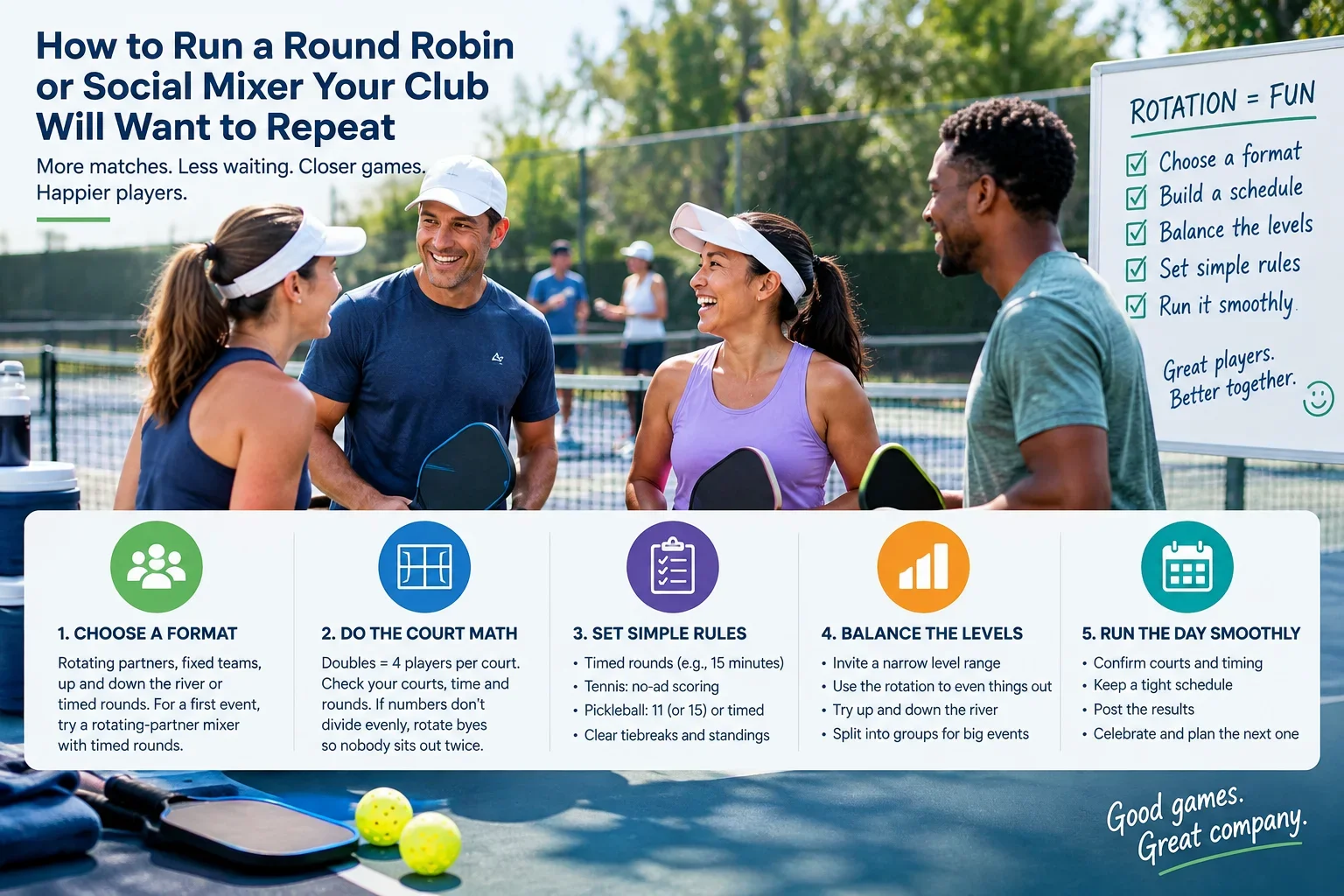
Image credit: ChatGPT
A good round robin or social mixer has three things: everyone plays a lot, nobody waits around for long, and the matches are close. Get those right and players will ask when the next one is. Get them wrong and you'll hear about the 40-minute wait and the lopsided 6–0 sets for weeks.
This guide covers how to choose a format, build a schedule, balance the levels and run the day smoothly, for tennis or pickleball. It includes a ready-to-use rotation for eight players.
Choose your format
| Format | How it works | Best for |
|---|---|---|
| Rotating-partner mixer | Players get a new partner each round. Individuals keep track of games won. | Social events, meeting new players, groups that turn up alone |
| Fixed-team round robin | Pairs (or singles players) play every other entry once. Most wins takes it. | Club championships, league nights, teams that sign up together |
| Up and down the river (king or queen of the court) | After each timed round, winners move up a court and losers move down. Partners split up each round. | Mixed-level groups, fast and energetic sessions |
| Timed round robin | Any of the above, with each round played for a set time instead of a set score | Keeping a strict schedule when court time is limited |
For a first event, a rotating-partner mixer with timed rounds is the easiest to run and the most fun for players of different levels.
Do the court math
Doubles needs four players per court. Start with how many courts and how much time you have, then work out how many players you can take.
| Courts | Ideal number of players (doubles) | Rounds in 2 hours (about 15 min each) |
|---|---|---|
| 2 | 8 | 6–7 |
| 3 | 12 | 6–7 |
| 4 | 16 | 6–7 |
If the numbers don't divide evenly, players will need to sit out. Rotate the byes so nobody sits out twice before everyone has sat out once, and keep each bye to one round. One or two extras per event is manageable. More than that, open another court or cap sign-ups.
For a fixed-team round robin, every entry plays every other entry once. With an even number of entries, that's one fewer round than the number of entries. With 6 teams, for example, there are 5 rounds of 3 matches. With an odd number, add a round and give one team a bye each round.
Our round-robin and ladder generator builds a full schedule for fixed singles or doubles entries in tennis or pickleball, with seeding and standings, so you don't have to work it out by hand.
A ready-made 8-player mixer
This rotation is for 8 players on 2 courts over 7 rounds. Every player partners each other player exactly once and plays against each other player exactly twice. Give each player a number from 1 to 8 when they arrive.
| Round | Court 1 | Court 2 |
|---|---|---|
| 1 | 1 & 2 vs. 3 & 4 | 5 & 6 vs. 7 & 8 |
| 2 | 1 & 3 vs. 5 & 7 | 2 & 4 vs. 6 & 8 |
| 3 | 1 & 4 vs. 5 & 8 | 2 & 3 vs. 6 & 7 |
| 4 | 1 & 5 vs. 2 & 6 | 3 & 7 vs. 4 & 8 |
| 5 | 1 & 6 vs. 3 & 8 | 2 & 5 vs. 4 & 7 |
| 6 | 1 & 7 vs. 4 & 6 | 2 & 8 vs. 3 & 5 |
| 7 | 1 & 8 vs. 2 & 7 | 3 & 6 vs. 4 & 5 |
Each player writes down the games they won each round. The player with the most total games wins. For 12 or 16 players, run the same chart on separate groups of courts, or switch to up and down the river.
Set simple scoring rules
Decide your rules in advance and tell everyone before the first round. Keep them short:
- Timed rounds: Play as many games as you can in 15 minutes. When the horn sounds, finish the point in progress, and the game stops there.
- Tennis scoring: Use no-ad scoring so games don't drag on. Rotate the serve as normal.
- Pickleball scoring: Play one game to 11 (or 15) per round, or play timed games with rally scoring to keep them a fixed length.
- Individual standings: In mixers, each player scores the games their team won that round.
- Ties: Decide in advance how to break them, such as by head-to-head result, total games lost or a quick tiebreak.
Balance the levels
Lopsided matches ruin mixers. Some simple ways to keep things close:
- Invite a narrow range of levels, such as NTRP 3.0–3.5 or 3.5–4.0. Players can check their level with our level estimator or the pickleball rating tool.
- Let the rotation even things out. In the 8-player chart, everyone partners everyone once, so a tough draw in one round balances out over the event. That only works if the levels are reasonably close to start with.
- Use up and down the river for wider level ranges. After a couple of rounds, similar players end up on the same court.
- Split by level for big events. Run separate groups on different courts rather than one big mixed group.
Run the day smoothly
Before the event
- Confirm courts, start time and finish time, and when players should arrive (15 minutes early is usual).
- Cap the number of players and keep a short waitlist for last-minute dropouts.
- Print the schedule, scorecards and rules. Have a backup if a player doesn't show up.
- Bring new balls for each court, plus a few spares.
On the day
- Use a timer or horn everyone can hear, and stick to it.
- Welcome players and introduce people who don't know each other. Name tags help at larger events.
- Keep warm-ups short: about 5 minutes before the first round only.
- Post the schedule and standings where everyone can see them.
- Have one person who can settle disputes and make decisions, ideally someone who isn't playing.
After the event
- Announce the winners. Fun prizes work well, like "most improved," "best rally" or "most sportsmanlike."
- Share results and photos with the group, with permission.
- Ask for quick feedback, then announce the next date while people are still enthusiastic.
Food and drinks after play do more for a social event than any format. Even a cooler of water and some snacks gives people a reason to stay and talk, and that's how mixers turn into regular groups.
Common mistakes
- Too many players for the courts. Long waits kill the mood quickly.
- Rounds that run long. Use timed rounds and keep to them.
- Rules that change mid-event. Decide scoring and tiebreaks beforehand.
- Ignoring level differences. A few lopsided rounds can put people off coming back.
- No follow-up. If you don't set the next date, the group often fades.
FAQ
What's the difference between a round robin and a mixer?
In a round robin, each entry, whether a singles player or a fixed doubles team, plays every other entry. In a mixer, partners change every round, and individual results are tracked.
How long should each round be?
About 15–20 minutes for doubles works well. It's long enough for a meaningful set of games and short enough that players meet several partners.
What if someone doesn't show up?
Use a waitlist player or the organizer as a fill-in. If you can't fill the spot, use a rotating bye, or play a round of "Canadian doubles" (two against one) on one court.
Can I run a mixer for singles?
Yes. Use a fixed round robin for singles players, or a singles version of up and down the river. Singles needs twice as many courts per player as doubles.
Keep learning
- Thinking bigger? Read Organizing a Local Tennis League and League or Ladder?
- Find players for your event with our player directory or by posting an open play session.
- Refresh everyone on the rules with our rules quiz and situation guide.
Comments
No approved comments yet.
Log in or sign up to join the conversation.