

NTRP Ratings Explained: What 3.0, 3.5 and 4.0 Actually Look Like
See what NTRP 3.0, 3.5 and 4.0 players look like on court, compare their skills, and learn how to assess your level and improve.
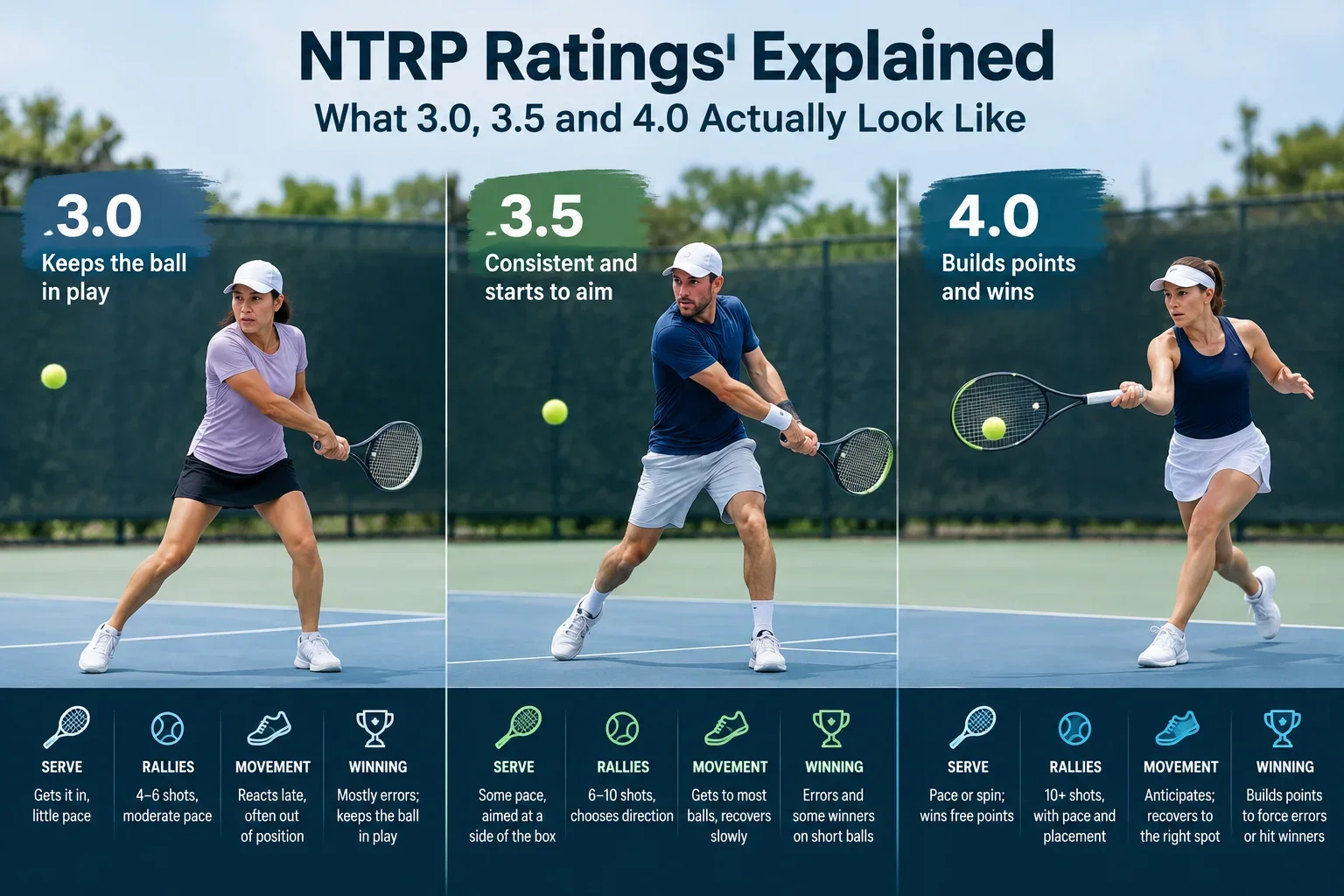
Image credit: ChatGPT
NTRP is the rating scale most US recreational players use to find fair matches. It runs from 1.5 (brand new) to 7.0 (world-class pro), and most club players sit between 3.0 and 4.0. The official descriptions are vague, though. "Consistent on medium-paced shots" can mean very different things to different people.
This guide shows what each of the three most common levels looks like on court: how the players serve, rally, move and win points. Use it to rate yourself honestly before you join a league, ladder or USTA team.
How NTRP works
NTRP stands for National Tennis Rating Program. The USTA (United States Tennis Association) uses it to group players for league play, and many clubs, ladders and apps borrow it. The scale goes up in half-point steps, and each level is meant to describe a clear jump in skill.
There are three ways to get a rating:
- Self-rating: You read the official descriptions and pick the level that fits you. This is how most new league players start.
- Computer rating: Once you play USTA league matches, a computer adjusts your rating from your results. Year-end ratings are published each fall.
- Appeals and coach input: Some leagues let a pro assess you, or let you appeal a rating that seems wrong.
A rating also comes with an unofficial position within the level. A "low 3.5" just made the level, while a "high 3.5" is close to moving up. Two players with the same number can still be a set apart.
3.0 vs 3.5 vs 4.0 at a glance
The biggest jump between levels is consistency under pressure, not raw power.
| Skill | 3.0 | 3.5 | 4.0 |
|---|---|---|---|
| Typical rally | 4–6 shots at moderate pace | 6–10 shots with some direction | 10+ shots, with pace and placement |
| Forehand | Reliable when the ball comes to them | Can direct it crosscourt or down the line | Can hit with depth and pace, and set up points |
| Backhand | Usually just keeps it in play; often a weakness | Consistent, but rarely used to attack | Dependable; can be used to change direction |
| First serve | Mostly gets it in; little pace or spin | Some pace, aimed at a side of the box | Placed with pace or spin; wins free points |
| Second serve | Often a soft "push"; double faults common | More reliable, still attackable | Has spin; rarely double faults under pressure |
| Volleys | Uncomfortable at the net | Comfortable on easy volleys | Can put volleys away and handle low balls |
| Movement | Reacts late; often caught out of position | Gets to most balls, recovers slowly | Anticipates; recovers to the right spot |
| Doubles | Mostly stays back; basic positioning | Plays one up, one back; starts to poach | Moves as a team; uses lobs and poaches on purpose |
| How points end | Mostly errors | Errors and some winners off short balls | Players build points to force errors or hit winners |
What a 3.0 looks like
A 3.0 can rally at moderate pace when the ball comes to them, but they struggle once the ball is hit harder, deeper or wider. Most 3.0 players have played for a year or two, or once played and are coming back.
On court, you'll usually see:
- Rallies that break down after a few shots, usually from an unforced error
- A forehand that works and a backhand they try to avoid
- A serve that goes in, but is easy to attack, especially the second serve
- Discomfort at the net; volleys get blocked back or missed
- Points won mostly by keeping the ball in play longer than the opponent
You're probably a 3.0 if: you can hold a friendly rally, but matches against steadier players turn into a string of your own errors.
What a 3.5 looks like
A 3.5 is consistent at moderate pace and starts to aim the ball rather than just get it back. This is the largest group in most USTA leagues, and the level has a very wide range.
On court, you'll usually see:
- Rallies of 6–10 shots, with the player choosing crosscourt or down the line
- A reliable backhand, though it's used mostly to stay in the point
- A first serve with some pace and direction, and fewer double faults
- Comfortable volleys on easy balls, with low or fast balls still a problem
- Attacking short balls, though the approach shot often isn't deep enough
- In doubles, players starting to poach and come to the net together
What still holds a 3.5 back is consistency when the pace goes up. A 4.0 who hits a bit harder or deeper usually draws errors that a 3.5 can't fix mid-match.
You're probably a 3.5 if: you can play a full match with solid rallies and a dependable serve, but strong, deep balls still push you into mistakes.
What a 4.0 looks like
A 4.0 hits dependable shots with pace, depth and direction, and builds points instead of just trading balls. Many club players consider 4.0 the point where tennis starts to look "real" to people watching.
On court, you'll usually see:
- Long rallies at good pace, with the player moving the opponent side to side
- Both groundstrokes used to attack, not just to defend
- A first serve that wins free points and a spin second serve that rarely double faults
- Volleys that end points, plus usable overheads
- Good anticipation and recovery after wide balls
- Clear tactics: approaching on short balls, lobbing a net player, targeting a weakness
The gap to 4.5 is mostly power and fewer errors under pressure. A 4.0 still loses the occasional rally to impatience, and their weaker side can break down against heavy pace.
You're probably a 4.0 if: you can rally at good pace with both wings, rely on your serve, and plan how to win points against someone you've never played.
How to rate yourself honestly
Rate yourself on what you do in a match, not on your best shot in practice. Most players overrate themselves by about half a point.
A quick self-check:
- Count your rallies. In a real match, how many shots does a typical rally last before someone misses? Fewer than 6 points to 3.0, 6–10 to 3.5, more than 10 at good pace to 4.0.
- Rate your weakest stroke. Your level is closer to your weakest shot than your strongest. A 4.0 forehand with a 3.0 backhand usually adds up to a 3.5.
- Check your second serve. If opponents step in and attack it, or you double fault several times a set, you're probably not yet a 4.0.
- Look at your results. If you win most sets against a level easily, move up. If you rarely win a game, move down.
- Ask someone else. A coach, or a player with a computer rating who has played you, will usually be more accurate than you are.
When in doubt, start lower. It's more fun to move up after a strong season than to spend one losing every match.
How to move up a level
The fastest way up is to fix your weakest shot and cut errors, not to hit harder.
| Moving from | Focus on | Practice idea |
|---|---|---|
| 3.0 to 3.5 | Consistency and a reliable second serve | Rally crosscourt until you can make 20 balls in a row; hit 50 second serves a session |
| 3.5 to 4.0 | Depth, a dependable backhand and net play | Aim every rally ball past the service line; finish practice points at the net |
| 4.0 to 4.5 | Pace under pressure and point construction | Play practice sets with a plan for each point; work on a serve you can place under pressure |
A few habits help at every level:
- Play people slightly better than you. A ladder is a good way to find them.
- Take a lesson or two on your weakest stroke rather than your favorite one.
- Play matches, not just rallies. Ratings measure what you do when the score counts.
FAQ
What NTRP level is a beginner?
Complete beginners are 1.5–2.0. Players who have taken lessons and can rally a little are usually 2.5. Most adults join leagues at 2.5 or 3.0.
How long does it take to go from 3.0 to 4.0?
It varies widely. Players who practice and play matches a few times a week often move up one level every 1–3 years. Many players stay at 3.5 for a long time, and that's normal.
Is 4.0 good?
Yes. A 4.0 is a solid club player who would beat most casual players easily. It's still well below college and professional levels, which start at around 5.0 and above.
What's the difference between NTRP and UTR?
NTRP uses half-point levels and is mainly used for USTA adult leagues. UTR (Universal Tennis Rating) runs from 1 to 16.5, uses two decimal places, and updates from every recorded match. Many clubs now use both.
Can my rating go down?
Yes. Computer ratings move up or down with your results, and the USTA can also adjust ratings that seem out of line.
Comments
No approved comments yet.
Log in or sign up to join the conversation.