

Organizing a Local Tennis League: A Step-by-Step Guide for Captains
A six-step guide for tennis league captains covering formats, player recruitment, courts, budgets, rules, scheduling and communication, plus running and wrapping up the season.
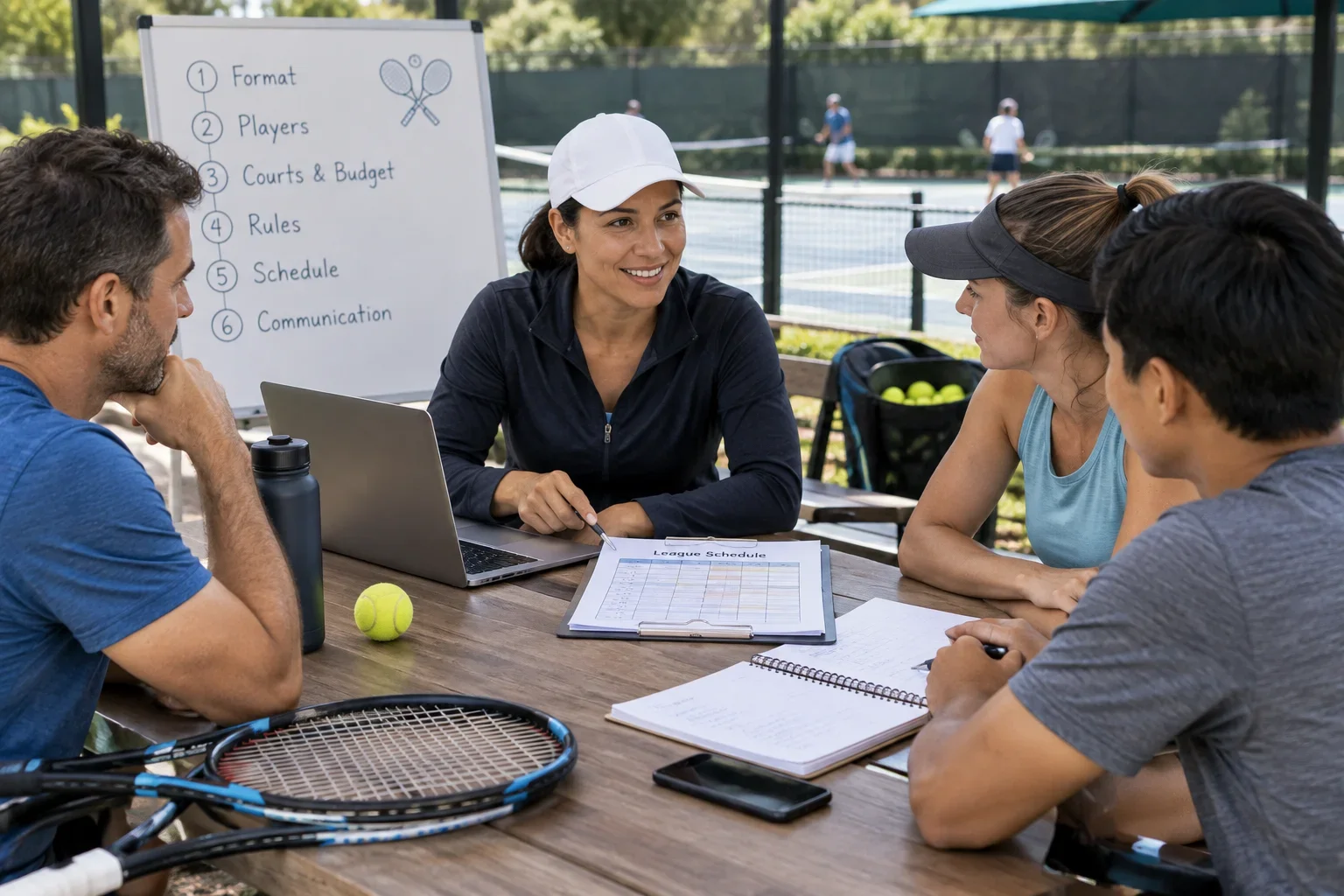
Image credit: ChatGPT
A local league is the easiest way to turn occasional hitting into regular, competitive tennis. Someone has to set it up, though, and that person is the captain.
A well-run league has fair matchups, a clear schedule, simple rules and up-to-date standings. Players know who they're playing, where and when. This guide walks you through setting one up in six steps, plus how to run the season and wrap it up. Plan on 6–8 weeks of preparation before the first match.
Step 1: Choose the format
Pick the format first, because it decides how much scheduling you'll do and how much commitment you need from players.
| Format | How it works | Best for | Captain workload |
|---|---|---|---|
| Ladder | Players are ranked and challenge people above them; winners swap places | Groups with mixed availability; ongoing play with no fixed end | Low |
| Round robin | Everyone plays everyone once in a set period | Groups of 6–10 players at a similar level | Medium |
| Flex league | Players get a list of opponents and arrange their own matches by a deadline | Busy adults with unpredictable schedules | Low to medium |
| Fixed-schedule league | Matches at a set time and venue each week | Clubs with reserved courts | High |
| Team league | Teams of players compete in singles and doubles lines | Social groups and clubs with 20+ players | High |
If this is your first season, start with a flex league or a ladder. They need the least coordination, and you can switch formats once you know your players.
Step 2: Recruit and level players
A league lives or dies on fair matchups. A season of 6–0 blowouts loses players fast, so grouping by level matters as much as recruiting.
Where to find players:
- Your regular hitting partners and their friends
- Notice boards and front desks at local courts and clubs
- Local coaches, who often know players looking for match play
- Community groups, neighborhood apps and social media
- Online tennis communities and player directories
How to group them:
- Ask for a self-rating. Use NTRP or a simple scale (beginner, intermediate, advanced) on the sign-up form.
- Set a group size. Groups of 6–10 work best for round robins. Ladders can hold 20 or more.
- Split by level, not by friendship. It's tempting to keep friends together, but close matches keep people coming back.
- Plan to adjust. Tell players up front that you may move them between groups after the first few matches.
Collect names, contact details, self-rating, general availability and preferred courts on one form. You'll use that information all season.
Step 3: Secure courts and set the budget
Decide early whether the league will book courts centrally or leave it to players. Central booking is more work, but it makes fixed-schedule and team leagues possible.
- Public courts: Free or cheap, but often first-come, first-served. Best for flex leagues and ladders.
- Parks and recreation departments: Many let you reserve courts for a block of weeks. Ask early, as popular times fill months ahead.
- Private clubs: More reliable, often with lights and indoor courts, but usually cost more and may need a member to book.
- Schools and colleges: Some rent out courts in the evenings and during breaks.
Then work out what the league costs per player. Typical costs include:
- Court fees, if you book centrally
- Balls, if the league supplies them
- Trophies, prizes or an end-of-season social
- A scheduling or league-management tool, if it isn't free
Keep the entry fee simple and collect it up front. Be clear about refunds and what happens if someone drops out mid-season.
Step 4: Write simple rules
Write your rules on one page, and send them out before the season starts. Most league arguments come from something nobody wrote down.
Cover these points:
| Rule | Common choice |
|---|---|
| Match format | Best of three sets, with a 10-point match tiebreak instead of a third set |
| Scoring | Regular or no-ad scoring; no-ad keeps matches shorter |
| Points in the standings | 2 points for a win, 1 for a loss, 0 for a forfeit; or count sets or games won |
| Deadlines | Each match must be played by a set date, or by the end of the round |
| Forfeits | A player who doesn't show within 15 minutes, or can't schedule by the deadline, forfeits |
| Balls | The home player or higher-ranked player brings a new can |
| Score reporting | The winner reports the score within 24 hours |
| Line calls and conduct | Follow the USTA's The Code or your local equivalent |
| Ladder challenges | How far up you can challenge, and how soon the challenged player must play |
| Tiebreakers in the standings | Head-to-head result first, then sets won, then games won |
Keep it short. If your rules don't fit on one page, they're probably too detailed for a recreational league.
Step 5: Build the schedule
A good schedule gives each player a fair number of matches and enough time to play them. For most recreational leagues, that means one match every 1–2 weeks.
- Pick the season length. 8–12 weeks works well. Shorter seasons keep players engaged; longer ones see more dropouts.
- Do the math. A round robin with 8 players means 7 matches each. Over 10 weeks, that's comfortable with a little slack for rain.
- Use rounds with deadlines. For flex leagues, give each round a 1–2 week window rather than a fixed date.
- Build in buffer weeks. Add 1–2 make-up weeks for rain-outs and illness.
- Avoid holidays. Check school breaks and public holidays before you set dates.
- Publish it in one place. Every player should see the same schedule, with opponents, deadlines and contact details.
For round robins, a standard rotation table, or any league tool, will generate pairings so nobody plays the same opponent twice.
Step 6: Set up communication and score reporting
Choose one channel for announcements and one place for scores and standings. Spreading them across texts, emails and spreadsheets is how results go missing.
- Announcements: A group chat or email list for the schedule, weather updates and reminders. Keep it for league news, not general chat.
- Player contacts: Share phone numbers or emails only with players' permission, so opponents can arrange matches.
- Score reporting: Use one form, spreadsheet or league app. The winner reports within 24 hours, and the loser confirms or flags a problem.
- Standings: Update them at least weekly so players can see where they stand. Players check them often, and fresh standings keep them motivated to play.
A league-management tool can handle scheduling, score reporting and standings in one place. That saves hours over a season compared with a spreadsheet.
Running the season
Once matches start, your job is mostly nudging, problem-solving and keeping things fair. Decide in advance how you'll handle the common problems, so you're applying rules rather than making judgment calls.
| Problem | How to handle it |
|---|---|
| A player can't get a match arranged | Send a reminder halfway through the round. At the deadline, apply your forfeit rule, or mark it unplayed if neither player is at fault. |
| No-shows | Award the match to the player who showed up, per your rules. Repeat no-shows may be removed from the league. |
| Rain-outs | Reschedule within the round if possible, or move the match to a buffer week. |
| A player drops out mid-season | Decide whether their results stand or are removed. Removing them is usually fairest in round robins. |
| Subs in team leagues | Allow subs at the same level or lower, and keep a list of willing players. |
| Score disputes | Ask both players for their version. If they can't agree, replay the disputed set or apply your rules. |
| Mismatched groups | Move players up or down after the first 2–3 matches, before standings settle. |
Send a short weekly update with standings, upcoming deadlines and a shout-out or two. It keeps people engaged and reminds them to play.
Wrapping up the season
A strong finish is what brings players back next season. Plan the last two weeks as carefully as the first two.
- Playoffs (optional): The top 2–4 players in each group play off over a weekend. It gives the season a clear finish and something to play for.
- Final standings: Publish them within a few days of the last match, with any tiebreakers explained.
- Awards: Keep them simple and fun. Ideas include a group winner, most improved, most matches played and a sportsmanship award.
- Social event: A post-season round robin, picnic or drinks gets players to know each other, which makes scheduling easier next time.
- Ask for feedback: Send a 3–5 question survey on format, level grouping, schedule and what to change.
- Open sign-ups early: Announce next season's dates while players are still keen, ideally within a week of the finish.
Planning timeline
Give yourself 8 weeks from first idea to first match. Most of the work happens before the season starts.
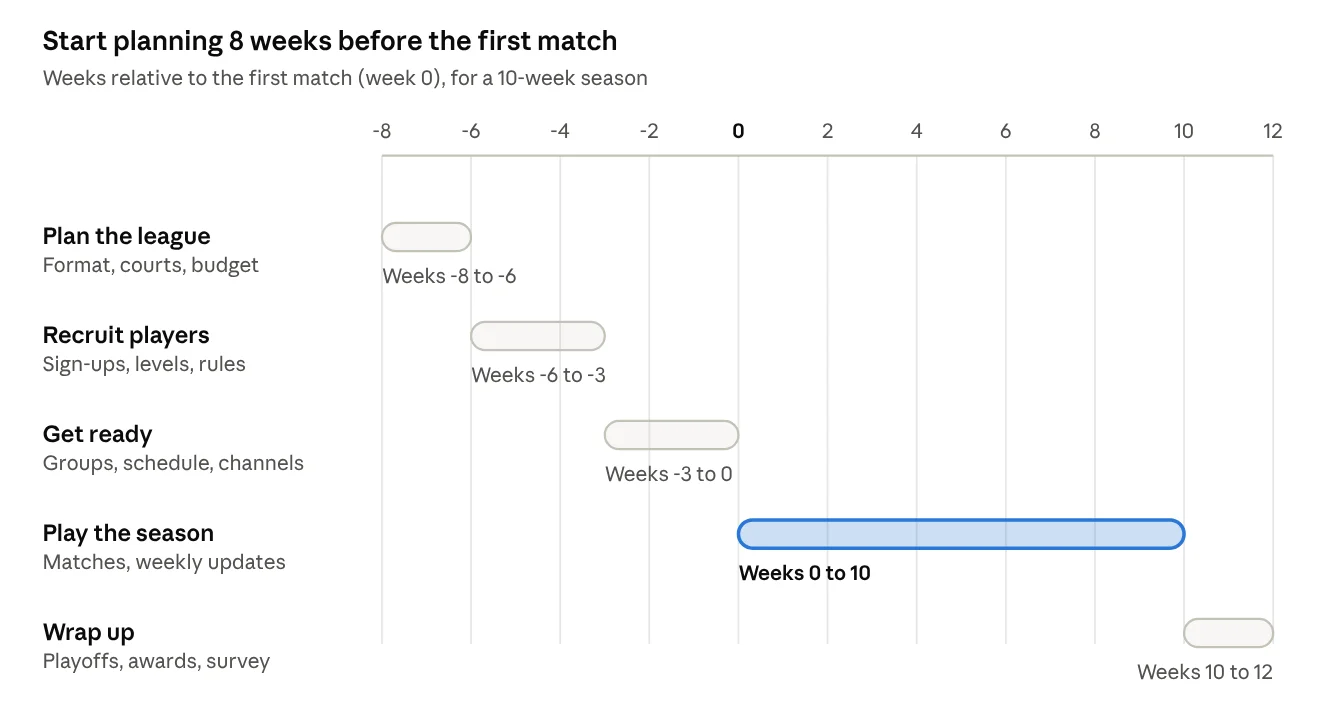
Planning, recruiting and preparation take about 8 weeks. A 10-week season and a 2-week wrap-up follow.
FAQ
How many players do I need to start a league?
Six is enough for a round robin or a small ladder. With 12 or more, you can split players into two levels.
How much should I charge?
Cover your real costs: courts, balls and any prizes. Many casual leagues charge nothing, or a small fee to cover balls and an end-of-season social.
Should the league be singles or doubles?
Singles is easier to schedule, since only two people need to agree on a time. Doubles is more social and suits players who don't want to cover the whole court. You can run both as separate divisions.
What if one player is far better than everyone else?
Move them to a higher group, or ask them to play in a higher division. Keeping one dominant player in a group makes matches less fun for everyone, including them.
Do I need USTA approval?
Not for an informal local league. You only need to go through the USTA, or your national association, if you want official ratings or a sanctioned league.
How much time does being a captain take?
Expect a few hours a week during setup, then about an hour a week during the season for updates, reminders and problems. A league tool can cut that down considerably.
Key takeaways
- Add a key takeaway.
- Add another takeaway.
Comments
No approved comments yet.
Log in or sign up to join the conversation.