
The Dink, Explained: How to Win the Soft Game at the Kitchen Line
Learn how to hit a reliable pickleball dink, where to aim it, when to stop dinking and attack, and drills to build a soft game you can trust.
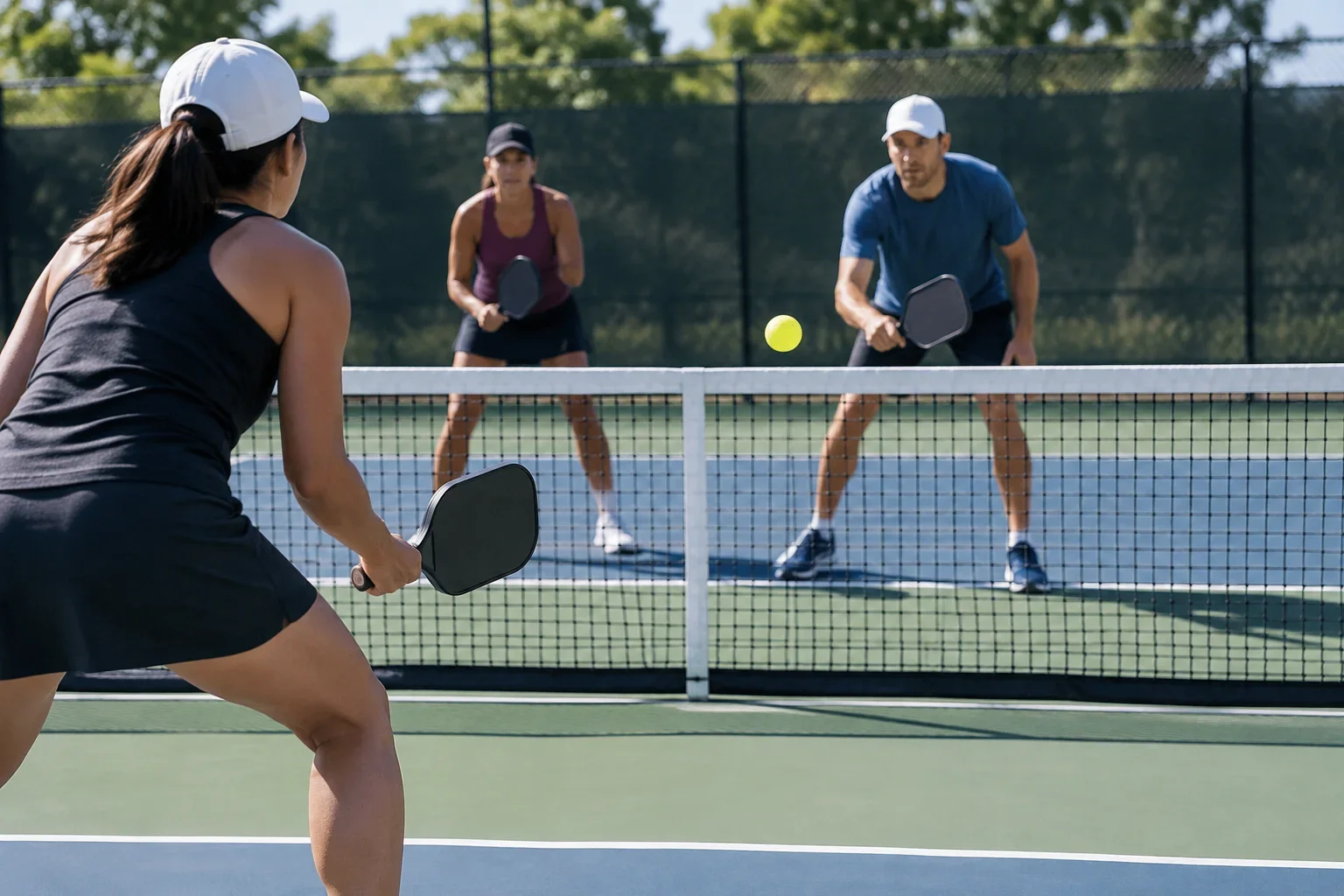
Image credit: ChatGPT
A dink is a soft shot hit from at or near the kitchen line that drops into your opponents' kitchen. Because it lands low and short, your opponents can't attack it, and they have to hit up on the ball. The team that dinks more patiently, and attacks only the right balls, wins most points at the intermediate level and above.
This guide covers how to hit a reliable dink, where to aim it, when to stop dinking and attack, and drills to build a soft game you can trust.
The short answer
- Grip: continental, held loosely (about 3–4 on a 10-point squeeze scale).
- Swing: a short, smooth lift from your shoulder, not a flick of your wrist.
- Contact: out in front of your body, with a slightly open paddle face.
- Target: low over the net, landing in the kitchen, usually crosscourt.
- Mindset: keep the ball low and wait for a high ball to attack.
How to hit a good dink
Get set at the kitchen line
Stand close to the kitchen line, with your toes just behind it, feet about shoulder-width apart and knees bent. Hold the paddle out in front of you, at about waist height. Remember, you can step into the kitchen to play a ball that has bounced, but you must not touch it while volleying. See The Kitchen Rule, Explained.
Use your legs and shoulder, not your wrist
The most common dink mistake is flicking the wrist, which makes the ball pop up. Keep your wrist fairly firm and let the motion come from your shoulder, like a gentle pendulum. Bend your knees to get low for low balls instead of reaching down with the paddle.
Aim for the apex on your side
The ball's highest point should be on your side of the net. That way, it's already dropping as it crosses the net, and lands softly in the kitchen. A dink that peaks over the net or on the other side tends to land deep or sit up.
Think "lift, don't hit." Your paddle should move about the same distance on the follow-through as on the backswing, and both should be short.
Where to aim your dinks
| Dink | Why use it |
|---|---|
| Crosscourt | The safest dink. The net is lower in the middle, and you have more court to land the ball in. Most dinks should go here. |
| Middle | Can cause confusion between your opponents, and reduces the angles they can hit back. |
| Straight ahead | Shorter distance and a higher net. Use it to change direction and move your opponent, not as your default. |
| At the feet | A dink that lands at your opponent's feet is very hard to attack. |
| To the backhand | Most players have a weaker backhand dink, and it's harder to speed up from. |
When to stop dinking and attack
Dinking isn't the goal. It's how you wait for a ball you can attack. A good rule of thumb:
- Ball below the net height: keep dinking. Attacking from low means hitting up, which gives your opponents an easy counter.
- Ball above the net height: attack it. Hit down at your opponent's feet, hip or paddle-side shoulder.
- Ball just at net height: it depends on your skill and your opponent's hands. When in doubt, dink again.
Speeding up a low ball is the most common way intermediate players lose points. Be patient. A dink rally of 10 or more shots is normal at good levels.
Common dink mistakes
- Flicking the wrist, so the ball pops up.
- Standing too far back from the kitchen line, so the dink has to travel farther and lands deep.
- Gripping too tightly, so the ball comes off the paddle too fast.
- Standing up straight instead of bending your knees.
- Attacking balls below the net, out of impatience.
- Watching the ball after you hit it, instead of resetting to ready position.
Drills to build your soft game
Crosscourt dink rally
With a partner, dink crosscourt only, using half the court on one diagonal. Count how many you can hit in a row. Then switch to the other diagonal.
Dink to 11
Play points using only the kitchen. Every shot must land in the kitchen, and any ball that lands outside it loses the point. First to 11 wins. This builds control and patience under pressure.
Dink and attack
Dink crosscourt with a partner. Either player can attack any ball that comes up above net height. This trains you to recognize the right ball to attack, and to keep your dinks low.
Target dinks
Put a towel or cone in the kitchen and aim for it. Move the target around: crosscourt, middle and at the feet.
FAQ
Should I use topspin on my dinks?
Once your basic dink is consistent, a little topspin can make dinks dip faster and bounce forward, which makes them harder to attack. Learn the flat dink first.
Can I dink out of the air?
Yes, as long as you're outside the kitchen. A volley dink takes time away from your opponents. Just make sure your feet, and anything else, don't touch the kitchen as you hit it.
Does my paddle affect my dinks?
Yes. A thicker, softer core makes it easier to take pace off the ball. See How to Choose a Pickleball Paddle.
Keep learning
- Get to the kitchen line in the first place with the right third shot. Read Third-Shot Drop vs. Drive.
- Check your level with the pickleball skill level estimator.
- Practice your dinks at an open play session near you.
Comments
No approved comments yet.
Log in or sign up to join the conversation.