
The Kitchen Rule, Explained: 7 Non-Volley Zone Situations That Cause Arguments
Learn what the pickleball kitchen rule really says about lines, momentum, partners, Ernes and standing in the non-volley zone, and how to make kitchen calls in rec play.
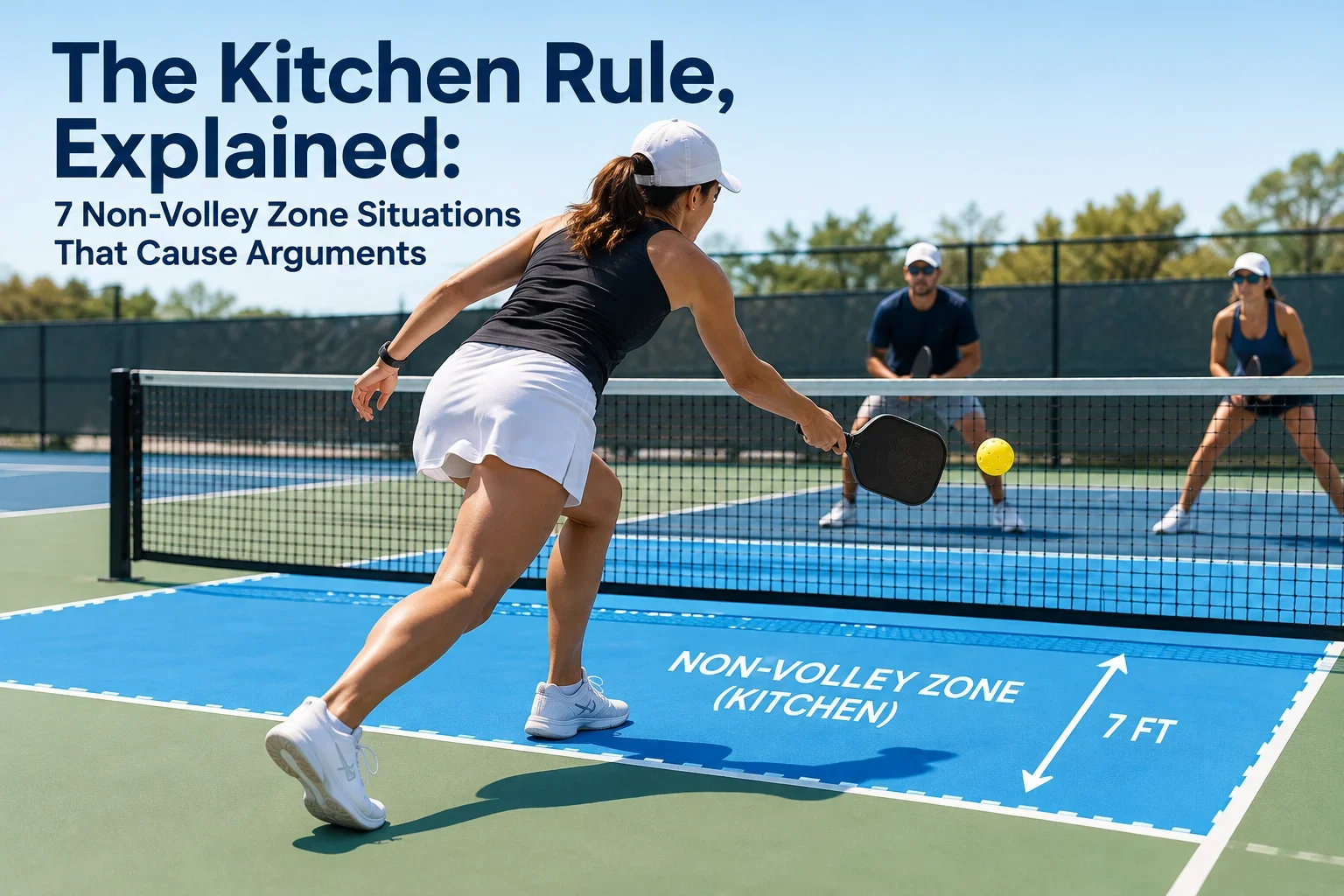
Image credit: ChatGPT
The kitchen rule fits in one sentence: you can't volley while you're touching the non-volley zone. Volleying means hitting the ball out of the air before it bounces. Almost every kitchen argument comes from the edges of that sentence. Does the line count? When is a volley over? What about your hat, your paddle or your partner?
This guide covers the seven kitchen situations that cause the most disputes in recreational play. For each one, it explains what the rule actually says and how to handle the call without souring the game.
The rule in plain English
The non-volley zone, or kitchen, is the 7-foot area on each side of the net, and the lines around it are part of it. Under the USA Pickleball rules:
- Every volley must start outside the kitchen.
- It's a fault if you, or anything you're wearing or carrying, touch the kitchen while you're volleying.
- The volley isn't over when the ball leaves your paddle. It lasts until your follow-through and momentum stop. If that momentum carries you into the kitchen, it's still a fault, even if the ball is already dead.
- You can step into the kitchen any time you aren't volleying, including to play a ball that has bounced, and you can stay there as long as you like.
- Once you've touched the kitchen, you can't volley again until both feet are back on the court completely outside it.
That's the whole rule. The arguments start when real points happen fast.
Quick reference: fault or legal?
| Situation | Call |
|---|---|
| Toe touches the kitchen line while you volley | Fault |
| You volley a winner, then stumble into the kitchen | Fault |
| Your hat falls into the kitchen as you volley | Fault |
| You volley and bump your partner, who is standing in the kitchen | Fault |
| You step out of the kitchen with one foot and volley | Fault |
| You stand in the kitchen and hit a ball that bounced | Legal |
| You stand in the kitchen and the ball hits you in the air | Fault (you were hit by the ball) |
| Your paddle reaches over the kitchen while you volley, without touching the ground | Legal |
| You jump from outside the court around the kitchen and volley (an Erne) | Legal, if you never touched the kitchen first |
| A dink lands on the kitchen line | In |
| A serve lands on the kitchen line | Fault (short serve) |
1. "Your toe was on the line"
This is the most common kitchen call, and the rule is simple: the kitchen line is part of the kitchen. If any part of your foot touches the line while you volley, it's a fault. Hanging your toes over the line is fine, as long as they're in the air and not touching the surface.
The argument usually comes down to timing. Your feet are judged at the moment you hit the ball. If you were on the line during your split step but had moved back by the time you made contact, that isn't a fault. If you hit the ball with your toe on the line, it is, even by a quarter inch.
Set up with your toes a few inches behind the line, not on it. You lose almost no reach, and you take the most common kitchen fault out of your game. If you can feel the line under your shoe, you're too close.
2. "The point was already over"
You crush a volley at your opponent's feet. They miss it. Then you lose your balance and step into the kitchen. Most players feel the point should count. It doesn't.
The act of volleying includes your follow-through and the momentum from it, and it lasts until you've regained your balance. If that momentum takes you into the kitchen, it's a fault, even if the ball has already bounced twice on the other side or gone into the net. There's no time limit. The volley isn't over just because the rally looks over.
The test is cause and effect, not seconds. If you regain your balance, stop, and then casually walk into the kitchen to pick up a ball, that's fine. If you're still falling forward from the shot, it isn't.
After a hard volley near the line, freeze. Hold your finish for a beat before you move toward the net. It feels awkward at first, but it saves points, especially on put-aways, where players lean in the most.
3. "Your hat landed in the kitchen"
The rule covers you and anything you're wearing or carrying. Your hat, sunglasses, towel and paddle all count. If any of them touch the kitchen while you're volleying, including from your momentum afterward, it's a fault.
Common versions of this argument:
- Your hat or sunglasses fly off on a lunging volley and land in the kitchen. That's a fault.
- You lose your grip and your paddle lands in the kitchen after the volley. That's a fault.
- Your hat falls off and lands outside the kitchen. That isn't a kitchen fault.
Your partner counts too. If you touch your partner during a volley while they're standing in the kitchen, it's a fault, because you're touching something that's touching the kitchen. A partner standing in the kitchen while you volley is fine, as long as the two of you don't make contact. A partner standing outside the kitchen can even grab you to stop you from falling in.
4. "You were still in the kitchen"
You run up to dig out a short ball, step into the kitchen to hit it, and then the opponent's reply comes back fast and high. You step back with one foot and volley it. That's a fault.
After you've been in the kitchen for any reason, both feet must touch the court completely outside the kitchen before you can volley. One foot out and one foot in isn't enough. One foot on the line isn't enough either, because the line is part of the kitchen.
Jumping doesn't get around this. If you leap from inside the kitchen, volley in the air and land outside, it's still a fault, because you never re-established both feet outside before the volley.
After hitting from inside the kitchen, think "two feet back" before anything else. If you can't get back in time, let the ball bounce if you can, or play a soft block that bounces before you return it.
5. "You can't stand in the kitchen"
Yes, you can. This is the most widespread kitchen myth in recreational play. There's no rule against standing in the kitchen, walking through it or waiting in it. The only thing you can't do there is volley.
Players often stand in the kitchen during a dink rally to reach short balls. That's legal. You can hit any ball that has bounced from anywhere in the kitchen, and you don't have to leave afterward.
The risk is practical, not legal. If you're standing in the kitchen and your opponent hits a ball at you in the air, you have two bad options:
- Volley it, which is a kitchen fault.
- Let it hit you, which is also a fault. A ball that hits a player before it bounces is a fault on that player, wherever they're standing.
Your only legal option is to dodge it and hope it lands out. That's why experienced players step back out of the kitchen as soon as their dink is away.
6. "That Erne was illegal"
An Erne is a volley you hit after moving around the outside of the kitchen, usually by jumping across the corner or running along the sideline, so you can volley close to the net. It looks like it should be illegal, but it isn't, as long as you follow the rules:
- You can't touch the kitchen or its lines on the way there. Stepping on the corner of the kitchen first and then jumping is a fault.
- If you jump, you must take off from outside the kitchen. Jumping from inside the kitchen and volleying in the air is a fault.
- You can land outside the court, beyond the sideline. That's not part of the kitchen.
- The ball must already be on your side of the net when you hit it. You can't volley a ball before it crosses the net.
Most disputes over Ernes are really about the first point. Watch the takeoff foot, not the shot.
7. "Your paddle was over the kitchen"
The kitchen rule is about touching the surface of the kitchen, not the air above it. Your paddle, your arm and your whole upper body can be over the kitchen while you volley. If your feet are outside and nothing touches the kitchen surface, it's a legal volley.
What about a paddle that scrapes the kitchen? Under current rules, the act of volleying begins when you hit the ball. A paddle that brushes the kitchen surface before contact, such as on a low backswing, isn't a fault. A paddle that touches the kitchen during or after the volley, including on the follow-through, is.
Rules on when a volley begins were updated in 2025, and USA Pickleball clarified the act of volleying again in 2026. If you play in sanctioned events, check the current rulebook for the exact wording.
Who calls kitchen faults in rec play
Most recreational games have no referee, so the players make the calls. The current USA Pickleball rules for non-officiated play say:
- Call your own kitchen faults. If you know you touched the line, say so, even if no one else saw it.
- You can call a kitchen fault on an opponent. This is one of the few faults you can call on the other side of the net, and you can call it right away instead of waiting for the rally to end.
- If the two teams disagree about a kitchen fault, replay the rally.
- If you and your partner disagree about whether one of you faulted, the call goes in your opponents' favor.
Local clubs, leagues and pro events can use their own rules, so check before you play in an organized event. For everything else, see the official USA Pickleball rulebook.
How to make a kitchen call without starting a fight
- Call it quickly and plainly: "Kitchen, sorry." A call made two points later invites an argument.
- Describe what you saw, not what you think of them: "I saw your toe on the line" works better than "You're always in the kitchen."
- Call your own faults first. Players who call themselves out earn the credibility to call others.
- When it's close and you aren't sure, don't call it. If you didn't clearly see it, it didn't happen.
- If you disagree, replay the point and move on. No rec game is worth an argument over a quarter inch of paint.
Our guide to recreational etiquette covers line calls and score disputes in more detail. It's written for tennis, but most of the advice applies on a pickleball court too.
FAQ
Why is it called the kitchen?
No one knows for sure. The most common explanation borrows from shuffleboard, which also has a "kitchen" area players try to avoid. Officially, it's the non-volley zone.
Is the kitchen line in or out?
It depends on the shot. On a serve, the kitchen line counts as part of the kitchen, so a serve that lands on it is short and a fault. On every other shot, the kitchen line is part of the court, so a dink that lands on it is in.
Can I volley with one foot in the air over the kitchen?
Yes. Only contact with the surface counts. Your foot can be in the air above the kitchen, but if it comes down in the kitchen as part of the same volley, it's a fault.
Can I go into the kitchen to hit a ball that bounced?
Yes, any time. You can go in, hit the bounced ball and stay there. You just can't volley until both feet are back outside.
Do the kitchen rules apply in singles?
Yes. The kitchen rules are the same in singles and doubles. The partner rule obviously only comes up in doubles.
Are there exceptions for wheelchair players?
Yes. Under USA Pickleball rules, a wheelchair player's front (smaller) wheels may touch the kitchen during a volley. The rear wheels follow the same rules as feet.
Keep learning
- New to the game? Start with Pickleball 101 for serving, scoring and the basics of the kitchen.
- Coming from tennis? Pickleball vs. Tennis covers the habits that cause the most kitchen faults for tennis converts.
- Practice the rules interactively on our pickleball learning page, and keep score with the pickleball scorekeeper.
Comments
No approved comments yet.
Log in or sign up to join the conversation.