

Stacking in Pickleball Doubles: What It Is and When to Use It
Learn what stacking is in pickleball doubles, why teams do it, how to stack when serving and receiving, and how to keep track of who serves.
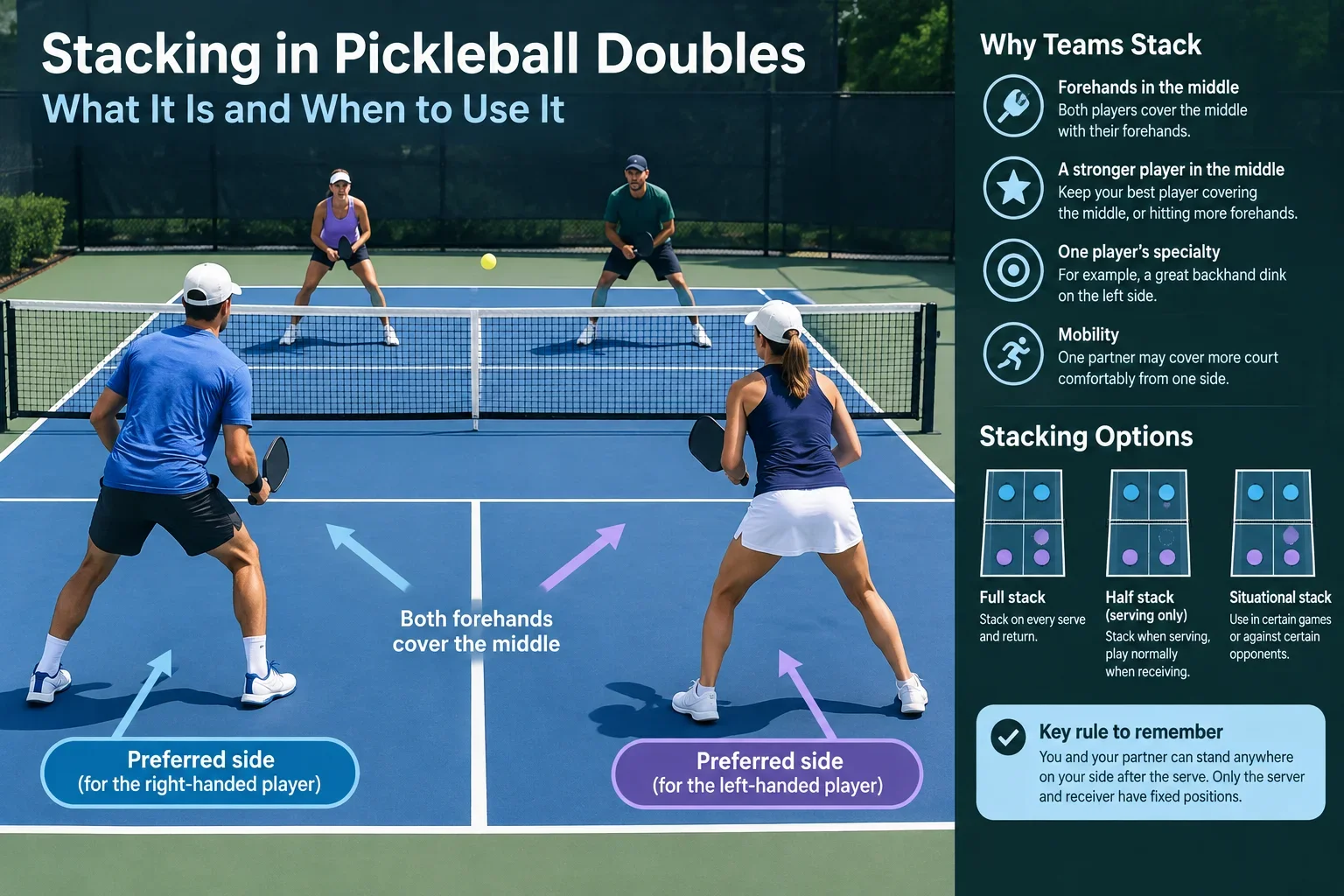
Image credit: ChatGPT
Stacking is a doubles strategy where you and your partner arrange yourselves so that each of you plays from your preferred side of the court on every point, instead of switching sides as the score changes. It's completely legal. The rules only say who must serve and receive, and from where. Once the ball is served, you can stand anywhere on your side.
This guide explains why teams stack, how full and partial stacking work for both the serving and receiving teams, and how to keep track of positions so you don't serve out of turn.
Why teams stack
In normal doubles, your court position depends on the score. Partners switch sides each time their team wins a point on serve. That means each player spends about half the game on their less preferred side. Stacking fixes that. Common reasons:
- Forehands in the middle. Most shots go down the middle. A right-handed player on the left side, with a left-handed partner on the right, has both forehands covering the middle.
- A stronger player in the middle. Some teams want their best player covering the middle, or hitting more forehands.
- One player's specialty. For example, a player with a great backhand dink who prefers the left side.
- Mobility. One partner may cover more court comfortably from one side.
What the rules require
Stacking works because the rules care about positions only at the moment of the serve:
- The correct server must serve from the correct side of the court, based on the team's score.
- The correct receiver must receive the serve, from the diagonal court.
- The server's partner and the receiver's partner can stand anywhere on their side of the net, including outside the court.
After the serve, all four players can move anywhere on their side. Serving out of turn, or the wrong player receiving, is a fault, so tracking positions matters. In rec play, players usually stop and sort it out, so agree on how to handle mistakes before you start.
Stacking when your team is serving
Say Pat (right-handed) wants to play the left side and Jo wants to play the right side.
- If the server is already on their preferred side, play normally. Pat serves from the left, Jo stands on the right.
- If the server is on the wrong side, the server serves from the correct court, and the partner starts off to one side of the court near the baseline, on the server's side. After the serve, the server moves across to their preferred side and the partner moves to theirs.
The partner "stacks" next to the server instead of standing on the other half of the court. That's where the name comes from.
The switch happens right after the serve. The server crosses behind the partner. Move quickly, but don't rush forward: the return has to bounce before your team can hit it, so you'll both be playing it from near the baseline.
Stacking when your team is receiving
Receiving is harder, because the receiver has to return the ball and then move to the kitchen line.
- If the receiver is already on their preferred side, play normally.
- If the receiver is on the wrong side, the receiver's partner stands at the kitchen line on the same side as the receiver, or off the court near the sideline. After returning, the receiver moves forward to the kitchen line and across to their preferred side, while the partner slides across to theirs.
The receiver should hit a deep, high return to buy time for the switch. A short, low return makes the switch very difficult.
Full stack vs. half stack
| Approach | What it means | Best for |
|---|---|---|
| Full stack | Stack on every serve and every return to keep both players on their preferred sides | Experienced teams, left-and-right-handed pairs |
| Half stack (serving only) | Stack only when serving, and play normally when receiving | Teams new to stacking; it avoids the hardest switch |
| Situational stack | Stack only in certain games, or against certain opponents | Exploiting a matchup, such as a weak player on one side |
How to keep track of who serves
Stacking makes it easy to lose track of positions. Some simple ways to stay organized:
- Remember the starting server. In traditional scoring, the player who started the game on the right serves from the right whenever your team's score is even, and from the left when it's odd.
- Call the full score before every serve, as the rules require: serving team's score, receiving team's score, then server number.
- Use a signal. Some teams have a simple word or hand signal for "we're stacking this point."
- Track the score on our pickleball scorekeeper, which shows the server and side.
When not to stack
- You and your partner haven't practiced it. The confusion costs more points than the positioning gains.
- Neither of you has a strong preference for one side.
- You're playing casual open play with a new partner. Ask first, since some players find it confusing.
FAQ
Is stacking allowed in pickleball?
Yes. The rules only control who serves and receives, and from where. Players can be anywhere else on their side of the court. See the USA Pickleball rules for the details.
Can the server's partner stand in the kitchen?
Yes, but there's no good reason to. Because of the two-bounce rule, they'd have to let the return bounce, and a player in the kitchen can't volley. See The Kitchen Rule, Explained.
Does stacking work with rally scoring?
Yes. The same principle applies. Positions are tied to the score, and you can rearrange after the serve.
Should a right-handed and left-handed team always stack?
Often, so that both forehands cover the middle. But try both setups, because some pairs prefer two backhands in the middle against teams that attack down the center.
Keep learning
- Tennis converts: read Pickleball vs. Tennis for doubles habits to change.
- Find a regular doubles partner in our player directory.
- Practice it at open play, with a partner who's agreed to try it.
Comments
No approved comments yet.
Log in or sign up to join the conversation.