

Tennis String Guide: Polyester vs. Multifilament vs. Natural Gut, and the Right Tension for You
Compare polyester, multifilament, natural gut, synthetic gut, and hybrid strings, and learn how gauge, tension, and restringing affect your game and comfort.
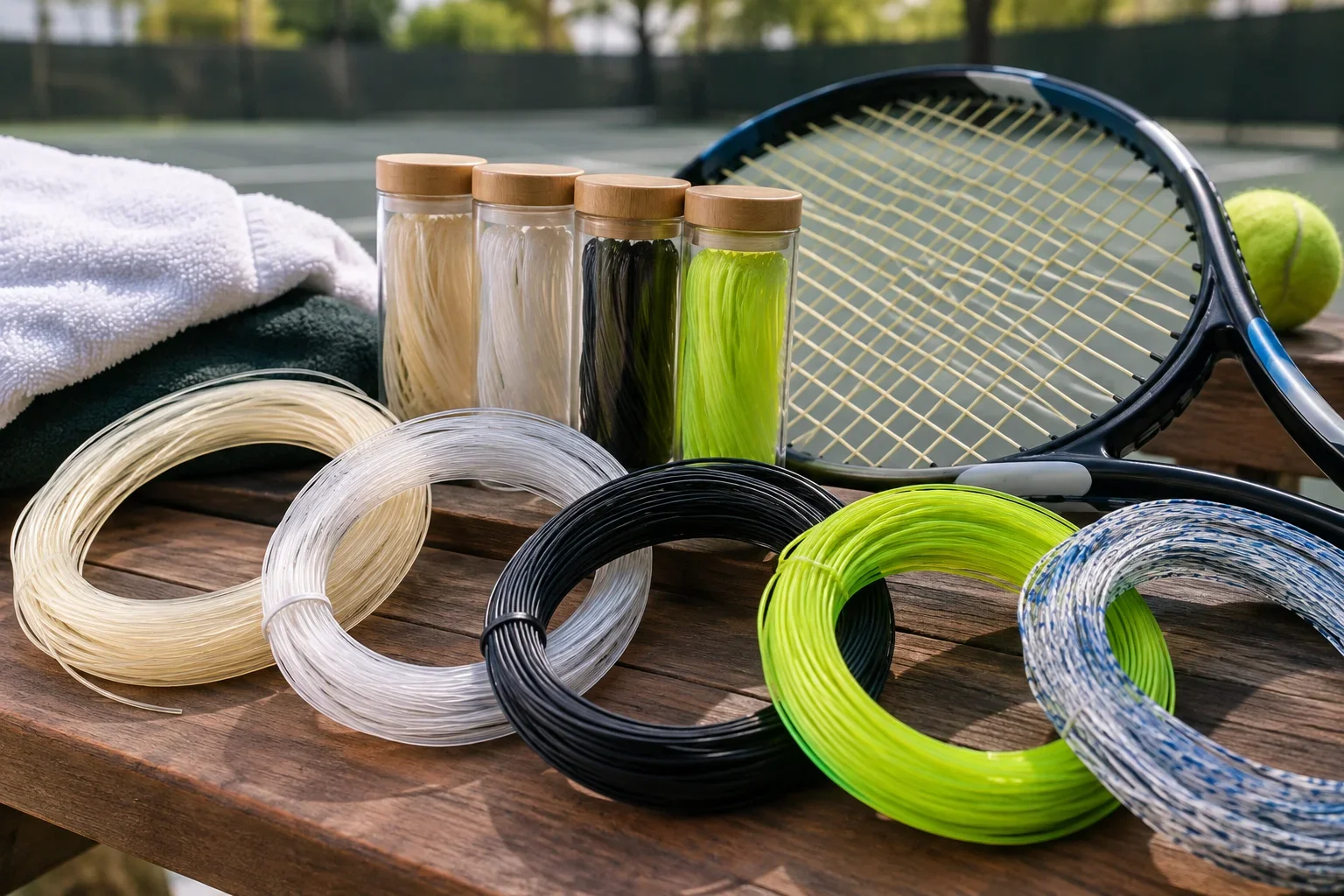
Image credit: ChatGPT
Ask most recreational players what’s in their racket and you’ll often get a shrug. Maybe it’s whatever came pre-strung from the store. Maybe it’s whatever the pro shop recommended three years ago, and it’s still in there.
That’s a missed opportunity. Your strings are the only part of the racket that actually touches the ball. The type of string, its thickness, and the tension it’s strung at affect your power, control, spin, comfort, and feel, often as much as the racket itself. A $250 racket with the wrong strings can play worse than a $120 racket with the right ones.
The good news is that you don’t need to be a gear expert to get this right. This guide explains the main string types, how tension and gauge work, and how to choose a setup that fits your game and your arm.
Why Strings Matter More Than You Think
When the ball hits your racket, the string bed stretches, holds the ball for a few milliseconds, and sends it back out. How the strings behave during that moment shapes the shot:
- Power: how much energy the strings return to the ball
- Control: how predictable the ball’s direction and depth are
- Spin: how much the strings grip and “snap back” on the ball
- Comfort: how much shock and vibration reach your arm
- Feel: how much feedback you get on touch shots like volleys and drops
- Durability: how long the strings last before breaking
- Tension maintenance: how well the strings hold their original tension over time
No single string is best at all of these. Every string is a trade-off, and the right one depends on how you play.
The Main Types of Tennis Strings
Natural gut
What it is: The original tennis string, made from cow intestine (specifically the serosa layer) that’s twisted, dried, and coated. It’s been used for over a century and is still considered the benchmark for feel.
How it plays:
- The most elastic string available, giving excellent, easy power
- Outstanding comfort and a plush feel
- The best tension maintenance of any string type: it plays much the same from the first hit to the last
- Excellent touch and feedback on volleys and finesse shots
Downsides:
- Price: typically the most expensive option, often $35–$50 or more per set, before labor
- Sensitivity to moisture: humidity and rain can damage it, although modern coatings help
- Durability: heavy topspin hitters may break it quickly
Best for: players who want maximum comfort and feel, players with arm sensitivity who can afford it, and all-court and serve-and-volley players.
Multifilament
What it is: A synthetic string made from hundreds or thousands of tiny fibers (usually nylon, polyurethane, or similar materials) bundled and wrapped together. It’s designed to imitate the feel of natural gut at a lower price.
How it plays:
- Soft, comfortable, and arm-friendly
- Good, easy power
- Nice feel on touch shots
- Moderate tension maintenance, better than polyester
Downsides:
- Fraying: the outer fibers can fray and “fuzz” with use, especially with heavy topspin
- Durability: can break quickly for frequent string breakers
- Less spin and control than polyester for big hitters
Best for: beginners and intermediate players, players who want comfort, players with sensitive arms, and anyone who doesn’t break strings often.
Polyester (and co-polyester)
What it is: A stiff, durable monofilament string, a single solid strand rather than a bundle of fibers. Co-polyesters blend polyester with other materials to adjust stiffness and feel. Polyester strings have dominated professional tennis for years.
How it plays:
- Spin: the strings slide and snap back on contact, adding significant spin
- Control: the stiff, lower-powered string bed lets big hitters swing fully while keeping the ball in the court
- Durability: resistant to breaking, which appeals to frequent string breakers
Downsides:
- Firmness: much stiffer and less comfortable than gut or multifilament
- Low power: if you don’t have a fast, full swing, poly can feel dead and make the ball fall short
- Poor tension maintenance: polyester loses tension quickly, often noticeably in the first day or two after stringing, and continues to lose playability over time
- “Dead” strings that don’t break: poly may not break for a long time, but it stops performing well long before it breaks
Best for: advanced players with fast, full swings who generate their own power, players who prioritize spin and control, and players willing to restring regularly.
Important: Polyester is the most common string at the professional level, but it’s not the right default for most recreational players. Pros restring constantly, often every match, and have the swing speed to make polyester work. A recreational player who leaves the same poly in their racket for months is playing with a stiff, dead string bed, and many experts point to that combination as hard on the arm.
Synthetic gut
What it is: A basic nylon string with a solid core and one or more outer wraps. It’s the simplest and most affordable option, and many rackets come pre-strung with it.
How it plays:
- A good all-round balance of power, control, and comfort
- No outstanding strengths, but no major weaknesses either
- Inexpensive, often around $5–$12 per set
Downsides:
- Less comfortable than multifilament or gut
- Less spin and control than polyester
- Loses playability over time
Best for: beginners, budget-conscious players, players still developing their strokes, and anyone who wants a simple, affordable starting point.
Hybrid setups
What it is: Two different strings in the same racket, one for the mains (vertical strings) and one for the crosses (horizontal strings). The most common hybrid pairs polyester with a softer string like multifilament or natural gut.
Common combinations:
- Polyester mains, multifilament or gut crosses: spin and control from the poly, with some added comfort and power
- Gut or multifilament mains, polyester crosses: more comfort and feel, with added durability and some spin. Roger Federer famously used a version of this (gut mains with poly crosses) for much of his career.
Upsides:
- A compromise between the performance of poly and the comfort of softer strings
- Can extend the life of expensive natural gut
Downsides:
- Still firmer than a full soft-string setup
- The softer string may wear out first
- More variables to adjust
Best for: intermediate and advanced players who break strings often but want more comfort than full polyester, and players who want to experiment.
Other string types
- Kevlar/aramid: extremely durable but very stiff, usually used only in hybrids for chronic string breakers. Not recommended for players with arm concerns.
- Textured and shaped strings: polyester and synthetic strings with ridges, twists, or shaped profiles (pentagon, hexagon, and so on) designed to grip the ball for extra spin.
String Types at a Glance
| String type | Power | Control | Spin | Comfort | Durability | Tension holding | Typical price per set* |
|---|---|---|---|---|---|---|---|
| Natural gut | High | Medium | Medium | Very high | Low–Medium | Excellent | $35–$50+ |
| Multifilament | High | Medium | Medium | High | Low–Medium | Good | $15–$25 |
| Synthetic gut | Medium | Medium | Medium | Medium | Medium | Fair | $5–$12 |
| Polyester | Low | High | High | Low | High | Poor | $8–$20 |
| Hybrid (poly/soft) | Medium | Medium–High | Medium–High | Medium | Medium–High | Medium | Varies |
*Price excludes stringing labor, which typically adds $15–$30. Prices vary by brand and location.
Understanding String Gauge
Gauge refers to string thickness. Confusingly, a higher gauge number means a thinner string.
| Gauge | Approximate diameter |
|---|---|
| 15L | 1.34–1.38 mm |
| 16 | 1.28–1.32 mm |
| 16L | 1.24–1.28 mm |
| 17 | 1.20–1.24 mm |
| 18 | 1.10–1.16 mm |
Thinner strings (17, 18):
- More feel and touch
- Slightly more spin potential and power
- Less durable, so they break sooner
Thicker strings (15L, 16):
- More durable
- Slightly less feel and spin
- Good for frequent string breakers
A good starting point: 16 gauge (about 1.30 mm) for most string types. If you break strings often, try a thicker gauge before switching to a stiffer string. Polyester players often use 16L or 17 (about 1.25 mm) for better feel and spin.
String Tension: The Most Misunderstood Setting
Tension is how tightly your strings are pulled when your racket is strung. Most rackets list a recommended range on the frame, typically somewhere around 50–60 lbs (about 23–27 kg).
The counterintuitive rule
Many players assume that tighter strings mean more power. It’s actually the opposite:
- Lower tension = more power, more comfort, and a higher launch angle. The strings stretch more and act like a trampoline, sending the ball off the racket with more energy.
- Higher tension = more control, less power, and a firmer feel. The string bed is stiffer, so the ball comes off with less energy and a more predictable trajectory.
How tension affects your game
| If you... | Try... |
|---|---|
| Hit the ball long often | Slightly higher tension |
| Hit the ball short or lack depth | Slightly lower tension |
| Have arm, elbow, or shoulder discomfort | Lower tension and a softer string |
| Want more control on big swings | Slightly higher tension |
| Want more feel and “pocketing” | Lower tension |
| Use polyester | Lower tension than you’d use for a soft string |
Tension by string type
Because polyester is so stiff, most players string it lower than they would string a multifilament or synthetic gut, often about 10% lower. A player who strings multifilament at 55 lbs might string polyester around 48–50 lbs. Lower tension softens poly’s harsh feel and gives back some power. Hybrids often fall in between, and many stringers recommend stringing the polyester component a few pounds lower than the softer component.
Tension loss
All strings lose tension over time, starting the moment they come off the stringing machine. Natural gut holds tension best. Polyester loses it fastest, both in the first few hours and over the life of the string. That’s why polyester strings that haven’t broken can still feel “dead” and play inconsistently.
Small changes matter
Adjust tension in small steps, typically 2–3 lbs (1–1.5 kg) at a time. Large swings in tension can make your racket feel completely different, which makes it hard to know what’s working.
How Your Racket Affects Your String Choice
Your racket and strings work together. A few factors to keep in mind:
Head size: Larger heads (around 100–110 sq. in.) have longer strings and a bigger sweet spot, which produces more power. Smaller heads (around 95–98 sq. in.) offer more control.
String pattern:
- Open patterns (for example 16×19): more spin and power, but strings may break sooner
- Dense patterns (for example 18×20): more control and durability, but less spin
Frame stiffness: A stiff racket paired with stiff polyester at high tension can be harsh. If your racket is on the stiffer side, consider a softer string or lower tension.
Matching Strings to Your Playing Style
Here are some common player types and setups to consider as a starting point:
The beginner or developing player
- String: synthetic gut or multifilament
- Gauge: 16
- Tension: middle of the racket’s recommended range
- Why: affordable, forgiving, comfortable, and gives easy power while you develop your strokes
The recreational player who wants comfort
- String: multifilament, or natural gut if the budget allows
- Gauge: 16
- Tension: low to middle of the range
- Why: maximum comfort and feel without sacrificing too much control
The intermediate player who breaks strings
- String: hybrid (polyester mains with multifilament crosses) or a thicker-gauge multifilament
- Gauge: 16
- Tension: middle of the range, with the poly a few pounds lower
- Why: improves durability while keeping comfort
The advanced, topspin-heavy player
- String: polyester or co-polyester
- Gauge: 16L or 17
- Tension: low to middle of the range
- Why: maximum spin and control for fast swings. This works best if you restring regularly.
The all-court or serve-and-volley player
- String: natural gut or a gut/poly hybrid
- Gauge: 16
- Tension: middle of the range
- Why: excellent feel at the net, with some control for groundstrokes
The player with arm, elbow, or shoulder concerns
- String: multifilament or natural gut
- Gauge: 16
- Tension: low end of the range
- Why: reduces stiffness and shock
Note: strings can help with comfort, but they aren’t a treatment for injury. Talk to a medical professional about persistent pain, and to a coach about technique.
How Often Should You Restring?
The classic rule of thumb
Restring your racket as many times per year as you play per week. If you play three times a week, restring about three times a year.
This rule works reasonably well for synthetic gut, multifilament, and natural gut. It doesn’t work well for polyester, which loses playability much faster.
Polyester players
If you play with polyester, consider restringing based on hours played, not just breakage. Many players and stringers suggest replacing poly after roughly 15–25 hours of play, or when you notice:
- Less spin and control
- The ball flying long or feeling unpredictable
- A harsh, “boardy” feel
- Strings that stay out of place and don’t snap back after shots
Signs any string needs replacing
- Visible fraying, notching, or wear
- Strings that move around and stay out of position
- A noticeable loss of feel, control, or power
- Increased arm discomfort
- It’s been months and you can’t remember the last restring
Working with a Stringer
A good stringer can make a big difference to how your racket plays. When you drop off your racket, be ready to tell them:
- What string you want, or ask for a recommendation
- What tension you want, in lbs or kg
- Your playing style and level
- Any arm discomfort
- What you liked or didn’t like about your last setup
Questions to ask
- “What tension would you recommend for this string in my racket?” A good stringer knows how different strings play at different tensions.
- “Do you pre-stretch strings?” Some strings, especially natural gut and some multifilaments, benefit from pre-stretching.
- “What kind of machine do you use?” Electronic constant-pull machines are generally the most consistent, though experienced stringers can get great results on other machine types.
- “How long will it take, and what will it cost?” Labor typically runs $15–$30, depending on your area and the turnaround time.
Keep a string journal
Write down your string, gauge, tension, and stringing date, plus how it played. Over time, you’ll find the setup that works best for you, and you’ll be able to tell your stringer exactly what you want.
Common String Mistakes to Avoid
- Copying the pros. Most pros use polyester at specific tensions, and they restring constantly. Their setup was built for their swing, not yours.
- Leaving polyester in too long. Polyester often plays poorly long before it breaks. Dead poly is uncomfortable and inconsistent.
- Stringing too tight for control. Very high tension can reduce power and comfort. If you’re struggling with control, technique or string type may be the issue.
- Never restringing. Factory strings in a racket you’ve had for two years aren’t helping you.
- Ignoring your arm. If your elbow or shoulder bothers you, look at your string type and tension, and talk to a coach and a medical professional.
- Changing too many things at once. Change one variable at a time (string type, gauge, or tension) so you know what made the difference.
Quick-Start Recommendations
Still not sure where to start? Use this as a simple guide:
| Your situation | Start with |
|---|---|
| New to tennis, budget-conscious | Synthetic gut, 16 gauge, mid-range tension |
| New to tennis, want comfort | Multifilament, 16 gauge, mid-range tension |
| Comfort is a priority or sensitive arm | Multifilament or natural gut, 16 gauge, lower tension |
| Intermediate, break strings occasionally | Hybrid (poly/multi), 16 gauge, mid-range tension |
| Advanced, heavy topspin, restring often | Polyester, 16L–17 gauge, lower–mid tension |
| Want premium feel, rarely break strings | Natural gut, 16 gauge, mid-range tension |
These are starting points, not rules. The best setup is the one that feels good and helps you play your best.
Find Your Setup and a Stringer Near You
Choosing strings is personal, and a little experimentation goes a long way. Start with a setup that fits your level and comfort needs, play with it for a few weeks, and adjust one variable at a time.
Try our String Setup Advisor: answer a few quick questions about your level, comfort needs, how often you break strings, your budget, and your restringing habits, and get a suggested string type and starting tension range.
Find a stringer near you: browse the LetsPlayTennis.com Stringers directory to find local stringers, compare services, and get your racket dialed in.
Frequently Asked Questions
What’s the best tennis string for beginners?
Synthetic gut or multifilament. Both are forgiving, comfortable, and affordable, and they give easy power while you develop your strokes. Most beginners don’t need polyester.
Is polyester bad for your arm?
Polyester is stiffer than other strings, and many players find it harsher on the arm, especially when it’s strung tight or left in the racket after it loses playability. If you have arm discomfort, a softer string like multifilament or natural gut is usually a better choice. See a medical professional for persistent pain.
What tension should I string my racket at?
Start in the middle of your racket’s recommended range, usually printed on the frame. Go lower for more power and comfort, or higher for more control. If you use polyester, many players string around 10% lower than they would with a softer string.
Do higher tensions give more power?
No. Lower tension gives more power because the strings stretch more and return more energy to the ball. Higher tension gives more control.
How often should I restring?
A common rule is to restring as many times per year as you play per week. Polyester players should restring more often, often every 15–25 hours of play, because polyester loses playability quickly.
Is natural gut worth the price?
For many players, yes, especially players who want maximum comfort, feel, and tension maintenance. It’s a premium option, so it makes the most sense if you don’t break strings frequently or you use it in a hybrid.
What’s the difference between mains and crosses?
Mains are the vertical strings, running from the top of the racket to the throat. Crosses are the horizontal strings. In a hybrid setup, different strings are used for each.
Should I use a vibration dampener?
A dampener reduces string “ping” and changes the sound and feel of impact, but it doesn’t significantly reduce shock to your arm. String type and tension have a much bigger effect on comfort.
Comments
No approved comments yet.
Log in or sign up to join the conversation.