

Volleys for Club Players: 7 Fixes for a More Confident Net Game
Seven fixes for common tennis volley problems, from grip and ready position to low volleys and placement, with a simple drill for each.
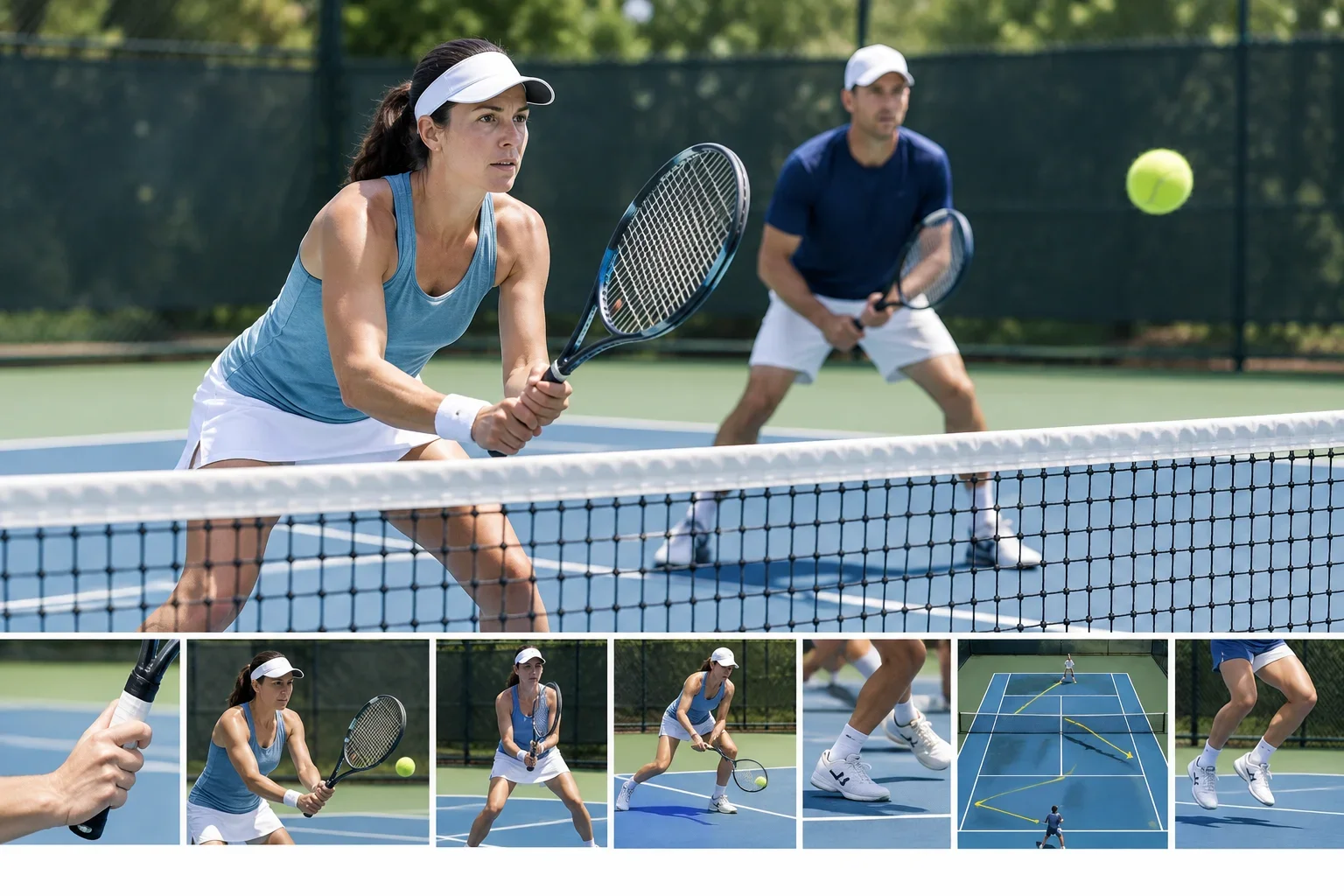
Image credit: ChatGPT
Many club players avoid the net because their volleys feel unreliable. Usually the problem isn't talent. It's a few fixable habits: the wrong grip, too big a swing, or a racquet held too low. Fix those, and the net becomes the easiest place on the court to win points, especially in doubles.
Here are seven fixes for the most common volley problems, with a drill for each.
The seven fixes at a glance
| Problem | Fix |
|---|---|
| Volleys float or go wild | 1. Use a continental grip |
| Volleys fly long | 2. Block or punch, don't swing |
| Late on fast balls | 3. Ready position with the racquet up and in front |
| Volleys go into the net | 4. Bend your knees for low volleys |
| No power or depth | 5. Step forward into the volley |
| Volleys sit up for the opponent | 6. Aim deep or at an angle |
| Caught flat-footed | 7. Split step as your opponent hits |
1. Use a continental grip
The continental grip, the same one you use to serve, lets you hit forehand and backhand volleys without changing grips. At the net, there's no time to switch. A forehand grip makes backhand volleys almost impossible, and it often causes volleys that float up.
Drill: stand close to the net with a partner. Volley back and forth gently, alternating forehand and backhand, without changing your grip. Go for 30 in a row.
2. Block or punch, don't swing
A volley is a short punch, not a swing. The ball is already coming at you with pace, so you only need to redirect it. A big backswing makes you late and sends the ball long.
- Keep the racquet in front of your body, where you can see it.
- Use a very short backswing, no further back than your shoulder.
- Make a short, firm push forward through contact, then stop.
Drill: stand with your back against the side fence at the net and volley gently. The fence stops you from taking a big backswing.
3. Ready position: racquet up and in front
At the net, hold the racquet in front of your chest with the head up, about at eye level. From there, you can block balls at your body and move to either side quickly. A racquet hanging low by your knees is too slow for hard-hit balls.
For balls hit straight at you, use a backhand volley. It covers your body much more easily than a forehand, which most players find awkward at close range.
4. Bend your knees for low volleys
On low volleys, get down to the ball with your legs. Don't drop the racquet head. Keep the racquet head above your wrist as much as you can, and open the face slightly to lift the ball over the net.
Low volleys are defensive. Aim them deep and down the middle, not for winners. Your goal is to get the next ball higher.
Drill: have a partner feed low balls to your feet while you stand at the service line. Bend your knees and volley them deep, into the back third of the court.
5. Step forward into the volley
Most of a volley's power and depth comes from moving forward, not from swinging. On a forehand volley, step forward with your left foot (for a right-hander). On a backhand volley, step forward with your right foot. If there's no time to step, just lean forward through contact.
6. Aim deep or at an angle
A volley that lands short and in the middle of the court gives your opponent an easy pass or lob. Volleys that win points do one of two things:
- Go deep, close to the baseline, to push your opponent back.
- Go at an angle or short crosscourt, away from your opponent, when you're close to the net and the ball is high.
In doubles, aim between your opponents, or at the feet of the player closest to the net. See Tennis Doubles Strategy for positioning.
7. Split step as your opponent hits
A split step, a small hop just as your opponent hits the ball, gets you balanced and ready to move either way. Without it, you'll be caught flat-footed and lunge at balls you should reach easily. See Tennis Footwork Basics for timing tips.
Where to stand at the net
- Halfway between the service line and the net is a good default for most volleys. It's close enough to put balls away, and far enough to cover lobs.
- Move closer when your partner or you have hit a strong shot and you can expect a weak reply.
- Move back slightly against players who lob well.
Handling the overhead
If you come to the net, expect lobs. Turn sideways, point at the ball with your non-hitting hand, move your feet to get under it, and swing like a relaxed serve. If the lob is very deep, let it bounce, then hit the overhead.
FAQ
Should I use one hand or two on backhand volleys?
One hand is standard, because it gives you more reach and is quicker. Two-handed backhand volleys can work close to the net, but most players switch to one hand at the net.
Why do my volleys feel weak?
Usually because you're swinging with your arm instead of moving forward, or your grip is too loose at contact. Step in and firm up your grip at the moment you hit.
When should I come to the net?
When you've hit a short ball deep, an approach shot or a strong serve that puts your opponent on the defensive. See Singles Strategy for 3.5 Players for approach patterns.
Keep learning
- Practice your volleys with a regular partner. Find one in our player directory.
- Want feedback on your technique? How to Find the Right Coach.
- Not sure what level you're at? Try the level estimator.
Comments
No approved comments yet.
Log in or sign up to join the conversation.