
Third-Shot Drop vs. Drive: When Each One Wins in Pickleball
Learn when to hit a third-shot drop or a drive in pickleball, where to aim each one, how to combine them, and drills to make the right choice under pressure.
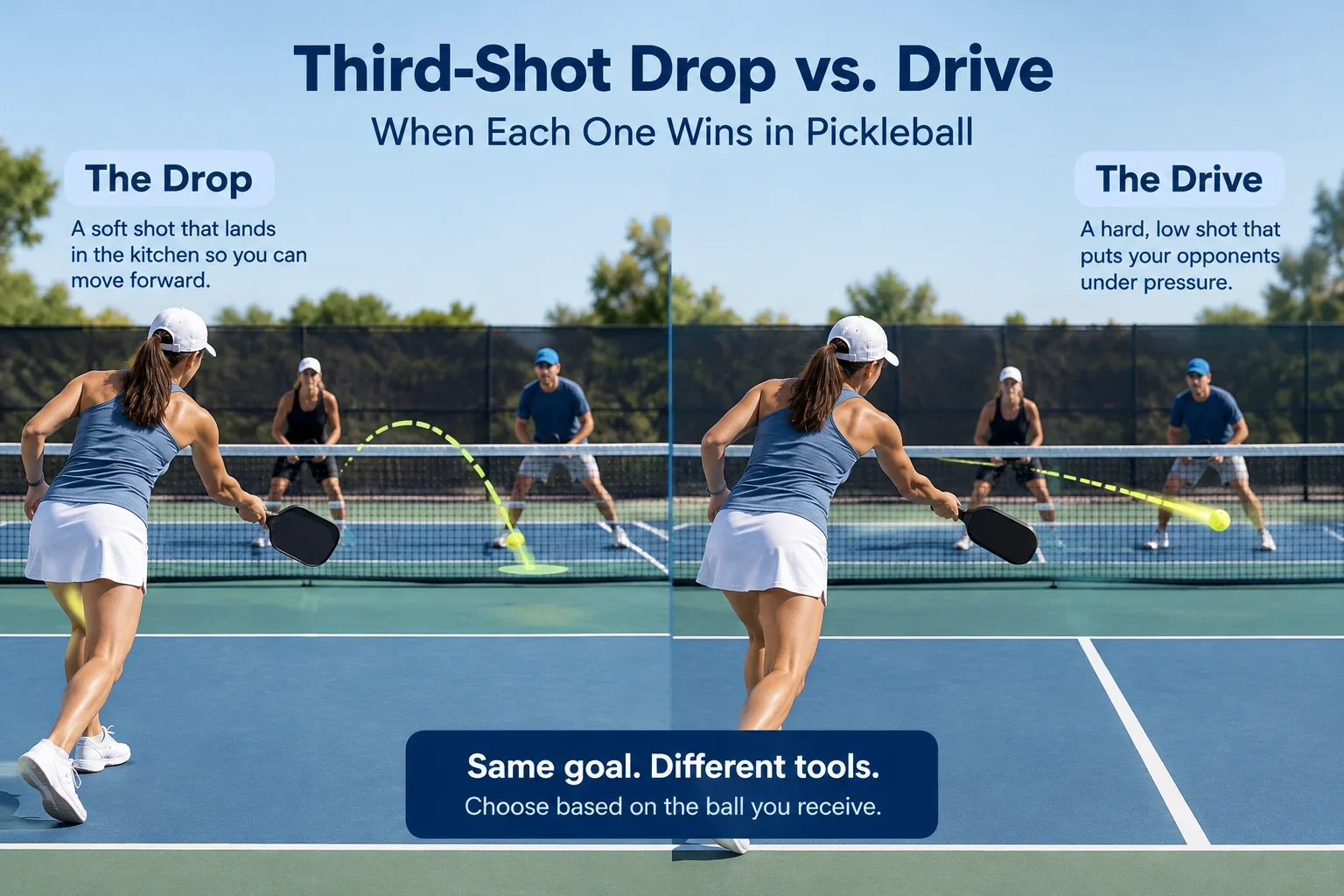
Image credit: ChatGPT
The third shot is the serving team's first chance to get to the net, and it's where many pickleball rallies are won or lost. You have two main options. The drop is a soft shot that lands in the kitchen so you can move forward. The drive is a hard, low shot that puts your opponents under pressure. Neither is always right. The best players choose based on the ball they receive.
This guide explains why the third shot matters, when each option wins, and how to practice both so you can make the choice in a split second.
Why the third shot is so important
Under the two-bounce rule, the serve must bounce before it's returned, and the return must bounce before the serving team hits it. That gives the returning team a head start. After returning the serve, they can move up to the kitchen line, while the serving team has to stay back and let the return bounce.
So on the third shot, the serving team is usually at the baseline facing two opponents at the net, which is the strongest position in pickleball. The third shot's job is to neutralize that advantage and let the serving team get to the net too.
The short answer
| Situation | Better choice | Why |
|---|---|---|
| Deep return, opponents at the kitchen line | Drop | A drive into two set net players usually comes back at your feet |
| Short or high return | Drive | You can attack from inside the baseline with a better angle |
| Returner still moving forward | Drive at their feet | They have to hit up while on the move |
| Opponents have weak hands or block poorly | Drive | Pace produces errors and pop-ups |
| Opponents are strong at the net | Drop | Taking pace off denies them a ball to attack |
| Low ball below net height | Drop | A drive from low contact has to go up, and that's an easy volley |
| Strong headwind | Drive | The wind holds the ball up, and drops tend to land short |
| Strong tailwind | Drop | Drives fly long more easily |
The third-shot drop
A good drop arcs gently over the net, peaks on your side, and lands softly in the kitchen, ideally near your opponents' feet. Because it lands in the kitchen, your opponents have to let it bounce or hit it up from below the net. They can't attack it. That gives you time to move forward.
When it wins:
- Against strong net players who punish anything with pace
- When the return is deep and you're hitting from the baseline
- In longer games, where being at the net decides most points
The risks: drops that are too high get attacked, and drops that are too low go into the net. It's a hard shot to learn, and many beginners give up on it too early.
Technique keys: keep the paddle face slightly open, lift the ball with your legs and shoulder rather than your wrist, and use a smooth, low-to-high swing that's about the same length as your follow-through. Aim for the peak of the ball's arc to be on your side of the net, not over it.
Where to aim the drop
- To the backhand of the player who is weaker at the net
- Down the middle, where the two opponents may hesitate over who takes it
- Crosscourt, which gives you more distance and the lowest part of the net
The third-shot drive
A drive is a hard, flat or topspin shot that crosses the net low. It doesn't need to win the point outright. Its job is to force a weak reply so you can hit a better shot next, often a drop on the fifth shot.
When it wins:
- When the return is short or high, and you can hit from inside the baseline
- When the returner hasn't reached the kitchen line yet
- Against opponents who struggle with pace or have slow hands
- When you're a tennis player with a strong forehand. See Pickleball vs. Tennis for how to use it.
The risks: against good opponents at the net, a drive that's too high gets blocked or volleyed back at your feet before you can move forward.
Where to aim the drive
- At the returner's feet if they're still moving forward
- At the hip or shoulder on the forehand side of a net player, where blocking is awkward
- Down the middle, to cause confusion
Drive and drop: the best of both
Many good players combine the two. They hit a third-shot drive to force a weaker reply, then follow with a fifth-shot drop off that easier ball. The drive puts your opponents on the defensive, and the drop gets you to the net.
Whatever you hit, don't stand and watch. After any third shot, move forward and split step as your opponents hit. If the ball comes back hard, stop, reset with a soft block into the kitchen, and keep moving forward. That's called a reset, and it's as important as the third shot itself.
Practice drills
Drop ladder
One player stands at the kitchen line and feeds deep. The other hits drops from the baseline into the kitchen. After 3 good drops in a row, move a step forward. After a missed drop, move a step back. Switch after 5 minutes.
Drop or drive call
A feeder at the net mixes deep and short feeds. The hitter has to decide quickly whether to drop or drive, and call it out loud. This builds the decision, not just the technique.
Third-shot game
Play points that start with a serve and return. The serving team scores 1 point for reaching the kitchen line in a good position, and the returning team scores if they win the point before that. This rewards smart third-shot choices.
FAQ
Should beginners learn the drop or the drive first?
Learn both, but practice the drop more. It's harder, and it becomes more important as your opponents get better at the net. Beginners often win with drives at first, then hit a wall at intermediate levels.
What about a third-shot lob?
It's an occasional surprise, especially against players crowding the net. It's risky against tall or quick opponents and in wind, so use it sparingly.
Does my paddle affect my third shot?
A bit. A thicker, softer core makes drops easier to control, and a thinner, livelier paddle adds pop to drives. See How to Choose a Pickleball Paddle.
Can I volley the third shot's return?
Yes. The two-bounce rule only applies to the serve and the return. After that, either team can volley, as long as they're outside the kitchen. See The Kitchen Rule, Explained.
Keep learning
- New to the game? Start with Pickleball 101.
- Check your level with the pickleball rating tool.
- Put it into practice at an open play session near you.
Comments
No approved comments yet.
Log in or sign up to join the conversation.