
Hard, Clay or Grass? How Court Surfaces Change the Way You Play
Learn how hard, clay, grass and artificial courts change ball speed, bounce and movement, how to adjust your game, and which shoes and balls suit each surface.
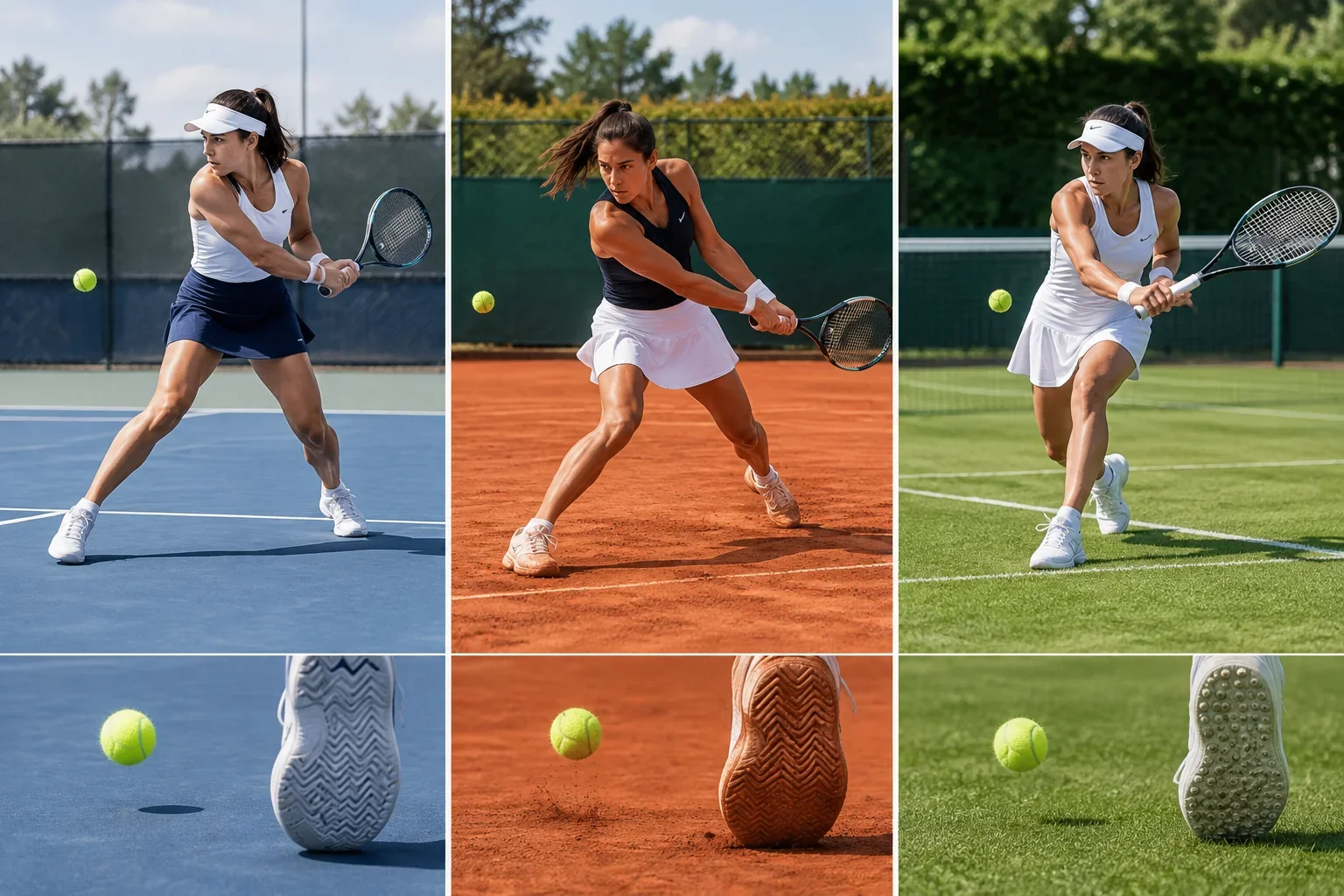
Image credit: ChatGPT
The court you play on changes the bounce, the speed of the ball and how you move. Hard courts give a true, medium-speed bounce. Clay slows the ball down, kicks it up higher and rewards patience and sliding. Grass keeps the ball low and fast and rewards big serves and short points.
Most recreational players in the U.S. play almost entirely on hard courts, so a trip to a clay club or a resort can feel like a different sport. This guide explains how each surface plays, how to adjust your game, and what to change in your shoes and balls.
The short answer
| Surface | Ball speed | Bounce | Favors | Easy on your body? |
|---|---|---|---|---|
| Hard (acrylic) | Medium to fast | Medium height, very predictable | All-court players | Hardest on joints |
| Red clay | Slow | High, with lots of grip on spin | Patient baseliners, heavy topspin | Easiest on joints |
| Green clay (Har-Tru) | Slow to medium | Medium to high | Consistent players, good movers | Easy on joints |
| Natural grass | Fast | Low, sometimes irregular | Big servers, slice, net players | Soft, but slippery |
| Artificial grass and carpet | Medium to fast | Low to medium | Flat hitters, net players | Fairly easy on joints |
Court speed varies a lot within each type. The ITF rates court pace on a scale from slow to fast, and two hard courts can play very differently depending on the amount of sand in the top coat, the weather and how worn they are.
Hard courts: the all-rounder
Hard courts are asphalt or concrete with an acrylic top coat. They're the most common courts in public parks, schools and clubs in North America, and two of the four Grand Slams (the Australian Open and the US Open) are played on them.
How they play:
- The bounce is predictable, so timing is easier to learn.
- Grittier surfaces slow the ball down and grip spin. Smoother, older courts play faster.
- Every style can win. Hard courts reward a mix of power, consistency and movement.
The downside is the impact on your body. Hard courts don't give, and a lot of stopping and starting adds up on your knees, ankles and back. Good cushioned shoes and a proper warm-up matter more here than anywhere.
Clay: slow, high and physical
There are two main types of clay court:
- Red clay is crushed brick over a base of stone and gravel. It's common in Europe and South America, and it's the surface of the French Open.
- Green clay, often called Har-Tru, is crushed stone. It's common at clubs in the eastern and southern U.S. It's usually a little faster and firmer than red clay.
How clay plays:
- The ball slows down after the bounce, so winners are harder to hit and rallies are longer.
- Topspin bounces high. A heavy topspin ball can kick up above shoulder height.
- You slide. Good clay players slide into wide balls instead of stopping with small steps. Start by sliding a short distance on easy balls, keeping your weight low.
- The surface is easier on your body. Many players with knee or back problems prefer clay.
How to adjust:
- Be more patient. Build the point with depth and spin instead of going for winners early.
- Add more topspin, so the ball kicks up and pushes your opponent back.
- Use the drop shot. The slow bounce and long rallies push players far behind the baseline.
- Move back a step on your return of serve, especially against high-kicking second serves.
On clay, the ball leaves a mark. In recreational play, you can check the mark to settle a close line call. Check it right away, before anyone walks over it, and only for the ball in question. Clay courts also need to be swept and the lines brushed, usually after play, so check the club's rules.
Grass: fast, low and rare
Natural grass is the original tennis surface and the surface of Wimbledon. It's expensive to maintain, so very few public or club courts have it, especially in the U.S.
How grass plays:
- The ball skids and stays low, so you have less time to react.
- Serves are more effective, and points are shorter.
- Slice is especially effective because it stays low after the bounce.
- The bounce can be irregular, especially as the court wears near the baseline.
How to adjust: shorten your backswing, bend your knees to get down to the low ball, and look for chances to come forward. Grass rewards players who take the ball early and finish points at the net.
Artificial grass, carpet and indoor courts
Sand-filled artificial grass is common at clubs in the UK, Australia and Japan. It plays low and medium-fast, with less impact than hard courts. Indoor courts may be carpet, hard courts or a cushioned acrylic surface. Indoors, there's no wind or sun, so the conditions are very consistent, and the ball often feels faster.
Shoes and balls for each surface
| Surface | Shoe outsole | Ball |
|---|---|---|
| Hard | Durable all-court or hard-court outsole | Extra-duty felt, which lasts longer on abrasive courts |
| Clay | Full herringbone (zigzag) pattern, which grips and releases clay | Regular-duty felt, which picks up less clay |
| Grass | Pimpled or nubbed outsole, often required by grass clubs | Regular-duty or grass-specific |
| Artificial grass and carpet | Omni or carpet-specific outsole, or an all-court shoe with a flatter tread | Regular-duty |
All-court shoes work on most surfaces for recreational play, but a herringbone clay shoe makes a noticeable difference if you play on clay regularly. Some clubs don't allow certain soles on their courts, so check before you play. See Tennis Shoes 101 for more on outsoles.
FAQ
Which surface is best for beginners?
Hard courts, mostly because the bounce is predictable and they're the easiest to find. Clay is a great second surface because it builds patience and footwork, and it's kind to your body.
Which surface is easiest on the knees?
Clay, followed by artificial grass and cushioned hard courts. Standard hard courts have the most impact.
Do pickleball courts work the same way?
Most pickleball courts are hard courts with an acrylic surface, so the same principles apply. Clay and grass aren't used for pickleball.
Why do some players do better on clay than on hard courts?
Clay rewards consistency, heavy topspin, endurance and sliding. Players who have those strengths, or who grew up on clay, often find hard courts too fast, and vice versa.
Keep learning
- Find courts near you, including clay and indoor courts, with our court finder and court map.
- Learn how surfaces shape the majors in What Is a Grand Slam in Tennis?
- Planning to play somewhere new? Read Planning a Tennis Trip.
Comments
No approved comments yet.
Log in or sign up to join the conversation.