

How Tennis Ladders Work (and How to Climb One Fast)
Learn how tennis ladders work, compare ladder formats and common rules, and find practical strategies to climb faster and defend your position.

Image credit: ChatGPT
A tennis ladder is a ranked list of players who move up by beating the people above them. There's no fixed schedule: you challenge someone, play the match, and the result updates the rankings.
Players like ladders because they're flexible. You play when it suits you, against people near your level, and every match counts toward something. This guide explains how ladders work, the common rules, and practical strategies to climb faster and hold your position.
How a ladder works
Every ladder runs on the same basic cycle: challenge, play, report, update. You can only challenge players ranked above you, usually within a few spots.
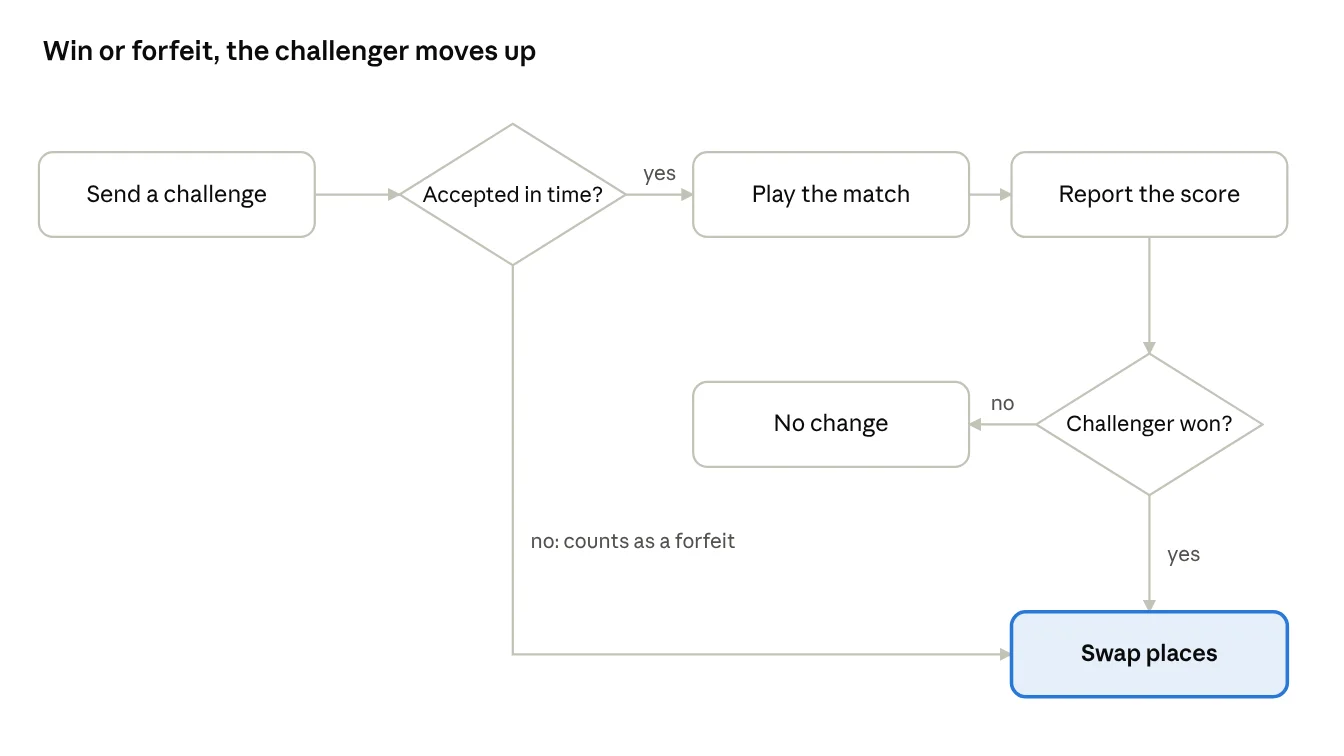
If the challenger wins, or the other player doesn't accept in time, the two players swap places. If the challenged player wins, the rankings stay the same. Either way, both players can challenge again once any rematch limit has passed.
Types of ladders
Not every ladder uses the same system. Check which one yours uses, because it changes the best way to climb.
| Type | How you move up | Best strategy |
|---|---|---|
| Position swap | Beat someone above you and you trade places with them | Challenge players just above you whom you can beat |
| Leapfrog | Beat someone above you and take their spot; everyone between moves down one | Same as position swap, but each win can be a bigger jump |
| Points-based | Earn points for wins, often more for beating higher-ranked players; ranked by total points | Play as many matches as you can |
| Rating-based | Results update a skill rating, such as an Elo-style score; ranked by rating | Beat strong players; wins against weaker players count less |
| Box ladder | Small groups play round robins; top finishers move up a box, bottom finishers move down | Win your box every cycle |
Common ladder rules
Every ladder sets its own rules, but most cover the same ground. Read yours before your first challenge.
| Rule | Typical setting |
|---|---|
| Challenge range | You can challenge players up to 3–5 spots above you |
| Response time | The challenged player must accept within 2–3 days |
| Play-by deadline | The match must be played within 7–14 days |
| Declining | Refusing or missing the deadline without a good reason counts as a loss or forfeit |
| Rematch limit | You can't challenge the same player again for 2–4 weeks |
| Open challenges | You can only have one or two active challenges at a time |
| Match format | Best of three sets, often with a match tiebreak instead of a third set |
| Activity rule | Players who don't play for 3–4 weeks drop down or are marked inactive |
| Score reporting | The winner reports the score within 24 hours |
| New players | Join at the bottom, or are placed by rating |
How to climb fast
The fastest climbers play often and pick their challenges carefully. Talent helps, but activity and smart targeting matter more than most players expect.
- Challenge the moment you're eligible. Every day you wait is a day someone else can challenge the player you wanted. Send challenges as soon as rematch limits or cooldowns end.
- Aim high within your range, if you can win. On a swap ladder, beating someone 5 spots up gains 5 places. Beating someone 1 spot up gains 1. Pick the highest-ranked player you think you can beat.
- Scout before you challenge. Check recent results. A player who just lost to someone below you, or hasn't played in weeks, may be ranked higher than their current form.
- Target style matchups. If you handle pushers well, challenge the pushers. If big servers bother you, find another target in your range.
- Keep a challenge always open. Ladders reward activity. Play every week if you can, and don't leave your challenge slots empty.
- Be easy to schedule. Offer two or three times when you challenge. Fast scheduling means more matches, and more matches means faster climbing.
- Use points ladders differently. On a points-based ladder, play as many matches as possible. On a rating-based ladder, prioritize matches against strong players.
One more tip: report your scores right away. A win doesn't help you until it's on the ladder.
Defending your spot
Once you're near the top, players below will start challenging you. Holding your place takes a different approach from climbing.
- Accept challenges quickly. Delaying rarely helps, and running out the deadline usually counts as a loss.
- Schedule on your terms. Offer times and courts that suit you, within the rules.
- Watch the players below you. Know who's been winning and how they play, so a challenge doesn't catch you off guard.
- Stay active. Many ladders drop inactive players. Keep challenging upward even when you're defending.
- Treat every match as a real match. Lower-ranked challengers are often improving fast. Warm up properly and play your best tennis.
Mistakes that keep players stuck
- Waiting to be challenged. Players who only respond to challenges tend to drift down. Climbing needs you to send challenges.
- Always challenging the player directly above. It feels safe, but it's slow. Look at the whole range you're allowed to challenge.
- Challenging the top player too early. A loss can lock you out of a rematch for weeks. Build up wins first.
- Letting scheduling drag. Matches that slip past the deadline often end as forfeits or get cancelled.
- Forgetting to report scores. An unreported win leaves the ladder unchanged.
- Ignoring the rules. Missing a response deadline or a rematch limit can cost you a spot without hitting a ball.
FAQ
Can I challenge someone below me?
Usually not on a position ladder, since you have nothing to gain. Some points-based and rating-based ladders allow it, and you can always play friendly matches.
What happens if I lose a challenge?
On most swap ladders, you stay where you are. Some ladders drop the losing challenger a spot, so check your rules.
Can I turn down a challenge?
Most ladders count an unexplained refusal as a forfeit. Injury, illness and travel are often accepted reasons if you tell the organizer.
How do new players get placed?
They usually start at the bottom. Some ladders place them by rating, or let them challenge further up for their first few matches.
Is a ladder better than a league?
A ladder suits players with unpredictable schedules who want to play at their own pace. A league suits players who like a fixed schedule and a clear end to the season.
Comments
No approved comments yet.
Log in or sign up to join the conversation.