

How to Read a Tennis Racquet Spec Sheet: Swingweight, Stiffness, Balance and More
Understand every number on a tennis racquet spec sheet, from head size and weight to balance, swingweight, stiffness, beam width and string pattern.
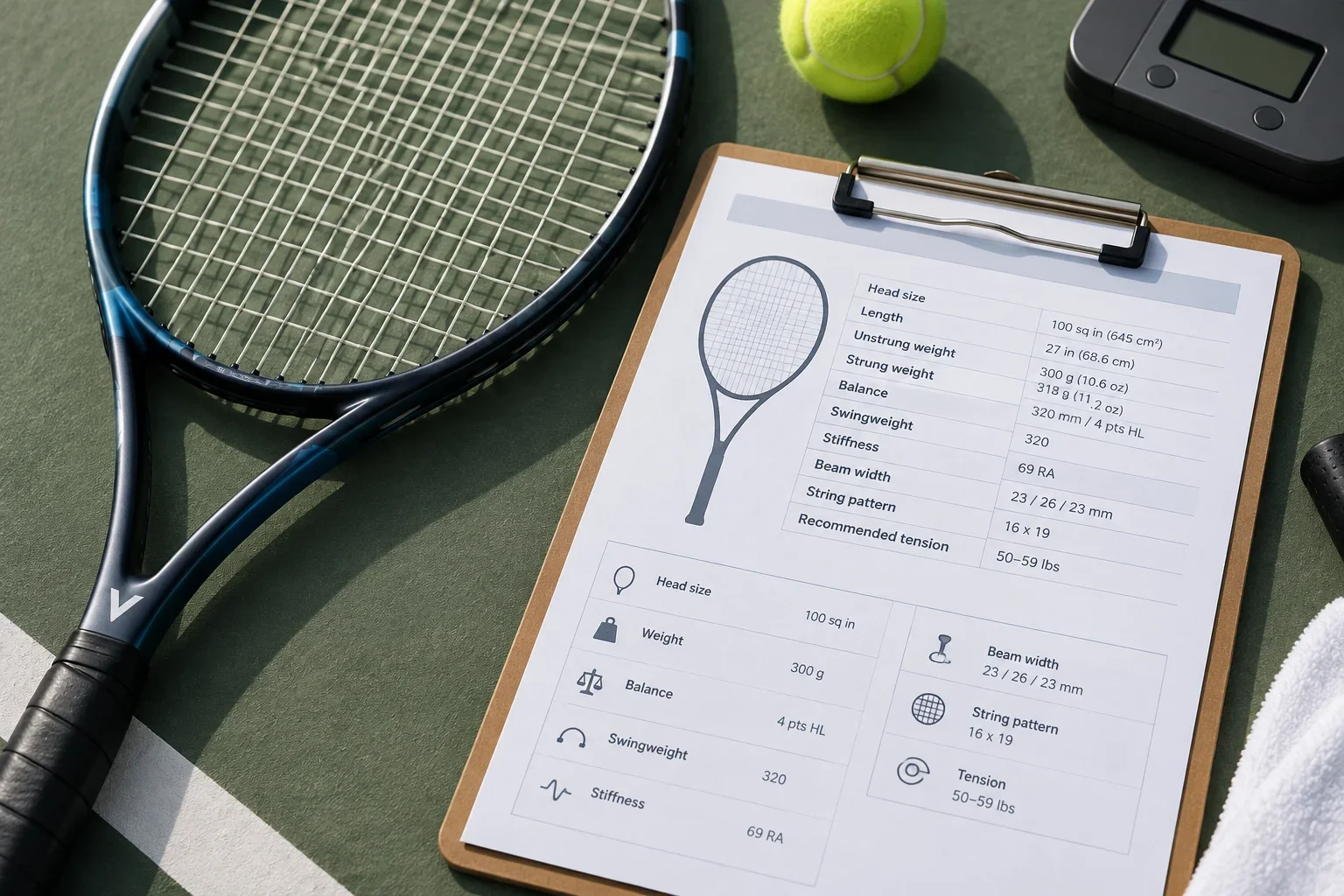
Image credit: ChatGPT
A racquet spec sheet tells you how a frame will feel before you hit a ball, as long as you know which numbers to look at. Head size, weight and balance tell you most of what you need. Swingweight and stiffness tell you how it will actually swing and how it will treat your arm. The rest is fine-tuning.
This guide explains every number you'll see on a typical spec sheet, what range is normal, and which specs matter most for your level. Use it alongside our racket finder, where you can filter frames and compare them side by side.
A typical spec sheet
Here's what a spec sheet for a popular all-round frame might look like:
| Spec | Example | Typical range for adult frames |
|---|---|---|
| Head size | 100 sq in (645 cm²) | 95–110 sq in |
| Length | 27 in (68.6 cm) | 27–27.5 in |
| Unstrung weight | 300 g (10.6 oz) | 255–320 g |
| Strung weight | 318 g (11.2 oz) | About 15–20 g more than unstrung |
| Balance | 320 mm / 4 pts head-light (unstrung) | Head-light to slightly head-heavy |
| Swingweight | 320 (strung) | About 290–340 |
| Stiffness | 69 RA | About 58–72 |
| Beam width | 23 / 26 / 23 mm | About 20–27 mm |
| String pattern | 16 x 19 | 16 x 19 or 18 x 20, plus some "open" patterns |
| Recommended tension | 50–59 lbs | Varies by frame |
Manufacturers measure specs slightly differently, and individual frames vary within a tolerance. Treat small differences of a few grams or points as noise, not as meaningful.
Head size
Head size is the area of the string bed. A bigger head has a bigger sweet spot and gives more power and forgiveness. A smaller head gives more control and precision but punishes off-center hits.
- 95–98 sq in: control-oriented, for advanced players with consistent contact.
- 100 sq in: the most popular size, a balance of power and control.
- 102–110+ sq in: more power and forgiveness, good for beginners and players with compact swings.
Weight: strung vs. unstrung
Most brands list unstrung weight. Add roughly 15–20 g for strings, and a few grams for an overgrip and dampener. Heavier frames are more stable and absorb more shock. Lighter frames are easier to swing and maneuver.
Weight alone doesn't tell you how a racquet feels. Two frames with the same weight can feel completely different because of where the weight is. That's what balance and swingweight describe.
Balance
Balance is the point where the racquet balances, measured from the butt of the handle. It's listed in millimeters or in "points" head-light (HL) or head-heavy (HH). For a standard 27-inch racquet, an even balance is about 343 mm. Each point is 1/8 inch, or about 3.2 mm.
- Head-light (for example, 320 mm or 7 pts HL): feels quick in the hand and is easy to maneuver at the net. Most heavier players' frames are head-light.
- Even balance: a middle ground.
- Head-heavy (for example, 350 mm or 2 pts HH): adds power and stability, usually on lighter frames.
Check whether balance is listed strung or unstrung. Strings shift the balance toward the head by roughly 2 points. A frame listed as 4 pts HL unstrung is often about 2 pts HL once strung.
Swingweight: the number that tells you how it swings
Swingweight measures how heavy the racquet feels when you swing it. It combines weight and how far that weight sits from your hand. It's measured on a special machine and listed in kg·cm², usually as a number such as 320.
- Lower swingweight (under about 310): easier and faster to swing, but less stable against heavy balls.
- Medium (about 310–330): where most adult club players are comfortable.
- Higher (over about 330): more stability and power on contact, but harder to swing fast and harder to keep up over three sets.
Swingweight is often more useful than weight for comparing frames. If a racquet feels "heavy" in a demo even though its weight is normal, its swingweight is probably high.
Stiffness (RA)
Stiffness, usually measured as an RA rating, is how much the frame bends on impact. Stiffer frames return more energy, giving more power, but they also send more shock to your arm.
- Under about 63: flexible. Comfortable, with good feel, but less free power.
- About 63–68: medium. A good balance for most players.
- Over about 68: stiff. Powerful and stable, but harder on your elbow and shoulder.
If you've had arm problems, stiffness is one of the first specs to check. See Tennis Elbow: Causes, Prevention, and the Gear That Actually Helps.
Beam width
Beam width is the thickness of the frame, often listed at three points, such as 23/26/23 mm. A thicker beam adds stiffness and power. A thinner beam gives more control and feel.
String pattern
The string pattern is the number of main (vertical) strings by the number of cross strings.
- 16 x 19 (open): more spin, more power and a livelier feel. It's the most common pattern, and strings wear out a little faster.
- 18 x 20 (dense): more control and a flatter ball flight. Strings last longer, but spin takes more effort.
The pattern also affects how you should string the racquet. See our tennis string guide and the string tension calculator.
Length
The standard length is 27 inches. Extended racquets, usually 27.25–27.5 inches, add reach and power on serves, at the cost of maneuverability. The maximum allowed under the rules is 29 inches.
Which specs matter most for you
| Player | Focus on | Usually suits |
|---|---|---|
| Beginner | Head size, weight, grip size | 100–105 sq in, 270–300 g strung, moderate stiffness |
| Intermediate (NTRP 3.0–4.0) | Swingweight, balance, stiffness | 98–100 sq in, 300–320 g strung, swingweight about 310–325 |
| Advanced | Swingweight, string pattern, feel | 95–100 sq in, 315 g+ strung, swingweight 320+ |
| Arm or elbow issues | Stiffness, weight, head size | Lower stiffness (under about 65 RA), more weight, soft strings |
Not sure where you are? The NTRP and UTR level estimator gives you a starting point.
FAQ
Why does my racquet weigh more than the listed weight?
Listed weights are usually unstrung, without an overgrip or dampener. Strings add about 15–20 g, and manufacturing tolerances add or subtract a few more.
Can I change a racquet's specs?
Yes, within limits. Lead tape adds weight and changes balance and swingweight. Adding weight is easy, but removing it isn't, so choose a frame that's slightly light rather than slightly heavy.
What's twistweight?
Twistweight measures how much the racquet resists twisting on off-center hits. It's not on most spec sheets, but some retailers and reviewers measure it. A higher number means more stability and a more forgiving feel.
Do pro players use the same racquets sold in stores?
Often not exactly. Many pros use customized frames, sometimes with different paint jobs, that are heavier with a higher swingweight than the retail version.
Keep learning
- Buying your first frame? Start with How to Choose Your First Tennis Racquet.
- Browse, filter and compare frames in the racket finder.
- Keep your setup playing well: How Often Should You Restring?
Comments
No approved comments yet.
Log in or sign up to join the conversation.