

League or Ladder? A Player’s Guide to Organized Tennis and Pickleball
Compare tennis and pickleball leagues and ladders, see how singles and doubles affect your options, and choose the organized-play format that fits your schedule and goals.
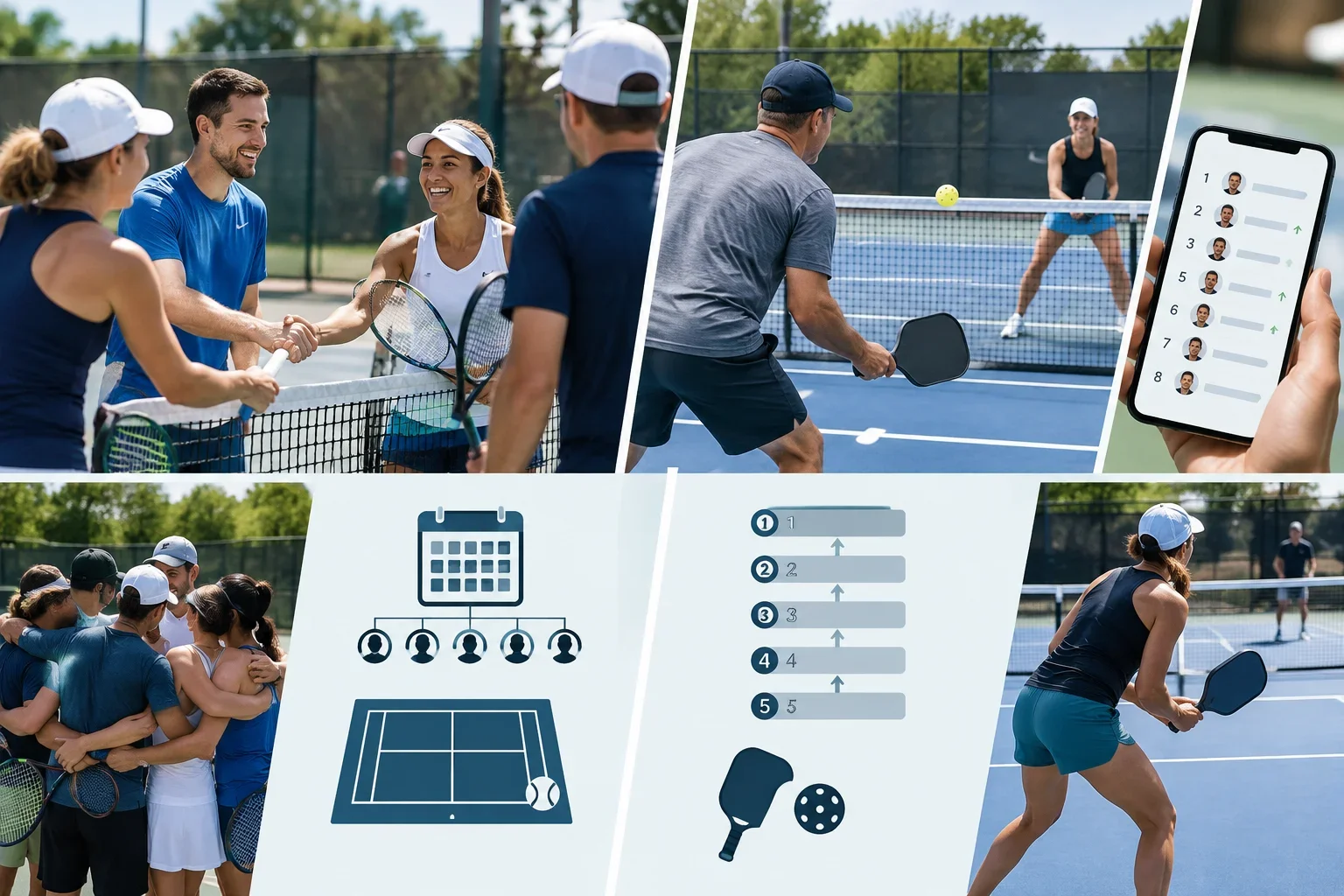
Image credit: ChatGPT
Every tennis and pickleball player eventually hits the same wall. You love the game, and you’re improving, but finding good, regular matches is harder than it should be. Open play is a gamble: some days you get competitive games, and other days you spend an hour waiting or playing someone far above or below your level. Texting the same three friends works until someone’s schedule changes.
Organized play solves this, and most players pick from two formats: leagues and ladders. Both give you regular, meaningful matches, but they work very differently and suit different people. Whether you prefer singles or doubles depends on which one works better for you.
This guide covers what leagues and ladders are, how they compare, how singles and doubles change the picture, and how to decide which one to join.
What Is a League?
A league is a structured competition with a defined season, a set schedule, and divisions organized by skill level. You know ahead of time when you’re playing, roughly who you’re playing, and what you’re playing for.
Common league formats
Team leagues are the most familiar format, especially in tennis. In USTA leagues, for example, players join a team at a specific rating level. Each team match is made up of several individual matches, called “lines.” A typical adult match might include two singles lines and three doubles lines, and the team that wins the most lines wins the match. Pickleball team leagues are growing quickly through clubs, recreation centers, and private facilities, and many use a similar multi-line structure.
Individual or flex leagues drop the team element. You’re placed in a division with other players at your level, play a round-robin schedule over the season, and are ranked by wins, sets, or games won. Many flex leagues let you schedule each match with your opponent within a weekly or biweekly window.
Rating-based divisions hold most leagues together. Tennis leagues usually use NTRP ratings (2.5, 3.0, 3.5, 4.0, and so on), and some use UTR. Pickleball leagues typically group players by DUPR rating or by self-rated skill brackets such as 3.0, 3.5, and 4.0+. The aim is for every match to be competitive.
How a league season works
Most league seasons run 6 to 12 weeks. Matches are scheduled for specific dates and times, often at a home facility. At the end of the regular season, the top teams or players usually move on to playoffs. In some systems, such as USTA, winning local playoffs can lead to sectional, regional, and even national championships.
What it feels like
A league feels like being on a team, even if you’re competing as an individual. There’s accountability, because people are counting on you to show up. There’s game-day energy and a chance to build friendships over a season. For many players, the social side is the main draw: post-match drinks, team group chats, and cheering for teammates on the next court.
What Is a Ladder?
A ladder is an ongoing ranking system. Players are listed from top to bottom, and you move up by challenging and beating the people ranked above you. It’s simple, flexible, and runs entirely on your own initiative.
How a typical ladder works
The details vary, but most challenge ladders follow similar rules:
- Players are ranked in order, from #1 down to the bottom of the list.
- You can challenge players within a set range above you, often up to three or four spots higher.
- If you win, you move up. In many ladders you take the defeated player’s position and everyone in between shifts down one spot.
- If you lose, you stay where you are, or in some formats drop slightly.
- Matches are self-scheduled. You and your opponent agree on a time and place, usually within a deadline such as 7 to 10 days after the challenge is issued.
- Declining or ignoring challenges usually has consequences, such as a forfeit or a drop in rank, which keeps the ladder moving.
Ladder variations
Not every ladder is a classic challenge ladder:
- Points-based ladders award points for wins, with bonus points for beating higher-ranked players and sometimes just for playing. Rankings follow total points, which rewards both skill and activity.
- Box or pyramid ladders put players into small groups (boxes) of four to six. Everyone in a box plays each other over a set period. The top finishers move up a box and the bottom finishers move down.
- Rolling vs. seasonal ladders: some ladders run indefinitely, while others reset every season so newcomers have a fresh shot at the top.
What it feels like
A ladder feels personal. You control when you play, who you challenge, and how hard you push. Your ranking gives you a clear, visible measure of progress, and climbing past someone who beat you two months ago is very satisfying. A ladder also asks more of you: if you don’t send challenges and schedule matches, you won’t play much.
Leagues vs. Ladders: Key Differences
Here’s a side-by-side comparison:
| Factor | League | Ladder |
|---|---|---|
| Scheduling | Fixed dates and times | Self-scheduled and flexible |
| Commitment | High; your team or division is counting on you | Low to moderate; you set the pace |
| Duration | Defined season with a clear finish | Ongoing or rolling seasons |
| Competition style | Team- or division-based | Individual climb up the rankings |
| Opponent choice | Set by the schedule | You choose, within the challenge rules |
| Social element | Strong team bonding | Varies; depends on how active you are |
| Pressure | Team stakes, standings, playoffs | Personal stakes |
| Cost | Often registration, team, or court fees | Usually low cost or free |
| Skill matching | Controlled by rating divisions | Self-corrects over time as players settle into their level |
| Best for | Structure lovers and social players | Busy schedules and self-starters |
The biggest differences come down to structure versus flexibility and team versus individual. A league gives you a schedule and a group and asks you to show up. A ladder gives you a framework and asks you to make the most of it.
Singles vs. Doubles: How Format Changes Everything
Whether you prefer singles or doubles has a big effect on which format suits you. Some formats are built around one-on-one play and struggle with four players. Others are built for doubles and offer limited singles opportunities.
Singles in leagues and ladders
Ladders and singles are a natural match. A ladder is about individual ranking, and singles is about individual performance. There’s no question about who deserves credit for a win or who should move up. Scheduling is also as easy as it gets: you only need to coordinate with one other person.
In leagues, singles spots are limited. In many tennis team formats there are fewer singles lines than doubles lines, often two singles matches versus three doubles matches. Captains usually give those spots to their fittest and most consistent players, so singles players may compete for playing time. Singles also demands more physically. You cover the whole court yourself, and a long three-setter is a real workout.
Tennis and pickleball differ a lot here. Singles is a central, respected part of tennis at every level, and many tennis ladders are singles-only. In recreational pickleball, singles is much less common. Most players stick with doubles, so pickleball singles ladders and leagues tend to be smaller and draw a more competitive, athletic crowd. If you love pickleball singles, a ladder may be one of the best ways to find regular opponents.
Doubles in leagues and ladders
Leagues and doubles are a natural match. Team leagues are built around doubles. Captains can mix partners, build lineups around strengths, and give more players court time each week. If you mainly play doubles, a league is usually the easiest way to get consistent, well-organized matches.
Doubles ladders are more complicated. The key design question is whether the ladder ranks teams or individuals.
- Fixed-partner ladders rank pairs. You and your partner climb (or fall) together. This builds chemistry and rewards teams that train together. The drawback is dependency: if your partner is injured, traveling, or loses interest, your ladder season stalls.
- Individual doubles ladders rotate partners and rank players individually. These are very popular in pickleball as “round-robin ladders,” “ladder nights,” or “king/queen of the court” sessions. Players rotate partners each round, earn individual points for games won, and move up or down courts based on results. You meet a lot of players, and nobody is stuck with one partner.
Scheduling gets harder with doubles. A singles ladder match needs two calendars to line up, and a doubles match needs four. Many doubles ladders avoid this by running at a set weekly time, such as a Tuesday-night ladder session, which makes them work more like a hybrid of a ladder and a league.
Pickleball is doubles-first. Because doubles dominates recreational pickleball, most pickleball leagues and ladders are designed around it, and mixed doubles is especially popular. If you’re joining a pickleball program, expect doubles to be the default.
Mixed doubles
Mixed doubles has its own place in both sports. Many tennis leagues run separate mixed seasons with combined-rating rules. A 7.0 mixed division, for example, might allow a 3.5 man with a 3.5 woman, or a 4.0 with a 3.0. That opens up strategic partner pairing: do you team up with a partner at your level, or pair a stronger and a developing player? In pickleball, mixed doubles is often run as its own bracket or ladder night and is one of the most social formats in either sport.
How format affects your ranking and rating
Doubles results reflect a partnership, not just your own skill. A strong partner can lift you up the standings, and a mismatched pairing can hold back a talented player. That’s one reason individual rotating-partner ladders are popular: over many rounds with different partners, your true level shows.
Rating systems handle this differently too. Some track singles and doubles separately, and some combine them. DUPR, for example, maintains separate singles and doubles ratings, and NTRP league ratings can reflect your results across formats. If improving your rating is a goal, find out which matches count toward which rating and pick formats accordingly.
Should You Join a League or a Ladder?
There’s no single right answer, but your schedule, your personality, and your preferred format will usually point you in a clear direction.
Join a league if you:
- Want a set weekly schedule. You like knowing that Thursday at 7 p.m. is tennis or pickleball night.
- Enjoy being part of a team. Shared goals, group chats, and post-match hangouts appeal to you.
- Are motivated by standings and playoffs. A championship push gets you out of bed.
- Mainly play doubles, especially in tennis, where leagues are built around it.
- Want rating-matched competition from day one, without waiting for a ladder to sort itself out.
Join a ladder if you:
- Have an unpredictable schedule. Shift work, travel, or family commitments make fixed weekly matches hard.
- Prefer singles, or want to control who and when you play.
- Want to track your individual progress. Your ranking is a scoreboard for your improvement.
- Are new to an area and want to meet many players quickly. Ladders are one of the fastest ways to build a tennis or pickleball network.
- Want a low-cost, low-pressure start to competitive play before committing to a full league season.
Why not both?
Many players do both, and they work well together. A league gives you structured team play and a regular social outlet. A ladder fills the gaps with extra matches on your own schedule. Ladders are also great between league seasons to keep you sharp, and they’re a good place to practice singles if your league role is mostly doubles.
A quick decision checklist
- Can you commit to a fixed weekly time?
Yes → a league is a great fit. No → start with a ladder. - Do you prefer singles or doubles?
Singles → a ladder is the easier fit. Doubles → a league, or a rotating-partner ladder. - Are you motivated by a team or by yourself?
A team → league. Yourself → ladder.
If your answers are mixed, try one of each and see which you look forward to more.
Tips for Success in Either Format
Get an accurate rating. Proper placement makes everything better. Playing too far above your level is discouraging. Playing below it (“sandbagging”) is unfair to others and won’t help you improve.
Communicate promptly. The most common complaint in any ladder is slow responses to challenges. Reply quickly, offer several time options, and confirm the court and time ahead of the match. In leagues, tell your captain early if you can’t make a match.
Know the rules. Learn the challenge range, scheduling deadlines, and forfeit policy for your ladder, plus the scoring format for your league. Many leagues use no-ad scoring or a match tiebreak in place of a third set, and that changes your strategy.
Report scores right away. Rankings and standings only work if results are entered promptly and accurately.
Practice good sportsmanship. In tennis, make fair line calls and give the benefit of the doubt on close balls. In pickleball, call your own kitchen faults. Your reputation travels quickly in a local playing community.
Get on the same page with your doubles partner. Talk strategy before the match: who covers the middle, who takes lobs, and whether you’ll stack in pickleball or play I-formation in tennis. A little planning can be worth several games.
Common Mistakes to Avoid
- Joining the wrong level. Be honest about your skill. If you’re unsure, ask the organizer or a coach.
- Overcommitting. Signing up for three leagues and a ladder sounds fun until you’re forfeiting matches and letting teammates down.
- Ignoring ladder deadlines. Missed challenge windows often mean forfeits and lost ranking. Stay on top of your notifications.
- Choosing a doubles partner for convenience. Pick someone whose game, schedule, and commitment level fit yours, not just whoever is available.
- Treating rank as the only measure of improvement. Rankings go up and down. Pay attention to how your game is developing, too: your serve, your consistency, your decision-making.
The Bottom Line
Leagues and ladders both turn casual play into regular, meaningful competition, and both are among the best ways to improve and meet players in your area.
Leagues give you structure, accountability, and community. They’re ideal if you like a set schedule, enjoy being on a team, and play mostly doubles. Ladders give you flexibility and a clear measure of individual progress. They’re ideal if your schedule is unpredictable, you prefer singles, or you’re motivated by climbing the rankings.
Your choice of singles or doubles often settles the question: singles players tend to do well on ladders, and doubles players tend to do well in leagues. Many of the happiest players do both.
Ready to get on the court? Browse leagues and ladders in your area on LetsPlayTennis.com and find your next match today.
Frequently Asked Questions
Can beginners join a ladder?
Yes. Many ladders welcome newer players, and some run separate beginner or lower-level ladders. Because you choose your challenges, you can start at the bottom and climb at your own pace.
How long does a ladder match take?
It depends on the format. A best-of-three-sets tennis match can take 1.5 to 2 hours. Many ladders shorten things with a match tiebreak in place of a third set. Pickleball ladder matches are usually much shorter, often one or two games to 11.
Do I need a partner to join a doubles league?
Not always. Many team leagues assign partners from the team roster, and rotating-partner ladders don’t require a set partner at all. Fixed-partner ladders and some doubles leagues do require you to register as a pair.
What happens if I can’t make my scheduled league match?
Tell your captain or league coordinator as early as possible. Most leagues allow substitutes or rescheduling within limits, but repeated no-shows can lead to forfeits and hurt your team.
Can I play in a league and a ladder at the same time?
Yes, and many players do. The ladder gives you extra, flexible matches, and the league provides structure and team play. Just make sure your schedule can handle both.
Comments
No approved comments yet.
Log in or sign up to join the conversation.