
Pickleball 101: The Complete Beginner’s Guide to Rules, Scoring, and History
Learn pickleball’s history, serving and kitchen rules, singles and doubles scoring, and how it differs from tennis, table tennis, and badminton.
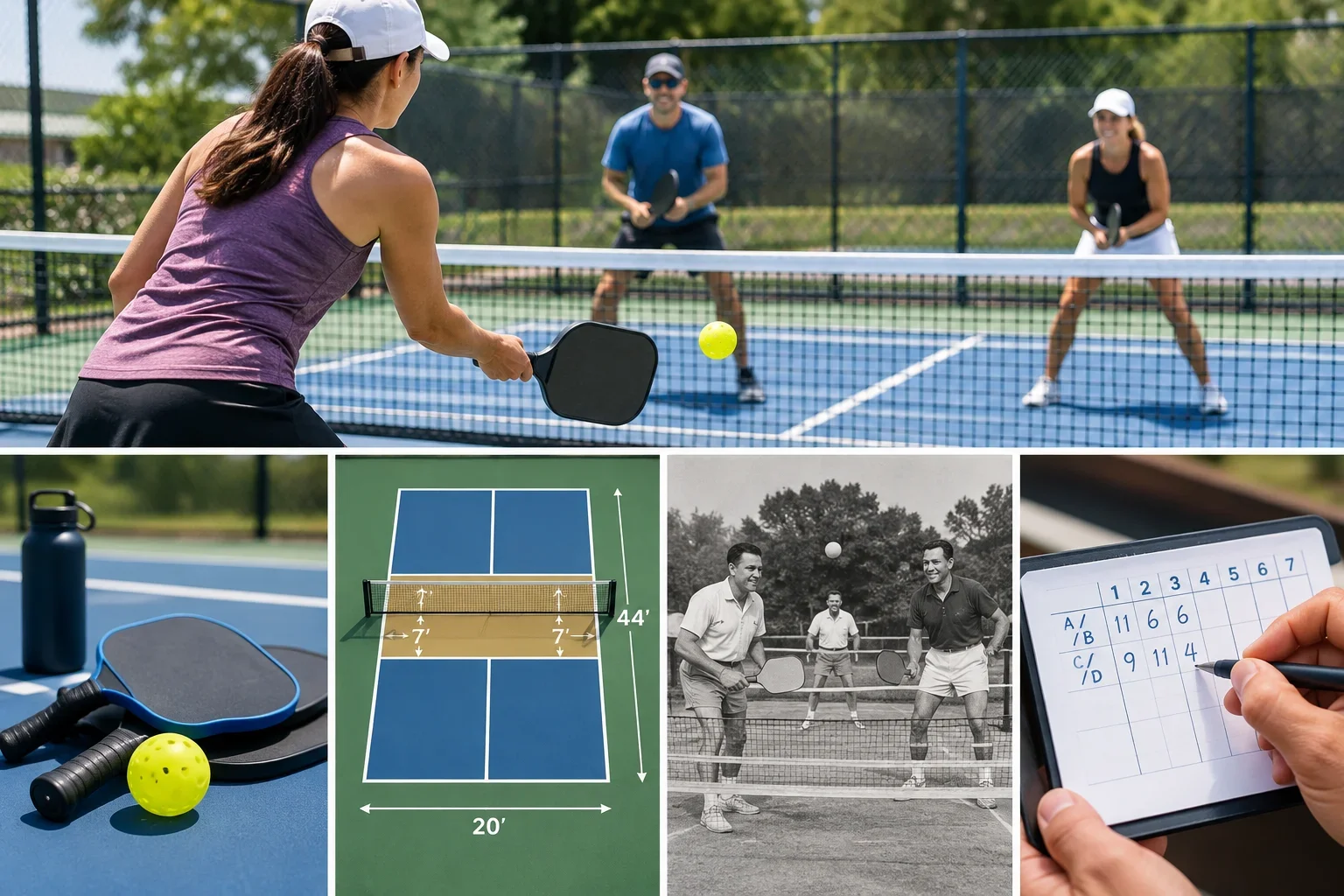
Image credit: ChatGPT
Pickleball is a paddle sport played on a compact court with a perforated plastic ball and a low net. It combines elements familiar to tennis, table tennis, and badminton players, but its serving, scoring, and non-volley-zone rules give it a character of its own.
This beginner’s guide covers where pickleball came from, what you need to play, how a rally works, and how to keep score. It focuses on traditional side-out scoring—the format many beginners encounter first—while explaining why you should confirm the scoring format before starting.
What Is Pickleball?
Pickleball can be played as singles, with one player on each side, or doubles, with two. Players use solid-faced paddles to hit the ball over the net, aiming to keep it within the opposing court and prevent opponents from returning it legally.
A pickleball court measures 20 feet wide by 44 feet long for both singles and doubles. The net is 36 inches high at the sidelines and 34 inches at the center. On each side of the net is a 7-foot-deep non-volley zone, commonly called the kitchen.
The court also has right and left service areas behind the kitchen. Serves travel diagonally into the opposite service area.
A Brief History of Pickleball
Pickleball began in 1965 on Bainbridge Island, Washington. Joel Pritchard and Bill Bell started improvising a game using a badminton court, paddles, and a perforated plastic ball. Barney McCallum subsequently helped develop the game and its equipment.
What started as a family activity developed into a sport with standardized courts, equipment, and rules. Today, pickleball is played in recreation centers, parks, dedicated clubs, and competitive events.
Accounts of the name’s origin differ. A commonly cited explanation connects it to a rowing “pickle boat,” whose crew is assembled from leftover rowers. Another popular story attributes the name to a family dog. Because those accounts conflict, the dog story is best treated as a disputed anecdote rather than settled history.
What You Need for Your First Game
Start with a paddle, a suitable ball, and a clearly marked court. Check the facility’s open-play policy and bring water. Ask an experienced player or coach to introduce serving, scoring, and the non-volley zone. Tennis experience does not determine a pickleball rating.
- Paddle: Choose a comfortable grip and a paddle you can control. Expensive equipment is not necessary to learn.
- Ball: Use a pickleball appropriate for the playing conditions. Indoor and outdoor balls commonly differ in hole design and performance.
- Shoes: Court shoes designed for lateral movement are generally a better choice than running shoes.
- Court and net: Use regulation markings and net height when possible. A temporary setup can work if the playing surface and surrounding space are safe.
Warm up before playing, check for wet or slippery areas, and leave enough space around the court to move safely.
How a Pickleball Rally Works
- The server sends the ball diagonally into the opposite service court.
- The receiver lets the serve bounce before returning it.
- The serving team lets that return bounce before hitting it.
- After those two required bounces, either side may hit the ball after a bounce or volley it, subject to the kitchen rules.
- The rally ends when a player commits a fault.
This sequence is called the two-bounce rule. It means one bounce on each side at the beginning of the rally—not two bounces on the same side.
Pickleball Serving Rules
Where to Stand and Aim
Serve from behind the baseline into the diagonally opposite service court. At contact, at least one foot must be on the playing surface behind the baseline. Your feet must not touch the baseline, the court, or the area outside the imaginary extensions of the sideline and centerline.
The serve must clear the kitchen and its boundary line. A serve that touches the non-volley-zone line is a fault. Other lines bounding the correct service court are in.
Volley Serve and Drop Serve
Two serving methods are available:
- Volley serve: Strike the ball before it bounces. Your arm must move in an upward arc, contact must be no higher than your waist, and the highest point of the paddle head must not be above the highest part of your wrist at contact.
- Drop serve: Release the ball and strike it after it bounces. Do not propel the ball downward or throw it upward to create the bounce. The volley serve’s upward-motion, waist-height, and paddle-position restrictions do not apply to a legal drop serve.
There is generally one serve attempt, not a tennis-style second serve. A serve that touches the net and lands legally remains in play; it is not automatically replayed.
The Kitchen: What You Can and Cannot Do
The kitchen is a non-volley zone, not a no-entry zone. A volley is a shot struck before the ball bounces.
- You may enter the kitchen to play a ball that has bounced.
- You may not volley while touching the kitchen or its boundary line.
- A volley is also a fault if your momentum carries you—or anything you are wearing or carrying—into the kitchen, even after the ball becomes dead.
- After being in the kitchen, you must reestablish both feet completely outside it before volleying.
You do not have to leave the kitchen immediately after hitting a bounced ball. However, recovering to a balanced position outside it usually makes you better prepared for the next shot.
Common Faults and Line Calls
A fault ends the rally. Common examples include:
- Hitting the ball out of bounds or failing to send it over the net.
- Allowing the ball to bounce twice before returning it.
- Volleying before the two-bounce rule has been satisfied.
- Committing a kitchen violation.
- Serving into the wrong service court or onto the kitchen line.
- Touching the net or its supporting system while the ball is live.
Except for the kitchen line on a serve, a ball touching a court boundary line is in. During rallies, the kitchen line is not an out-of-bounds line.
In self-officiated play, make line calls promptly and give opponents the benefit of doubt. If you cannot clearly determine that the ball was out, treat it as in.
How Traditional Pickleball Scoring Works
In traditional side-out scoring, only the serving side can score. A common game is played to 11 points, with a two-point winning margin. Events may use other target scores, so agree on the format before playing.
Doubles: Why the Score Has Three Numbers
The doubles score is announced as serving team’s score, receiving team’s score, server number. For example, “4–2–1” means the serving team has four points, the receiving team has two, and the first server of that service turn is serving.
The server number identifies the first or second server in the current service turn. It is not a permanent label for either player.
- The game starts at 0–0–2. The opening team gets only one server before its first side out.
- The opening server serves from the right-hand court.
- When the serving team wins a rally, it scores a point. The server switches sides with their partner and serves again.
- When that server loses a rally, service normally passes to the partner. The exception is the opening service turn, when it passes directly to the opponents.
- When the second server loses a rally, a side out occurs: the opponents take over serving.
At the beginning of each new team service turn, the player positioned on the right serves first. Partners do not switch sides simply because they win a rally while receiving.
A Simple Doubles Scoring Example
Team A begins at 0–0–2. Its server wins a rally, so the score becomes 1–0–2 and that server moves to the left to serve. If Team A then loses the rally, Team B takes over. Team B’s player on the right serves at 0–1–1.
Singles Scoring
Singles uses two numbers: the server’s score followed by the receiver’s score. Serve from the right when your score is even and from the left when it is odd. When the server loses a rally, the opponent becomes the server.
What About Rally Scoring?
Rally scoring awards a point on each rally rather than only to the serving side. It is used in some pickleball formats, but service procedures and end-of-game provisions can depend on the rules being used. Confirm whether your group or event uses traditional side-out scoring or a specific rally-scoring format.
How Pickleball Differs from Tennis, Table Tennis, and Other Sports
Key differences between pickleball and related sports| Sport | What feels familiar | Key differences |
|---|---|---|
| Tennis | Groundstrokes, volleys, court positioning, and doubles teamwork. | Pickleball has a smaller court, solid paddles, a plastic ball, a kitchen, and two required opening bounces. Its traditional scoring is not tennis scoring. |
| Table tennis (ping-pong) | Paddle control, reactions, placement, and spin awareness. | Pickleball is played on a court rather than a table. Players move around that court, and the serve and volley rules are different. |
| Badminton | The court dimensions and diagonal service pattern are familiar. | Pickleball uses a bouncing ball and a low net, rather than a shuttlecock and a high net. |
| Padel | Doubles tactics and solid-faced paddles. | Padel is played on an enclosed court where walls are part of play. Pickleball does not use rebound walls. |
Experience in another racket sport can help with anticipation and coordination, but pickleball’s rules and positioning still require practice. In particular, tennis players need to resist volleying the return of serve before it bounces.
Beginner Shots and Simple Tactics
- Serve: Start with a repeatable, legal motion and aim comfortably inside the service court.
- Return: Let the serve bounce, then aim for a controlled return with enough depth to keep opponents back.
- Dink: A soft shot intended to land in the opponent’s kitchen, encouraging an upward reply rather than an easy attack.
- Volley: A shot taken before the bounce. Practice compact swings from a legal position outside the kitchen.
- Third-shot drop: A soft third shot aimed into the kitchen. It can help the serving team advance, but beginners should first prioritize consistency.
In doubles, communicate about middle balls and move with your partner rather than leaving a large gap between you. Advance toward the kitchen line when it is safe, but stop and get balanced before your opponent hits.
A Practical Plan for Your First Session
- Warm up and rally gently to learn how the ball bounces.
- Practice serves and diagonal returns.
- Play short rallies using the two-bounce rule.
- Practice hitting bounced balls in the kitchen and volleying from outside it.
- Play a game with an experienced player helping announce the score.
Before joining open play, ask how players rotate onto courts and whether games are grouped by experience. If a ball rolls onto another court, warn the players rather than entering during their rally.
Beginner FAQs
Can You Stand in the Kitchen?
Yes. Being in the kitchen is not itself a fault. The restriction concerns volleying and the momentum associated with a volley.
Can You Volley a Serve?
No. The receiver must let the serve bounce. The serving side must also let the return bounce before hitting it.
Does the Receiving Team Score When It Wins a Rally?
Not in traditional side-out scoring. Winning a rally while receiving changes the server or produces a side out. Rally-scoring formats work differently.
Is Pickleball Easier Than Tennis?
Many beginners find it approachable because the court is smaller and they can begin with modest swings. That does not make advanced pickleball simple: placement, patience, movement, and decision-making remain important.
Related Topics for Your Next Step
This guide provides a pillar-page structure: basics and history, equipment, rules, scoring, sport comparisons, and first-session advice. Useful companion articles can explore each area in greater depth:
- Pickleball Scoring Explained: Worked doubles examples, serving positions, the opening-server exception, and practice scenarios.
- Kitchen Rules Without the Confusion: Legal entry, volley momentum, boundary lines, and common situations.
- How to Choose Your First Pickleball Paddle: Grip fit, manageable weight, control, budget, and equipment approval.
- Pickleball for Tennis Players: Transferable skills, positioning changes, compact strokes, and habits to unlearn.
- Your First Open-Play Session: Court rotation, communication, safety, line calls, and beginner etiquette.
Where to Check the Official Rules
Rules and competition formats can change. For the current rulebook and detailed guidance, consult USA Pickleball’s official rules. For organized play, also check the event’s published format and any applicable local procedures.
Comments
No approved comments yet.
Log in or sign up to join the conversation.