
Pickleball vs. Tennis: What Tennis Players Need to Know Before Picking Up a Paddle
A guide for tennis players trying pickleball, covering equipment, rules, transferable skills, habits to change, strategy, etiquette, and a first-month plan.
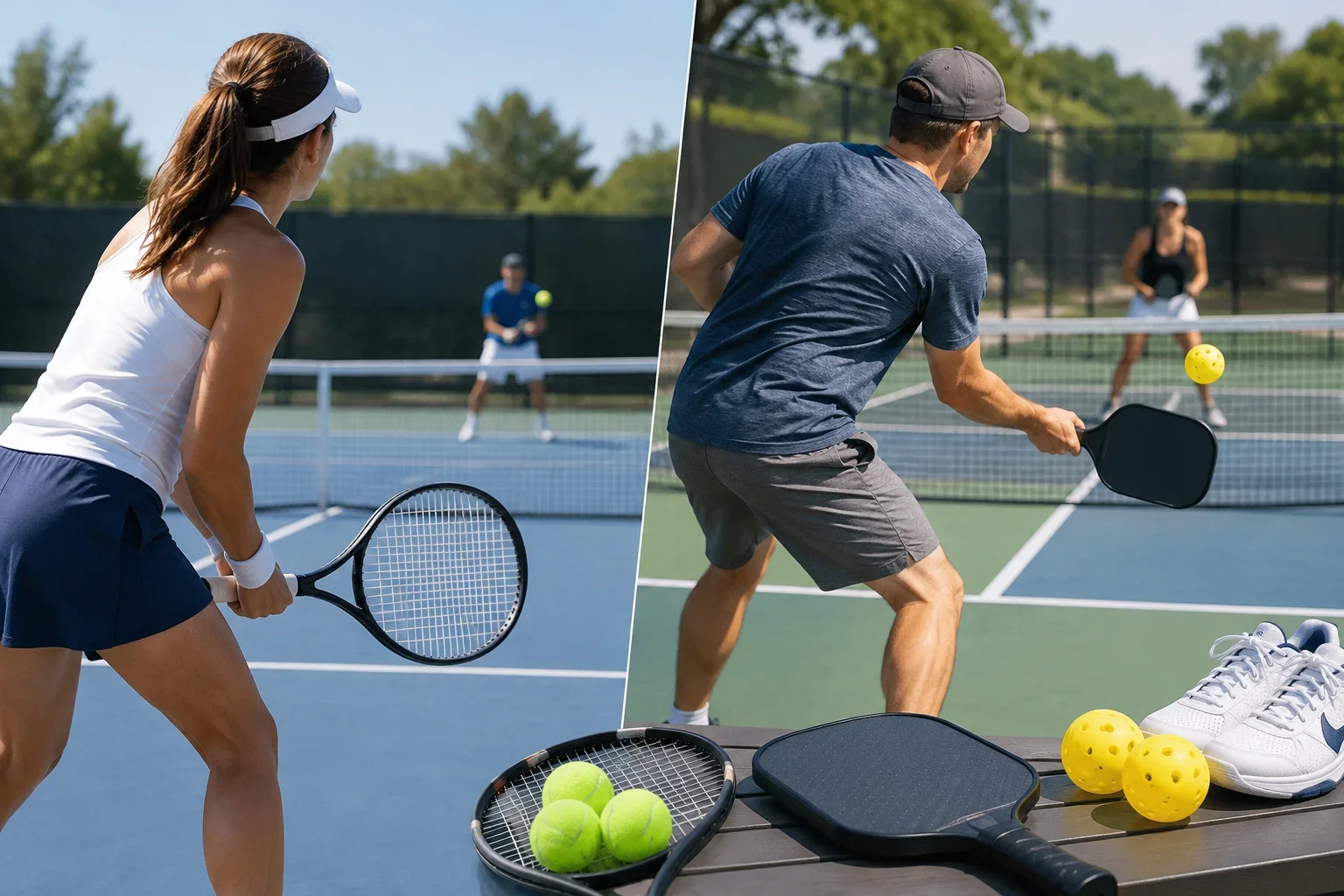
Image credit: ChatGPT
Your tennis friends keep disappearing on Saturday mornings. When they come back, they talk about “dinks,” “the kitchen,” and “third-shot drops.” Then the invitation arrives: “You should come play pickleball with us. You’ll be great at it.”
They’re partly right. Tennis players have a real head start in pickleball. You already have the hand-eye coordination, footwork, volleying instincts, and doubles sense that it takes newer athletes years to develop. Most tennis players can rally comfortably on day one.
But pickleball isn’t “mini tennis.” The court is smaller, the ball is slower, the rules are different, and several habits that serve you well in tennis will cost you points on a pickleball court. The players who make the switch smoothly are the ones who know what transfers and what to unlearn.
This guide covers the key differences, the advantages you bring, the habits to change, and a simple plan for getting good quickly.
Pickleball in a Nutshell
Pickleball was invented in 1965 on Bainbridge Island, Washington, as a backyard game for families. Nearly six decades later, it’s one of the fastest-growing sports in the United States, with millions of players and courts appearing in parks, clubs, and converted tennis facilities nationwide.
The basic idea is simple: two or four players use solid paddles to hit a perforated plastic ball over a low net on a small court. Doubles is the most common format, especially in recreational play.
Why are so many tennis players adding pickleball to their week?
- It’s easier on the body. Less running and a smaller court mean less wear on knees, hips, and shoulders.
- It’s social. Open-play sessions rotate players constantly, so you meet many people quickly.
- It’s accessible. Courts are often easier to find, games are shorter, and you can usually just show up and play.
- It’s competitive fast. Tennis players can enjoy real competitive games within weeks rather than years.
The Equipment: Paddle vs. Racket, Ball vs. Ball
The paddle
The first thing you’ll notice is that the paddle has no strings. Its solid face, usually a composite or carbon-fiber surface over a polymer honeycomb core, doesn’t “pocket” the ball the way strings do. That means less natural spin and less margin for error on off-center hits.
Paddles are also much shorter and lighter than rackets. Rules limit paddles to a maximum length of 17 inches, with length plus width no more than 24 inches. Hitting with a paddle feels a bit like hitting with a tennis racket gripped up at the throat: quicker in your hands, but with less reach and leverage.
When shopping for your first paddle, consider:
- Weight: Midweight paddles (roughly 7.5–8.3 oz) balance power and control well.
- Grip size: Tennis players often like a slightly larger grip, but a smaller grip allows more wrist flexibility for touch shots.
- Core thickness: Thicker cores (around 16 mm) give more control and a softer feel, which helps tennis players learn the soft game.
- Surface texture: Textured faces help generate spin.
The ball
A pickleball is a hollow plastic ball with holes. Outdoor balls typically have around 40 smaller holes and are harder. Indoor balls have around 26 larger holes and are softer.
Compared to a tennis ball, a pickleball:
- Moves more slowly through the air
- Bounces lower and “deader”
- Is more affected by wind
- Doesn’t respond to spin quite the same way
Expect your timing to be off for the first few sessions. Your instincts are calibrated for a ball that bounces higher and arrives faster, so you’ll often swing early.
Shoes
Good news: your tennis shoes are perfect. Court shoes provide the lateral support pickleball demands. Avoid running shoes, which are designed for forward motion and increase the risk of rolled ankles.
The Court: Smaller, Closer, Faster Exchanges
A pickleball court is 20 feet wide by 44 feet long, and the same dimensions are used for singles and doubles. A tennis doubles court is 36 by 78 feet. About four pickleball courts fit on one tennis court, which is why so many tennis facilities are adding pickleball lines.
The net is also lower: 36 inches at the sidelines and 34 inches at the center, compared to 42 inches and 36 inches in tennis.
The most important feature on the court, and the one with no tennis equivalent, is the non-volley zone, better known as “the kitchen.” It’s a 7-foot area on each side of the net, and it shapes the entire game. More on that next.
Rules That Trip Up Tennis Players
The serve
Forget everything you know about serving. In pickleball:
- The serve must be underhand. For a traditional volley serve, you must contact the ball below your waist, with your arm moving in an upward arc and the paddle head below your wrist.
- The drop serve is an alternative. You can drop the ball from your hand and hit it after it bounces, with fewer restrictions on your motion. Many tennis players find this easier at first.
- You serve diagonally, and the ball must land beyond the kitchen in the opponent’s service court.
- There’s no second serve. If you miss, you lose your serve.
- Lets are played. If the serve clips the net and lands in, play continues.
The serve is not a weapon in pickleball the way it is in tennis. A consistent, deep serve is far more valuable than a hard one.
The two-bounce rule
This rule surprises nearly every tennis player. The return of serve must bounce, and the third shot (the serving team’s first shot after the return) must also bounce. Only after those two bounces can players volley.
The two-bounce rule eliminates serve-and-volley. If you serve and charge the net like it’s 1985 Wimbledon, you’ll be out of position when the return comes back, and you can’t volley it anyway.
The kitchen rules
The non-volley zone is where most beginner faults happen:
- You can’t volley while standing in the kitchen or touching the kitchen line. The line is part of the kitchen.
- Momentum counts. If you volley outside the kitchen and your follow-through carries you into it, even after the ball is dead, it’s a fault.
- You can enter the kitchen to play a ball that has bounced. You just can’t volley from there.
The kitchen exists to stop players from camping at the net and smashing everything. It forces a slower, more strategic game at the net, which is where pickleball’s unique skills come in.
Scoring
Traditional pickleball uses side-out scoring:
- Only the serving team can score points.
- Games are typically played to 11, win by 2.
- In doubles, both partners serve before the serve passes to the other team, except at the very start of the game, when only one partner serves.
The score is called as three numbers in doubles: the serving team’s score, the receiving team’s score, and the server number (1 or 2). Games begin at “0-0-2” because the first serving team gets only one server on the opening possession. Every new player finds this confusing, and everyone figures it out within a few games.
Some formats, including certain professional and league play, now use rally scoring, where a point is scored on every rally regardless of who served. It’s worth knowing about, but most recreational games still use side-out scoring.
There’s no love, deuce, advantage, or sets in most rec play. Games are short, and you’ll play many of them in a session.
Line calls
A ball that touches any line is in, with one important exception: a serve that lands on the kitchen line is out. As in tennis, each team calls the lines on its own side, and the benefit of the doubt goes to the opponent.
What Transfers from Tennis: Your Advantages
You’re not starting from scratch. Tennis players bring several valuable skills:
- Hand-eye coordination and reading the ball. You’ll track the ball, judge depth, and make clean contact from the start.
- Volleys and net play. Much of pickleball is played at the net, so your volley technique and quick hands are a huge asset.
- Footwork and the split step. Ready position, quick lateral movement, and timing your split step all carry over directly.
- Doubles strategy. Moving with your partner, covering the middle, and poaching all apply.
- A competitive mindset. You understand point construction, playing under pressure, and reading opponents’ tendencies.
- Overheads. When an opponent lobs, your tennis overhead will usually end the point.
Many tennis players reach an intermediate level of pickleball within a few weeks. The challenge is the next step.
What to Unlearn: Tennis Habits That Hurt You
The same instincts that make you a good tennis player can hold you back in pickleball. Watch out for these:
Big backswings and full follow-throughs. At the kitchen line, the ball arrives in a fraction of a second. Long tennis strokes leave you late. Keep your swings compact, especially at the net.
Hitting hard from the baseline. Power from the back of the court is far less effective in pickleball. The slower ball gives opponents at the net time to react, and a hard ball that stays high is easy for them to put away.
Staying back. In tennis, the baseline is home base. In pickleball, it’s a defensive position you want to leave as soon as possible. The team that controls the kitchen line usually wins the point.
Heavy topspin groundstrokes. Topspin has its place, but the solid paddle face and low bounce make big, looping swings riskier. Many tennis players net ball after ball until they flatten out their strokes.
Thinking of the serve as a weapon. An underhand serve won’t produce many aces. Focus on depth and consistency, and save your aggression for later in the point.
Too much wrist. The short game rewards a firm wrist and soft hands. Flicking at the ball leads to pop-ups that get attacked.
Rushing the net after serving. The two-bounce rule makes this a losing strategy. Stay back after your serve, let the return bounce, and work your way forward.
Lobbing too often. Lobs can work, but on a small court against opponents who move well, a short lob is an easy smash. Use them sparingly and with disguise.
Treating every ball as a putaway. Hitting hard at opponents (often called “banging”) is legal and part of the game, but in recreational play, constantly firing at less experienced players can come across as poor etiquette. Read the room.
The Shots That Make Pickleball Different
To get past the intermediate plateau, you’ll need to learn shots that have no real equivalent in tennis.
The dink
A dink is a soft shot hit from near the kitchen line that arcs over the net and lands in your opponent’s kitchen. Because the ball lands in the non-volley zone, your opponent can’t attack it in the air and must let it bounce, then hit up on it. Dink rallies are where much of high-level pickleball is decided. Patience, placement, and waiting for your opponent to pop the ball up are the keys.
The third-shot drop
Because of the two-bounce rule, the serving team starts the point stuck at the baseline while the returning team moves forward to the kitchen line. The third-shot drop is the solution: a soft, arcing shot from the baseline that lands in the opponent’s kitchen, giving you time to move forward. It’s widely considered the most important and hardest shot in pickleball to master.
The reset
When an opponent hits hard at you while you’re out of position, a reset absorbs that pace and softly drops the ball back into the kitchen. This neutralizes the attack. Think of it as a tennis block volley with even softer hands.
The drive
Here’s where your tennis groundstrokes help. A drive is a hard, flat or topspin shot, often used as a third shot instead of a drop. Good players mix drives and drops to keep opponents guessing.
Speed-ups and hand battles
When a dink sits up too high, players “speed up” the ball, attacking it hard at an opponent. This often triggers rapid-fire volley exchanges at the net, sometimes called hand battles. With quick reflexes and solid volleys, tennis players often shine here.
The Erne and ATP
Two advanced highlight shots are worth knowing about:
- The Erne: a player jumps over or steps around the corner of the kitchen to volley a ball close to the sideline, staying legally outside the non-volley zone.
- The ATP (Around the Post): a shot hit around the outside of the net post rather than over the net, which is legal in pickleball.
Stacking
In doubles, players normally switch sides depending on the score. Stacking is a positioning strategy that lets partners stay on their preferred sides, such as keeping both forehands in the middle, while still following the serving and receiving rules. It’s common at intermediate and advanced levels.
Strategy: Patience Beats Power
The biggest mindset shift for tennis players is this: tennis rewards aggressive shot-making, while pickleball often rewards patience and placement.
Doubles positioning
In tennis doubles, one-up, one-back is a standard formation. In pickleball, the goal is for both players to get to the kitchen line together. A team with one player back leaves a large gap and is vulnerable to balls aimed at the feet of the back player.
How a typical point unfolds
- Serve deep to keep the returning team back.
- Return deep, then move up to the kitchen line.
- The serving team hits a third-shot drop (or drive) and works its way forward.
- Both teams dink at the kitchen line, waiting for an attackable ball.
- Someone pops the ball up too high, and the other team attacks.
The soft game and the hard game
The best players balance both. They know when to stay patient with dinks and drops, and when to attack with speed-ups, drives, and overheads. Most tennis players arrive with a strong hard game and need to build the soft game.
What about singles?
Pickleball singles is much closer to tennis. There’s more running, more passing shots, and more reliance on groundstrokes and serve placement. It’s less common in recreational play, but tennis singles players often feel right at home.
Physical Demands and Injury Considerations
Pickleball involves less overall running than tennis, but it’s full of short, explosive movements: quick lateral shuffles, sudden lunges, and reaching for low balls.
It’s lower impact, which is one reason pickleball is so popular with older players and with tennis players managing joint issues. But it isn’t injury-free. Common problems include:
- Ankle sprains and falls, often from backpedaling to chase lobs
- Achilles and calf strains from sudden starts
- Wrist and elbow issues, including tennis elbow, which a stiff paddle and repetitive motion can also cause
To stay healthy:
- Warm up properly before playing, just as you would for tennis.
- Never backpedal for a lob. Turn sideways and run back, or let your partner take it.
- Choose an arm-friendly paddle. A softer core and moderate weight reduce vibration.
- Don’t overdo it at first. It’s easy to play for hours because games are short and social. Build up gradually.
Ratings, Leagues, and Playing Opportunities
Rating systems
Tennis uses NTRP and UTR. Pickleball’s most widely used rating system is DUPR (Dynamic Universal Pickleball Rating), and many recreational programs use self-rating brackets such as 3.0, 3.5, and 4.0+.
Tennis players often move up the pickleball rating scale quickly, then plateau until they develop the soft game. If you’re a 4.0 tennis player, don’t be surprised if you get to the 3.5 level in pickleball fast and then need serious work to break through to 4.0 and beyond.
Open play and paddle stacking
Recreational pickleball works very differently from booking a tennis court. At many facilities, open play is the norm: players place their paddles in a rack or line, and the next group of four takes the court when a game ends. It’s a great way to meet people and get many games in.
Leagues, ladders, and tournaments
Once you’ve learned the basics, organized play is the best way to improve. Pickleball leagues and ladders are widespread and mostly doubles-focused. If you’re deciding between them, see our guide to tennis and pickleball leagues and ladders.
Court access
Depending on your area, you may find dedicated pickleball courts, tennis courts with pickleball lines, or shared facilities with scheduled times for each sport. Be respectful of shared spaces, since tennis and pickleball players often compete for the same courts.
Pickleball Etiquette for Newcomers
Pickleball has a friendly, welcoming culture. Fit in quickly by following these unwritten rules:
- Call the score loudly before every serve so all four players are on the same page.
- Wait for the point to end before walking behind or across a court.
- Return stray balls to the court they came from, and call “ball on!” if a stray ball rolls onto your court during a point. Play stops and the point is replayed.
- Mix in at open play. Play with all levels, not just your friends or the strongest players.
- Stay humble. It’s a rite of passage for a former college tennis player to lose to a 70-year-old who dinks with perfect precision. Enjoy it, and learn from it.
Should You Play Both?
Many players enjoy both sports, and they complement each other well.
The benefits of cross-training:
- Pickleball sharpens your volleys, reflexes, hands, and touch around the net.
- Tennis builds endurance, power, and full-court movement.
- Playing both keeps things fresh and gives you more chances to get on the court.
The possible downsides:
- Switching between the two can throw off your timing for the first few minutes.
- Pickleball’s compact swings can creep into your tennis strokes, and tennis’s big swings can creep into your pickleball.
- Grip and contact-point differences take a short adjustment each time.
Tips for playing both:
- Spend a few extra minutes warming up when you switch sports.
- If you have an important tennis match, avoid a heavy pickleball session the day before, and vice versa.
- Think of each sport as having its own “mode.” Many players find the switch becomes automatic over time.
Getting Started: Your First Month
Here’s a simple plan to go from tennis player to confident pickleball player:
Week 1: Learn the basics.
Borrow or buy a beginner-friendly paddle, read up on the rules (especially serving, the two-bounce rule, the kitchen, and scoring), and join an open-play session or a beginner clinic.
Week 2: Master the start of the point.
Focus on a consistent, deep serve and return, then practice moving to the kitchen line after your return.
Week 3: Build your soft game.
Spend time drilling dinks and third-shot drops. A lesson or clinic is worth it here, because these shots are where most tennis players need help.
Week 4: Get competitive.
Get a rating, play with players at or slightly above your level, and consider joining a league or ladder to get regular, structured matches.
The Bottom Line
Tennis players have a real head start in pickleball: coordination, footwork, volleys, and doubles instincts all transfer. But the players who improve fastest are the ones who accept what makes pickleball different. That means softer hands, shorter swings, patience, and getting to the kitchen line.
Pickleball doesn’t have to replace tennis. For many players, it adds more fun, more friends, and more court time. So pick up a paddle, keep an open mind, and don’t be too proud to learn from the dinkers.
Ready to try it? Find pickleball courts, players, leagues, and ladders near you on LetsPlayTennis.com.
Quick Comparison: Pickleball vs. Tennis
| Pickleball | Tennis | |
|---|---|---|
| Court size | 20 × 44 ft (singles and doubles) | 36 × 78 ft (doubles), 27 × 78 ft (singles) |
| Net height | 36 in. sides / 34 in. center | 42 in. posts / 36 in. center |
| Equipment | Solid paddle | Strung racket |
| Ball | Perforated plastic | Pressurized felt-covered rubber |
| Serve | Underhand, one attempt | Overhand, two attempts |
| Special rules | Kitchen, two-bounce rule | None comparable |
| Scoring | Games to 11, win by 2 (usually side-out) | Points, games, and sets |
| Typical game length | 10–20 minutes per game | 1–2+ hours per match |
| Most common format | Doubles | Singles and doubles |
| Learning curve | Quick to start, hard to master | Slower to start, hard to master |
Frequently Asked Questions
Will playing pickleball hurt my tennis game?
For most players, no. Pickleball can actually improve your volleys, reflexes, and touch. You may notice a brief timing adjustment when you switch sports, and some players find their swings get a bit shorter. A proper warm-up usually solves both.
Can I use my tennis shoes for pickleball?
Yes. Tennis shoes are an excellent choice because they provide the lateral support pickleball requires. Avoid running shoes.
What’s the best paddle for a tennis player?
A midweight paddle with a thicker core is a good starting point. It offers enough power to feel familiar while giving you the control you need to develop dinks and drops. Many tennis players also prefer a slightly elongated paddle for extra reach and a more racket-like feel.
How long does it take a tennis player to get good at pickleball?
Most tennis players can play competitive recreational games within a few weeks. Reaching an advanced level takes longer, often several months or more, because it requires mastering the soft game that tennis doesn’t teach.
Is pickleball easier than tennis?
It’s easier to start. The smaller court, slower ball, and underhand serve mean beginners can rally quickly. But at higher levels, pickleball demands a lot of precision, patience, and strategy. Like tennis, it’s easy to learn and difficult to master.
Comments
No approved comments yet.
Log in or sign up to join the conversation.