
Tennis Balls Explained: Regular vs. Extra Duty, Pressureless and When to Open a New Can
Learn the difference between extra-duty, regular-duty, high-altitude and pressureless tennis balls, how long a can lasts, and which balls suit your court and level.
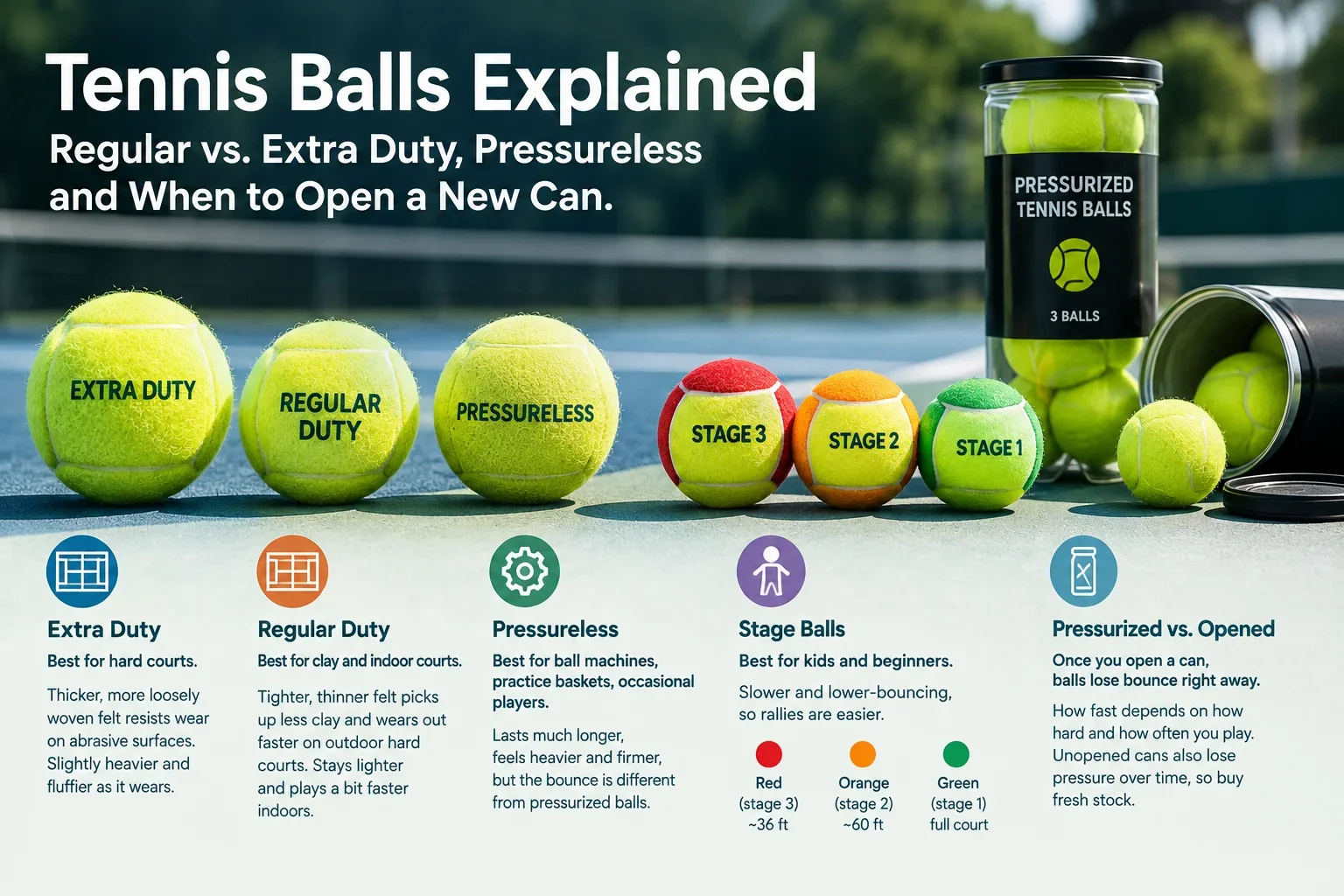
Image credit: ChatGPT
Not all tennis balls are the same. Extra-duty balls are made for hard courts, and regular-duty balls are made for clay and indoor courts. Pressureless balls last for months but feel heavier. And once you open a can of pressurized balls, they start losing bounce right away.
This guide explains the main types of tennis ball, how to choose the right one for your court and level, how long a can really lasts, and what to do with old balls.
The short answer
| Ball type | Best for | Feel and lifespan |
|---|---|---|
| Extra-duty felt | Outdoor hard courts | Thicker felt resists wear on abrasive surfaces; slightly heavier and fluffier as it wears |
| Regular-duty felt | Clay and indoor courts | Tighter felt picks up less clay; wears out quickly on outdoor hard courts |
| High-altitude | Courts above about 4,000 ft (1,200 m) | Lower internal pressure to make up for the thinner air |
| Pressureless | Ball machines, practice baskets, occasional players | Lasts much longer; feels heavier and firmer |
| Red, orange and green (stage) balls | Kids and beginners | Slower and lower-bouncing, so rallies are easier |
Extra duty vs. regular duty
The difference is the felt.
- Extra-duty balls have thicker, more loosely woven felt. On rough outdoor hard courts, regular felt wears off quickly. Extra-duty felt lasts longer. The trade-off is that it fluffs up as it wears, which slows the ball down.
- Regular-duty balls have tighter, thinner felt. On clay, they pick up less clay and stay lighter. Indoors, on smoother courts, they last fine and play a little faster.
Using regular-duty balls on outdoor hard courts isn't wrong. They just wear out faster. Using extra-duty balls on clay makes them heavy and slow as clay gets trapped in the felt. See how court surfaces change the way you play for more.
Pressurized vs. pressureless
Most tennis balls are pressurized. The hollow rubber core is filled with air at a pressure higher than the air outside. That gives a lively bounce and a soft feel. They come in sealed cans to keep the pressure in.
Pressureless balls get their bounce from a thicker, firmer rubber core instead. They don't lose bounce over time the same way, so they're common in ball machines and coaching baskets. The downsides are that they feel heavier, can be harder on your arm, and the bounce feels different from the balls you'll use in matches.
How long do tennis balls last?
Pressurized balls start losing pressure as soon as you open the can. How quickly you notice depends on how hard and how often you play.
- Competitive players often notice a difference after a single long match, and many open a new can for every match.
- Recreational players can usually use a can for a few sessions before the balls feel noticeably flat or fuzzy.
- Unopened cans also lose some pressure slowly over time, so buy fresh stock rather than a stockpile that sits for years.
A quick bounce test: drop a ball from about head height onto a hard court and compare it with a new ball. If the old one bounces noticeably lower, it's time to retire it from match play. It'll still be fine for warm-ups, drills or a ball machine.
Signs a ball is past its best:
- It feels soft when you squeeze it.
- The bounce is noticeably lower, or the ball feels "dead" off the strings.
- The felt is bald, very fluffy or caked with clay.
- It's harder to get the ball to spin or move through the air.
Balls for kids and beginners
Stage balls are slower and bounce lower, so young players and beginners can rally sooner. They follow the ITF's color system:
| Color | Speed compared with a standard ball | Typical court |
|---|---|---|
| Red (stage 3) | Much slower (often foam or a large felt ball) | Short court, about 36 ft |
| Orange (stage 2) | Slower | About 60 ft |
| Green (stage 1) | Slightly slower | Full court |
Green-dot balls are also great for adult beginners and players coming back after a long break. See Tennis Basics for more.
Approved balls for tournaments and leagues
The ITF approves balls for official competition, and they must meet standards for size, weight, bounce and deformation. Leagues and tournaments usually specify a brand or type. Check the event rules before you buy a case.
Storing and recycling
- Store cans somewhere cool. Heat speeds up pressure loss, so don't leave them in a hot car.
- Ball pressurizer tubes can slow the loss of pressure between sessions for recreational players.
- Old balls are great for drills, ball machines and dog toys.
- Some clubs and brands run recycling programs. Ask at your club or local tennis shop.
What about pickleballs?
Pickleballs are plastic balls with holes, not felt balls. Outdoor balls are usually harder, with more and smaller holes, to handle wind and rough surfaces. Indoor balls are softer, with fewer and larger holes. See Pickleball 101 for the basics.
FAQ
Why do tennis balls come in a pressurized can?
To keep the pressure in the ball. The can is pressurized to match the ball, so it doesn't lose air before you open it. That's why a new can hisses when you open it.
Are more expensive balls worth it?
For matches and league play, a good-quality championship or tournament ball is worth it, because it stays consistent longer. For practice, budget or pressureless balls are fine.
Do tennis balls affect tennis elbow?
They can. Dead or very heavy, fluffy balls feel heavier at impact. Fresh balls are a little kinder to your arm. See Tennis Elbow for other gear that helps.
Why are tennis balls yellow?
Optic yellow balls were introduced because they're easier to see, especially on television. White balls are still allowed under the rules but are rarely used today.
Keep learning
- Pair the right balls with the right shoes: Tennis Shoes 101.
- Find a court near you with our court finder.
- Track your racquet and string setup in the equipment database.
Comments
No approved comments yet.
Log in or sign up to join the conversation.