

Tennis Doubles Strategy: 10 Positioning Mistakes Recreational Players Make
Learn how to fix 10 common doubles positioning mistakes, cover the middle, move with your partner, handle lobs, and practice effective formations.
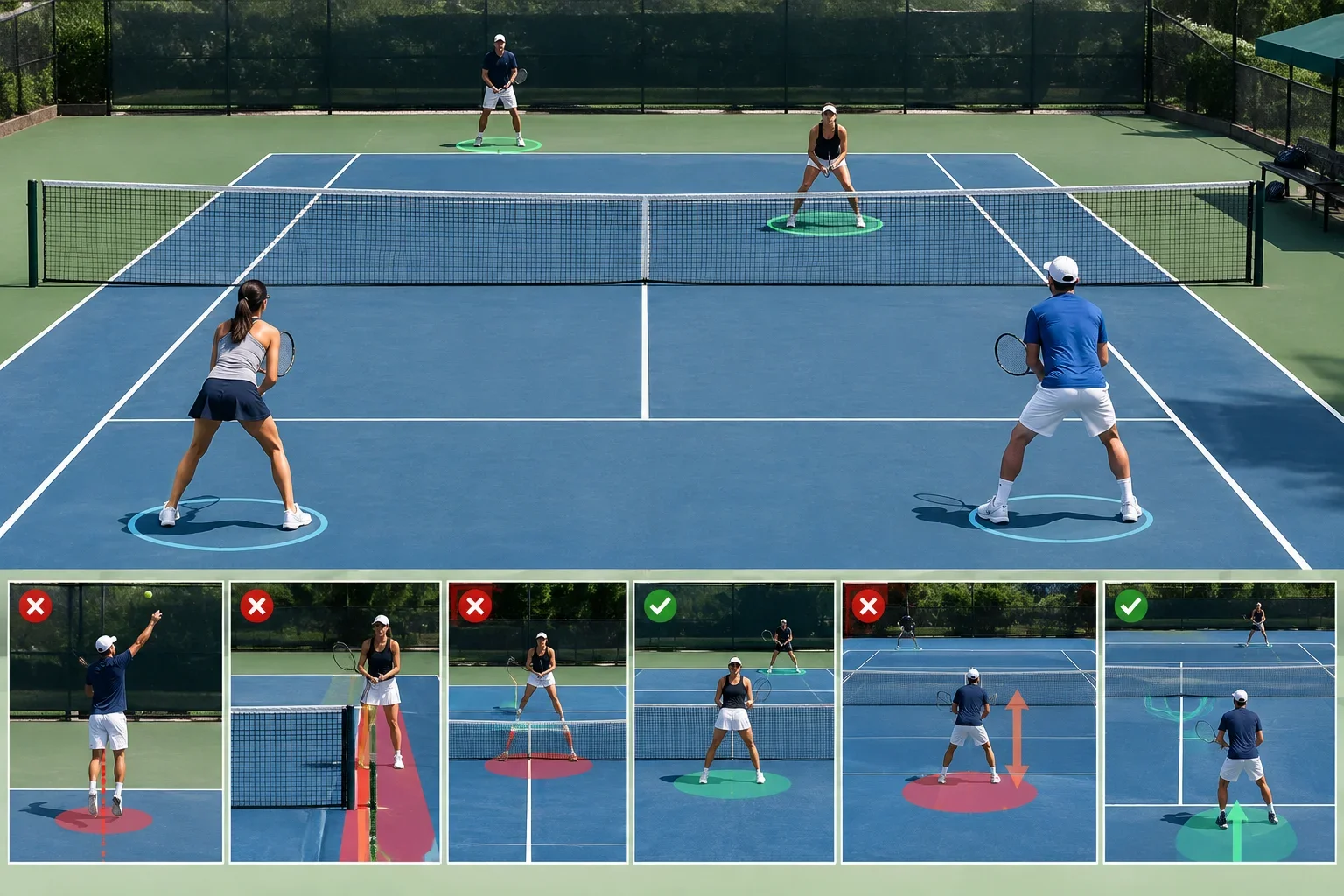
Image credit: ChatGPT
Most recreational doubles matches aren’t decided by spectacular shots. They’re decided by positioning.
You’ve probably seen it happen: a team with average strokes beats a team with better ones because they’re always in the right place. They cover the middle, close the net together, and make every opponent’s shot feel harder than it should be. Meanwhile, the team with the bigger forehands keeps getting passed down the alley, lobbed over, and split down the middle.
The good news is that positioning is the easiest part of doubles to improve. You don’t need a new stroke or months of lessons. You just need to know where to stand, when to move, and how to work with your partner.
Here are the 10 most common doubles positioning mistakes recreational players make, why they hurt you, and how to fix each one.
The Basics: How Doubles Positioning Works
Before getting into the mistakes, here’s a quick refresher on the standard starting positions.
Serving team:
- The server stands behind the baseline, roughly halfway between the center mark and the doubles sideline.
- The server’s partner stands at the net, roughly in the middle of the service box, on the opposite side from the server.
Receiving team:
- The returner stands near the baseline, positioned to cover the serve, usually close to where the serve will bounce.
- The returner’s partner usually stands near the service line, on the opposite side from the returner.
This is the classic “one up, one back” starting formation. From there, the goal for most teams is to get both players to the net whenever possible, because the team that controls the net usually controls the point.
Now, here’s where things go wrong.
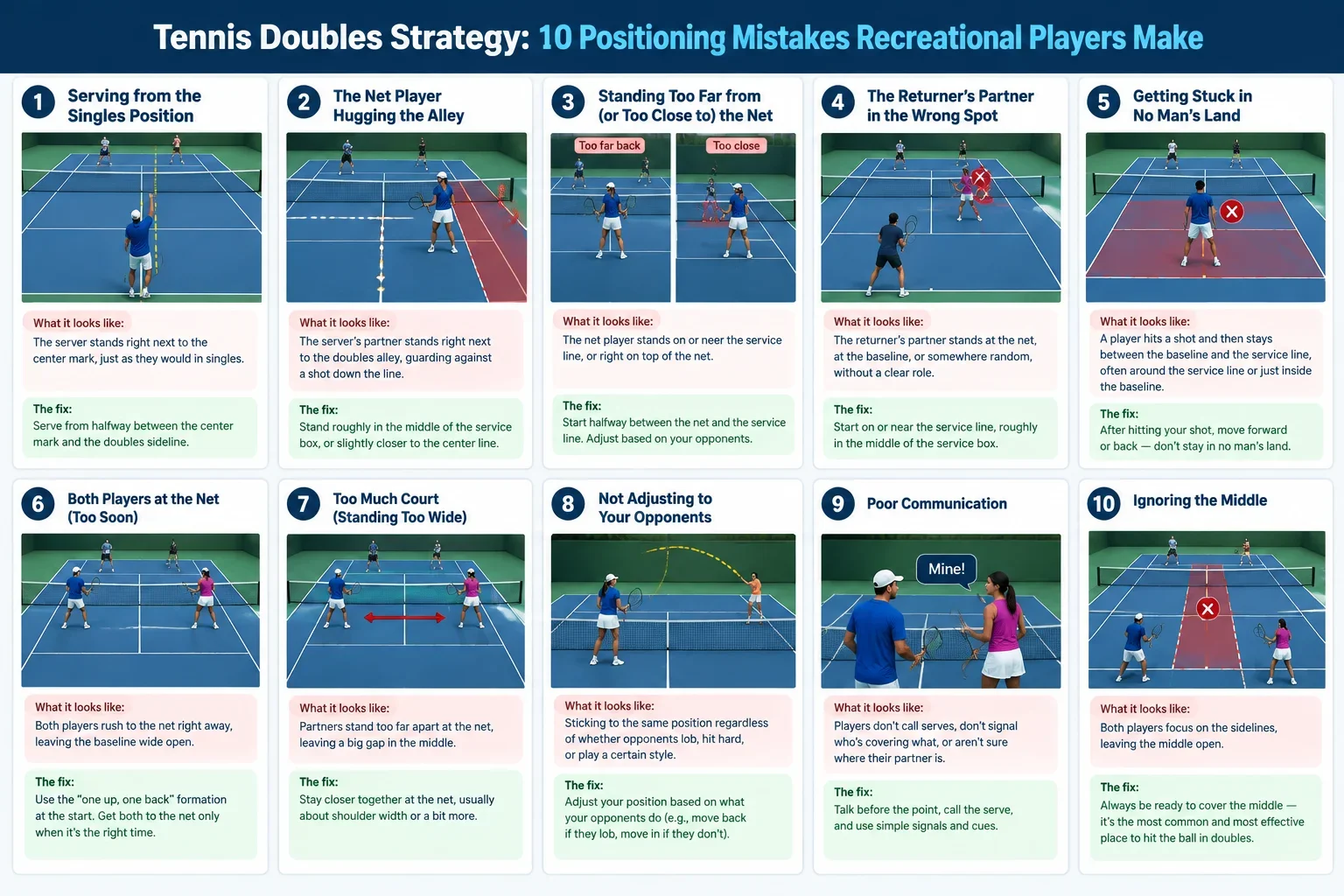
Mistake #1: Serving from the Singles Position
What it looks like
The server stands right next to the center mark, just as they would in singles.
Why it hurts
In singles, you serve from near the center so you’re in position to cover the whole court. In doubles, your partner covers half the court. Serving from the center:
- Creates a sharper angle for the returner, who can pull you wide with a crosscourt return.
- Leaves a big gap on your side of the court that you have to cover after the serve.
- Makes it harder to cover the crosscourt return, which is the most common return in doubles.
The fix
Serve from roughly halfway between the center mark and the doubles sideline. This puts you in better position to cover the crosscourt return and reduces the angle available to the returner.
Exception: If your team is using the I-formation or Australian formation (more on these later), you’ll serve from closer to the center mark.
Mistake #2: The Net Player Hugging the Alley
What it looks like
The server’s partner stands right next to the doubles alley, guarding against a shot down the line.
Why it hurts
Many recreational net players are so afraid of getting passed down the alley that they stand almost in it. But the alley is a small target that most returners rarely hit. Meanwhile, standing there:
- Leaves a huge gap in the middle, which is where most returns go.
- Takes you out of the point because you can’t reach crosscourt balls to poach.
- Puts more pressure on your server, who now has to cover more of the court.
The fix
Stand roughly in the middle of your service box, or slightly closer to the center line. From there, you can protect the alley with a quick step while still threatening the middle.
Remember: Getting passed down the alley occasionally is fine. It means you’re doing your job by covering the middle and making the returner hit a difficult shot. If the returner hits the alley consistently, then adjust.
Mistake #3: Standing Too Far from (or Too Close to) the Net
What it looks like
The net player stands on or near the service line, or right on top of the net.
Why it hurts
Too far back (near the service line):
- Volleys arrive at your feet, forcing you to hit up.
- You give the opponents more time and more angles.
- You can’t put away volleys.
Too close (right on the net):
- You’re easy to lob.
- You have less time to react to hard shots.
- You may touch the net while volleying.
The fix
As the server’s partner, start roughly halfway between the net and the service line. Adjust based on your opponents:
- Move closer if your opponents rarely lob and you want to put away volleys.
- Move back if they lob often or hit hard at you.
As the point develops, move forward when your team is attacking (to cut off angles and put the ball away) and back up slightly when you’re defending (to give yourself time to react).
Mistake #4: The Returner’s Partner in the Wrong Spot
What it looks like
The returner’s partner stands at the net, at the baseline, or somewhere random, without a clear role.
Why it hurts
The returner’s partner has a specific job: watch the opposing net player. If the returner’s shot gets poached or picked off at the net, the ball is coming right at the returner’s partner. If they’re standing at the net, they’ll get hit or won’t have time to react. If they’re at the baseline, they’re too far away to help the team move forward.
The fix
Start on or near the service line, roughly in the middle of the service box, on the opposite side from the returner. From there:
- Call the serve. You’re in a great position to call whether the serve is in or out on the service line.
- Watch the opposing net player, not your partner’s return.
- If the return gets past the net player, move forward toward the net.
- If the net player is going to volley it, stay back and get ready to defend.
Variation: If you’re facing a strong serve or an aggressive net player, both members of the receiving team can start at the baseline. This is a common defensive strategy at every level.
Mistake #5: Getting Stuck in No Man’s Land
What it looks like
A player hits a shot and then stays between the baseline and the service line, often around the service line or just inside the baseline.
Why it hurts
“No man’s land” (the area between the baseline and service line) is the hardest place on the court to play from. Balls land at your feet, you have to hit up, and you’re neither in a good attacking position nor a good defensive position. Opponents at the net will feast on your low, rising shots.
The fix
Make a decision: go forward or stay back. After you hit an approach shot or return, either:
- Keep moving forward toward the net, stopping to split step as your opponent hits, then continuing forward after your volley.
- Stay back behind the baseline and wait for a better opportunity to come in.
If you do get caught in no man’s land, split step, hit the best low volley or half-volley you can (usually back deep or low, toward the middle), and keep moving forward.
Mistake #6: Not Moving as a Unit
What it looks like
Both players stand in their starting positions and stay there for the entire point, regardless of where the ball is.
Why it hurts
Doubles positioning is about the ball, not fixed spots on the court. If the ball moves to one side and your team doesn’t shift, you leave gaps in the middle or the alley that opponents can hit through.
The fix
Think of your team as connected by a rope about 10 to 12 feet long. When the ball moves to one side, you both shift that direction together. When one of you moves forward, the other moves forward too.
When the ball goes wide to one side:
- The player on that side shifts toward the alley to protect the line.
- The partner shifts toward the middle to cover the center.
When the ball goes to the middle:
- Both players shift toward the center, closing the gap between them.
This is sometimes called the “windshield wiper” effect: the team swings together, side to side, with the ball.
Mistake #7: Leaving the Middle Open
What it looks like
A ball comes down the middle, and both players either let it go (“Yours!”) or both go for it and clash rackets.
Why it hurts
The middle is the most important part of the doubles court. Shots down the middle:
- Cross the lowest part of the net
- Create confusion between partners
- Reduce the opponents’ angles
If your team doesn’t have a plan for the middle, opponents will hit there all day.
The fix
Agree on a “middle rule” before the match. Common options:
- The player crosscourt from the ball takes it. The player diagonal from the hitter has a better angle and usually more time, so they take middle balls.
- The forehand takes it. If both players are at the net, the player with the forehand in the middle takes it.
- The player who hit last takes it. Some teams use this rule, though it’s harder to apply in fast exchanges.
- The player closer to the net takes it. If one player is up and one is back, the net player should take any middle ball they can reach. They’re in a better position to finish the point.
Whichever rule you choose, communicate loudly and early: “Mine!” or “Yours!” Silence is the enemy of good doubles.
Mistake #8: Staying One Up, One Back When the Opponents Are at the Net
What it looks like
Your team stays in the one-up, one-back formation while both opponents move to the net.
Why it hurts
One-up, one-back creates a diagonal gap between partners. When both opponents are at the net, they can volley through that gap, at the net player’s feet, or at a sharp angle the back player can’t reach. Your net player is especially vulnerable, since they’re standing close to two opponents who are volleying down at them.
The fix
Match your formation to the situation:
- When your team is attacking, try to get both players to the net.
- When your team is defending against two opponents at the net, consider both players moving back to the baseline. This gives you more time to react, reduces the gaps, and sets up lobs and passing shots.
Teams that move between “both up” and “both back” are much harder to beat than teams that stay frozen in one-up, one-back.
Mistake #9: Turning Around to Watch Your Partner Hit
What it looks like
The net player turns their head (or entire body) to watch their partner hit the ball from the baseline.
Why it hurts
If you’re watching your partner, you’re not watching the opponents, and that’s where the ball is going next. By the time you turn back around, the ball may already be on its way at you. You lose reaction time, miss poaching opportunities, and are more likely to get hit.
The fix
Watch the opponents, not your partner. As the net player, keep your eyes on the opponent who is about to hit, and read their body position and racket face. You’ll know where your partner’s shot went by where the opponent moves.
It feels strange at first, but it’s one of the quickest ways to improve your net play.
Mistake #10: Mishandling Lobs
What it looks like
The opponent lobs over the net player. The net player backpedals awkwardly or freezes, and the partner doesn’t move. Or both players run for the ball, and nobody covers the court.
Why it hurts
Lobs are one of the most effective shots in recreational doubles because many teams don’t have a clear plan for handling them. A good lob can turn an attacking position into a defensive scramble in an instant.
The fix
Have a plan for lobs:
- If the net player can reach it, they should turn sideways and move back (never backpedal, which is slow and dangerous) and hit an overhead.
- If the lob is over the net player’s head, the partner should cross behind to cover it, and the net player switches sides.
- Communicate: call “Switch!” or “Mine!” loudly as soon as possible.
- After a lob goes over your heads, it’s usually best for both players to move back to the baseline, then work your way forward again.
You can also reduce lobs by positioning sensibly. If you’re getting lobbed often, move back slightly from the net.
Bonus Mistake: Never Changing Your Formation
What it looks like
A team uses the same standard formation every point, even when it’s not working.
Why it hurts
If your opponents are hitting great crosscourt returns, winning lots of points against your serve, or reading your patterns, staying in the same formation means you’ll keep losing the same points.
The fix
Try a different formation to change the returner’s target:
Australian formation: The net player stands on the same side as the server, and the server moves to the other side after the serve. This blocks the crosscourt return and forces the returner to hit down the line.
I-formation: The net player crouches at the center line in front of the server, then moves left or right after the serve (using a signal agreed with the server). This confuses the returner and creates poaching opportunities.
Even trying a different formation for a few points can disrupt your opponents’ rhythm.
Quick Reference: Where to Stand
| Player | Starting position | Main job |
|---|---|---|
| Server | Behind the baseline, about halfway between the center mark and doubles sideline | Get a high percentage of first serves in, cover the crosscourt return |
| Server’s partner | About halfway between the net and the service line, roughly in the middle of the service box | Cover the middle, poach, put away volleys |
| Returner | Near the baseline, where they can cover the serve | Return crosscourt and low, away from the net player |
| Returner’s partner | Near the service line, roughly in the middle of the service box | Call the serve, watch the opposing net player, move forward when possible |
Drills to Improve Your Doubles Positioning
1. The rope drill
Partners stand at the net, holding opposite ends of a rope or towel (or just imagining one). A coach or third player feeds balls to different parts of the court, and partners move together, keeping the same distance apart.
2. Crosscourt only
Play points where all shots must go crosscourt, with net players allowed to poach. This builds crosscourt consistency and teaches net players when to move.
3. Middle ball drill
Feed balls down the middle to two players at the net. Practice your “middle rule” and calling “Mine!” or “Yours!”
4. Lob and switch
One team stands at the net. The other team lobs over them. Practice turning, moving back, switching sides, and calling “Switch!”
5. Formation practice
Play several service games using only the Australian formation, then several using only the I-formation. You’ll learn when each one is useful.
Find Doubles Partners and Practice Together
The best way to improve your doubles positioning is to play regularly with the same partner, so you can develop a plan for the middle, communicate well, and learn how each other moves.
Find doubles partners on LetsPlayTennis.com by creating a free player profile, marking that you play doubles, and browsing players near you at your level. You can also find leagues, ladders, round robins, clubs, and coaches to give you more chances to put these tips into practice.
The Bottom Line
Good doubles positioning comes down to a few simple principles: stand where you can cover the middle, move with your partner, get to the net together, avoid no man’s land, and communicate. Fix even two or three of these mistakes, and you’ll win more points without changing a single stroke.
Pick one mistake to work on this week, talk it over with your partner, and watch how quickly your team improves.
Frequently Asked Questions
Where should the net player stand in doubles?
The server’s partner should start roughly halfway between the net and the service line, roughly in the middle of the service box. Adjust closer to the net to attack, and back slightly if the opponents lob often.
Who should take the ball down the middle in doubles?
Agree on a rule with your partner before the match. Common rules are that the player crosscourt from the ball takes it, or that the player with the forehand in the middle takes it. If one player is at the net and the other is back, the net player should take any middle ball they can reach.
What is no man’s land in tennis?
No man’s land is the area between the baseline and the service line. It’s hard to play from because balls land at your feet. Either move forward to the net or stay back behind the baseline.
Should both players be at the net in doubles?
In most cases, yes. The team with both players at the net usually controls the point. But when the opponents are both at the net and you’re defending, moving both players back to the baseline can be a better choice.
What is the Australian formation?
In the Australian formation, the server’s partner stands at the net on the same side as the server. After the serve, the server moves to the other side. It’s used to block crosscourt returns and force the returner to hit down the line.
What is the I-formation in tennis doubles?
In the I-formation, the server’s partner crouches at the center line in front of the server. After the serve, they move left or right based on a pre-arranged signal, and the server covers the other side. It’s used to confuse the returner and create poaching opportunities.
Comments
No approved comments yet.
Log in or sign up to join the conversation.