

Tennis Etiquette for Recreational Players: Line Calls, Score Disputes and Warm-Up Manners
A guide to recreational tennis etiquette, covering line calls, score disputes, warm-up manners, doubles etiquette and courtesies before and after a match.
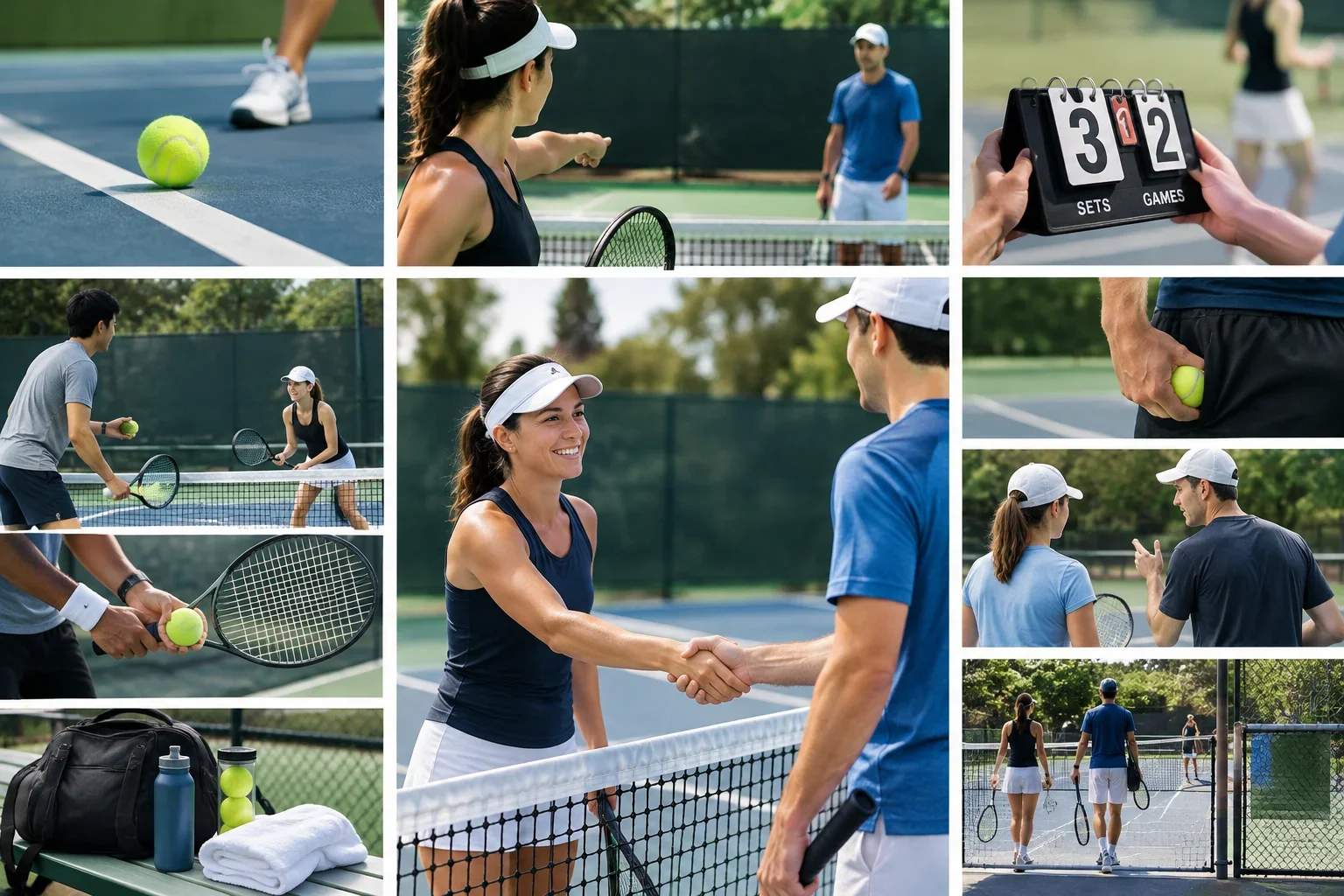
Image credit: ChatGPT
In recreational tennis, there's no umpire. You call your own lines, keep your own score and settle your own disputes. That system only works when everyone follows the same unwritten rules.
Most of them are written down, actually. In the US, the USTA publishes The Code, a short guide to fair play in matches without officials. This article covers the parts that come up most: line calls, keeping score, warming up, and the small courtesies that make people want to play with you again.
Line calls
The golden rule is simple: if you're not sure the ball was out, it's in. Your opponent gets the benefit of the doubt every time.
- Call your own side. You make the calls on your half of the court. Your opponent makes the calls on theirs.
- Call it fast and clearly. Say "out" or point clearly, right away. A call made after you've hit the ball back, or after watching where your shot went, isn't fair.
- Only call what you saw. If you were looking elsewhere, or the ball was too fast to track, play it as good.
- Don't ask your opponent to make your call. You can ask for their opinion, but you have to accept what they say if you do.
- Correct your own bad calls. If you call a ball out and then realize it was in, say so. The point goes to your opponent.
- Don't take calls from spectators. Friends, parents and players on the next court don't get a say.
- On clay, check the mark. The ball leaves a mark you can check if either player is unsure, but only on a point-ending shot or when play stops.
If you think your opponent is making bad calls, ask politely: "Are you sure about that one?" If it keeps happening in a league match, stop and ask for an official or the league coordinator. Don't start making bad calls back.
Calling the score and settling disputes
Most score arguments are avoided with one habit: the server calls the score out loud before every point. It should be loud enough for the opponent to hear.
- Server's score first. Say "30–15," not "15–30," when you're serving and ahead.
- Game score at changeovers. Say the set score when you switch ends, for example "3–2, me."
- Use a visual aid. A score flip, a score-keeping app or a ball in your pocket helps on long matches.
If you still disagree on the score:
- Go back to the last score you both agree on. Talk through the points since then.
- If you can't agree on the disputed points, play from the last agreed score.
- In a league match where that still doesn't work, contact the league coordinator or an official if one is on site.
Never argue for a score you're unsure of just because it favors you. Losing a disputed point is cheaper than losing a playing partner.
Warm-up manners
The warm-up is for both players to find their rhythm, not for you to practice winners. A typical match warm-up lasts 5–10 minutes.
- Hit to your opponent, not away from them. Aim rally balls at a comfortable height so they can hit back.
- Take turns at the net. Give each player a few minutes of volleys and some overheads.
- Practice serves before the first point, not during the match. Both players take their practice serves in the warm-up. "First one in" isn't a thing.
- Don't serve while your opponent is warming up. Take turns, or both serve to opposite boxes.
- Return practice serves gently, or not at all. Hitting them back hard is a common way to annoy people.
- Finish on time. If you booked a slot, keep the warm-up short enough to fit the match.
During play
Once the match starts, the focus is on fair play and pace of play.
- Serve when the receiver is ready. Don't quick-serve before your opponent is set. The receiver should play at the server's reasonable pace, too.
- Call lets on your own side. A serve that clips the net and lands in is a let. Either player can call it, but call it right away.
- Stray balls from another court. If a ball rolls onto your court during a point, call "let" and replay the point. Return the ball when your point is over, not during theirs.
- Wait to cross behind courts. Only walk behind another court between points, and don't stop there.
- Keep noise down. Grunting is fine. Shouting, swearing and racquet throwing aren't. Talking to distract the opponent mid-point isn't allowed.
- Pass balls to the server. Roll them along the ground or hit them gently so the server can catch them on the bounce.
- Hand over balls between points. Collect balls on your side and send them back promptly.
- Don't stall. Take reasonable time between points, and keep changeovers to about 90 seconds.
Doubles etiquette
Doubles adds a partner, which means more people to call lines and more ways to disagree.
- Either partner can call a ball out on your side. If one partner calls it out and the other saw it in, the ball is in. Doubt goes to the opponents.
- The receiver's partner usually calls the service line. The receiver watches the ball, while their partner watches the line.
- Don't coach your partner mid-point. Encouragement is fine. Correcting their technique during a match rarely helps.
- Own your errors. A quick "my fault" or "good try" goes a long way. Never sigh or roll your eyes at a partner's miss.
- Agree on who takes the middle. A simple rule, such as "forehand takes it," stops both of you from going for the same ball, or neither.
- Don't aim at the net player's body to hurt them. Hitting at a player is a legitimate tactic, but blasting a ball at someone from close range isn't.
Before and after the match
Good manners start before the first ball and end after the last one.
- Arrive on time and ready. Show up 5–10 minutes early with your racquet, water and a new can of balls if it's your turn to bring them.
- Confirm the format first. Agree on sets, tiebreaks and whether you're playing ad or no-ad scoring before you start.
- Respect booked court time. Leave on time when the next group arrives, even mid-set. Note the score and finish another day.
- Wait for your court. If a group is playing past their slot, let them know politely rather than walking on.
- Shake hands at the net. Win or lose, finish with a handshake or racquet tap and a "good match."
- Report scores promptly. In leagues and ladders, the winner usually enters the score. Do it the same day so standings stay accurate.
- Clean up. Take your empty can, water bottles and towels with you.
Quick reference: do and don't
| Situation | Do | Don't |
|---|---|---|
| Ball lands near the line | Call it in unless you clearly saw it out | Call it out because you're not sure |
| You called a ball out by mistake | Correct it and give your opponent the point | Pretend it didn't happen |
| Score disagreement | Go back to the last agreed score | Insist on the version that helps you |
| Warm-up | Hit rally balls to your opponent | Practice winners or hard serves at them |
| Ball rolls onto your court mid-point | Call a let and replay the point | Keep playing, or claim the point |
| Walking behind a court | Wait until the point ends | Cross in the middle of a rally |
| Partner misses an easy shot | Say "next one" | Sigh, coach or complain |
| Court time is up | Leave and finish another day | Keep playing while the next group waits |
| End of the match | Shake hands and report the score | Leave without a word |
FAQ
Who calls the lines in a casual match?
Each player calls the lines on their own side of the net. In doubles, both partners can make calls on their side.
What if my opponent keeps making bad calls?
Ask calmly if they're sure. In a league match, if it keeps happening, stop and contact the league coordinator or an on-site official. Don't make bad calls in return.
Is it rude to ask my opponent for a call on my side?
No, but if you ask, accept their answer. If they say it was in, it's in.
How long should a warm-up be?
About 5–10 minutes for a match, including a few minutes of volleys and serves for each player.
Do I have to give my opponent the point if I hit the ball after it bounced twice?
Yes. Double bounces, touching the net and being hit by the ball are all called on yourself. Say so right away.
What if we run out of court time?
Leave on time. Write down the score and agree on when to finish, or count the match as unfinished if your league allows it.
Comments
No approved comments yet.
Log in or sign up to join the conversation.