
Tennis Grips Explained: Continental, Eastern and Semi-Western (and When to Use Each)
Find each tennis grip using the bevel system, learn what continental, eastern, semi-western, western and two-handed grips do best, and which to learn first.
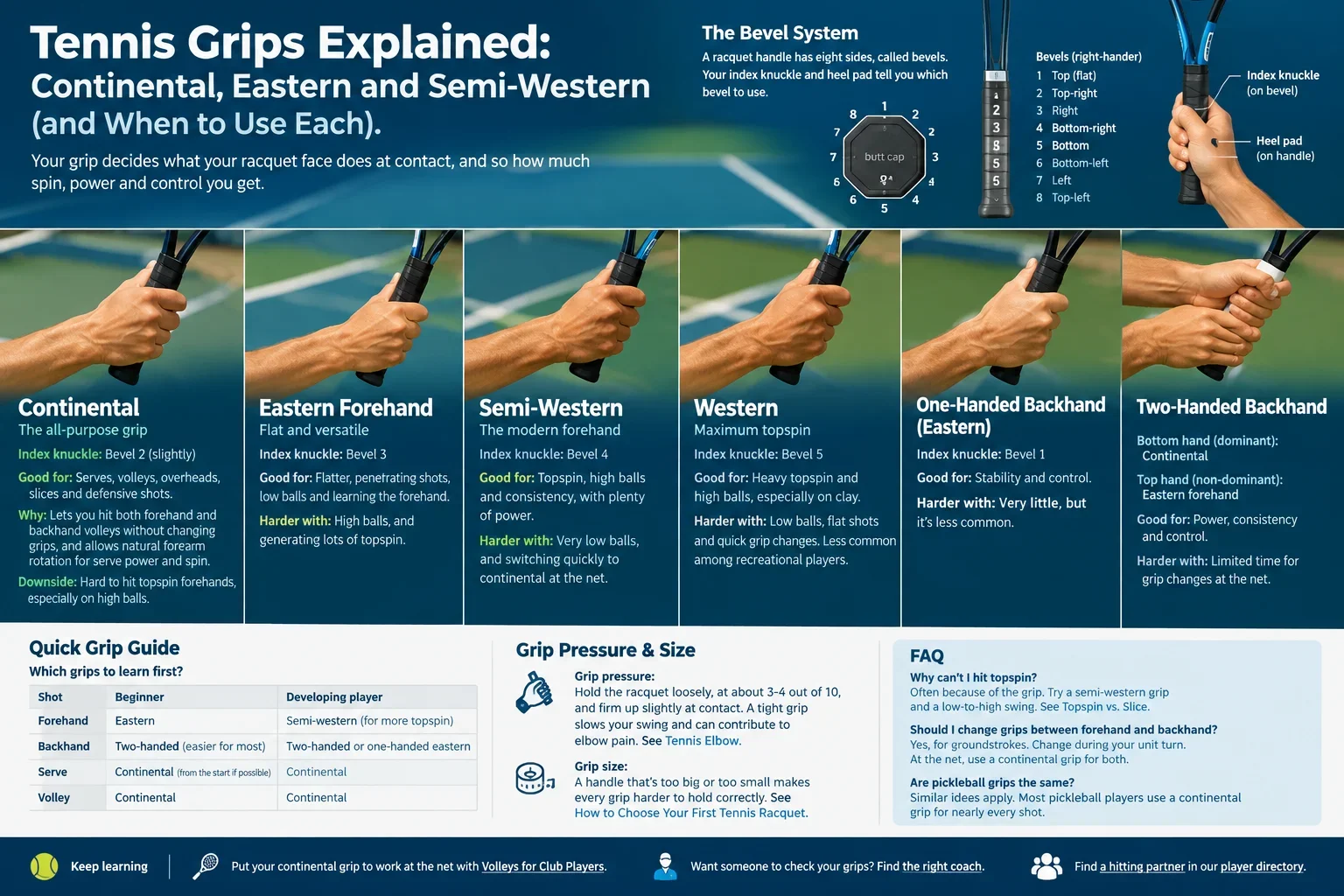
Image credit: ChatGPT
Your grip decides what your racquet face does at contact, and so how much spin, power and control you get. Most players use a continental grip for serves, volleys and slices, an eastern or semi-western grip for forehands, and either a one-handed eastern backhand grip or a two-handed grip for backhands.
This guide explains each grip, how to find it using the bevels on your handle, what it's good and bad at, and which grips to learn first.
How to find a grip: the bevel system
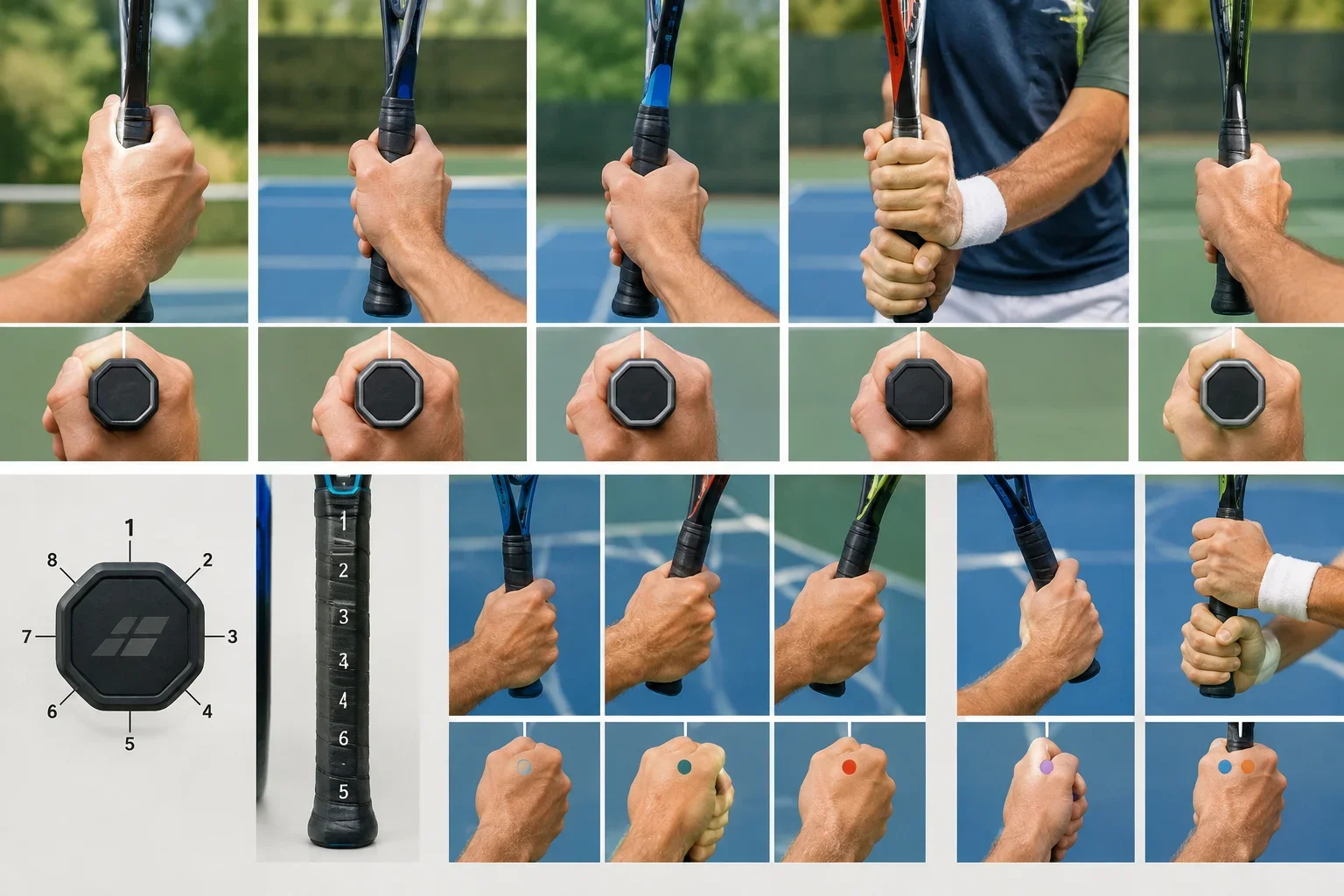
A racquet handle has eight sides, called bevels. To describe a grip, coaches use the position of your index knuckle (the base knuckle of your index finger) and the heel pad of your hand on these bevels.
For a right-hander, hold the racquet with the edge of the frame pointing straight up and down. Bevel 1 is the flat top of the handle. Looking at the butt cap at the end of the handle, count clockwise from there: bevel 2 is the top-right slanted edge, bevel 3 is the right side, bevel 4 the bottom-right edge, and so on. Left-handers count counterclockwise.
| Grip | Index knuckle on (right-hander) | Main use |
|---|---|---|
| Eastern backhand | Bevel 1 | One-handed backhand |
| Continental | Bevel 2 | Serve, volley, overhead, slice |
| Eastern forehand | Bevel 3 | Flat, versatile forehand |
| Semi-western | Bevel 4 | Modern topspin forehand |
| Western | Bevel 5 | Heavy topspin forehand |
Continental: the all-purpose grip
Hold the racquet like you're shaking hands with the edge of the frame, or holding a hammer. The V between your thumb and index finger sits on the top of the handle, slightly toward bevel 2.
- Use it for: serves, volleys, overheads, slices and defensive shots.
- Why: it lets you hit both forehand and backhand volleys without changing grips, and it allows the natural forearm rotation that gives the serve its power and spin.
- Downside: it's hard to hit topspin forehands with it, especially on high balls.
If you only change one thing in your game, learn to serve and volley with a continental grip. See Fix Your Serve in 30 Days.
Forehand grips
Eastern forehand
Place your palm flat against the strings, then slide your hand down to the handle. Your index knuckle is on bevel 3. It's like shaking hands with the racquet.
- Good for: flatter, penetrating shots, low balls and learning the forehand. It's easy to switch to continental from it.
- Harder with: high balls, and generating lots of topspin.
Semi-western
Turn your hand a little further under the handle, so your index knuckle is on bevel 4. It's the most common forehand grip in the modern game.
- Good for: topspin, high balls and consistency, with plenty of power.
- Harder with: very low balls, and switching quickly to continental at the net.
Western
The hand turns even further under the handle, with the index knuckle on bevel 5.
- Good for: heavy topspin and high balls, especially on clay.
- Harder with: low balls, flat shots and quick grip changes. It's less common among recreational players.
Backhand grips
One-handed: eastern backhand
Turn your hand toward the top of the handle, so your index knuckle sits on bevel 1. This puts the palm on top of the handle and supports the racquet at contact.
Two-handed
The most common two-handed grip:
- Bottom hand (your dominant hand): continental.
- Top hand (your non-dominant hand): eastern forehand, as if hitting a left-handed forehand for a right-hander.
The top hand does much of the work. Many coaches describe the two-handed backhand as a non-dominant-side forehand.
Which grips to learn first
| Shot | Beginner | Developing player |
|---|---|---|
| Forehand | Eastern | Semi-western, if you want more topspin |
| Backhand | Two-handed (easier for most beginners) | Two-handed or one-handed eastern |
| Serve | Continental, from the start if possible | Continental |
| Volley | Continental | Continental |
Changing a grip feels strange for a few weeks, and your shots may get worse before they get better. Stick with it in practice before using it in matches.
Grip pressure and grip size
- Grip pressure: hold the racquet loosely, at about 3–4 out of 10, and firm up slightly at contact. A tight grip slows your swing and can contribute to elbow pain. See Tennis Elbow.
- Grip size: a handle that's too big or too small makes every grip harder to hold correctly. How to Choose Your First Tennis Racquet shows how to measure.
FAQ
Why can't I hit topspin?
Often because of the grip. An eastern or continental forehand grip makes topspin harder. Try a semi-western grip and a low-to-high swing. See Topspin vs. Slice.
Should I change grips between forehand and backhand?
Yes, for groundstrokes. Change during your unit turn, as the ball approaches. At the net, there's no time, so use a continental grip for both.
Are pickleball grips the same?
Similar ideas apply. Most pickleball players use a continental grip for nearly every shot, because there's so little time at the kitchen line.
Keep learning
- Put your continental grip to work at the net with Volleys for Club Players.
- Want someone to check your grips? Find the right coach.
- Find a hitting partner in our player directory.
Comments
No approved comments yet.
Log in or sign up to join the conversation.