

Tennis Racquet Customization: Lead Tape, Grips and Dampeners Explained
How overgrips, replacement grips, lead tape and dampeners change your tennis racquet, where to add weight, and how to match two racquets.
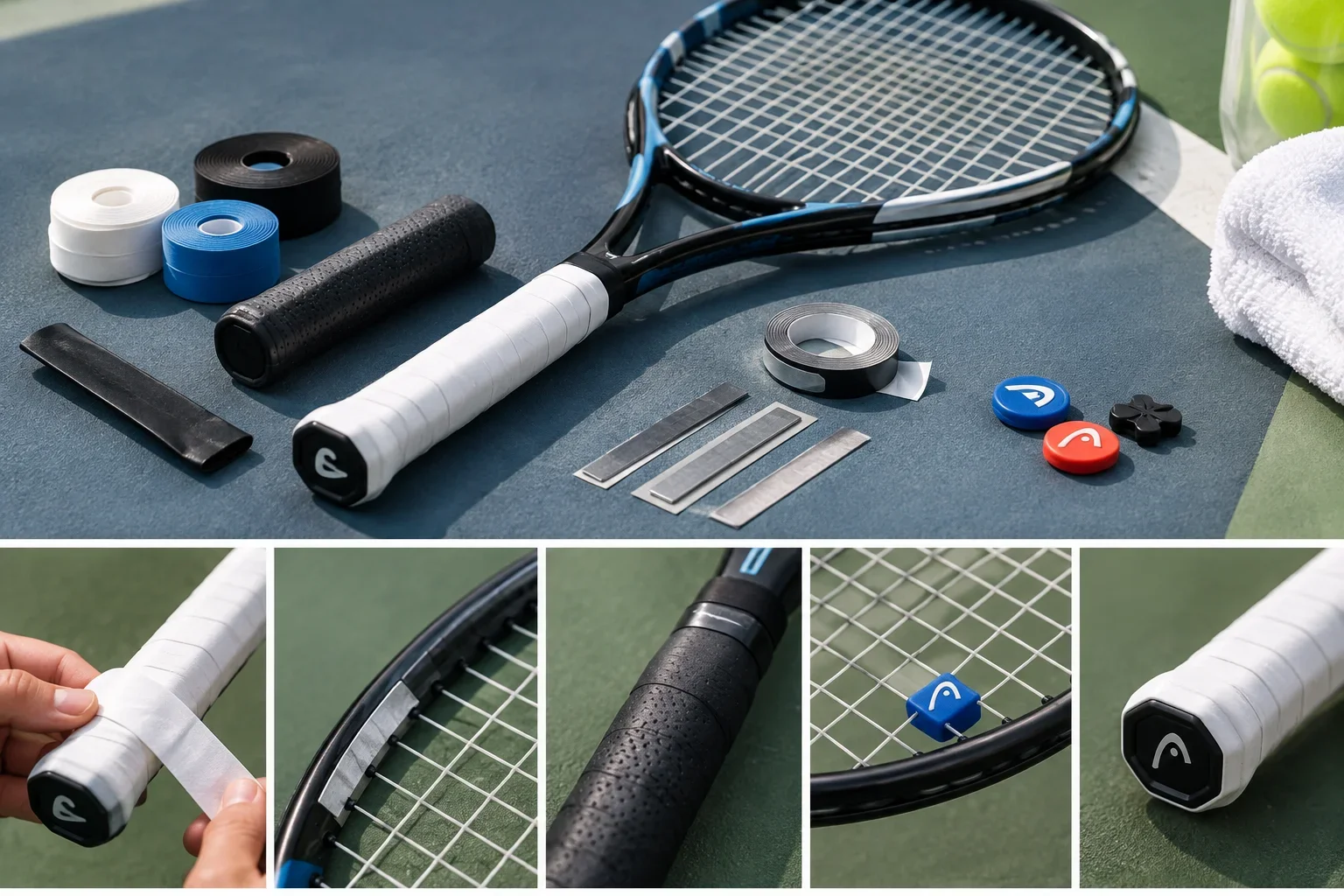
Image credit: ChatGPT
Small changes can make a racquet feel noticeably different. A few grams of lead tape, a thicker grip or a different overgrip can add stability, change the balance or make the handle more comfortable. You don't need a pro stringer to do the basics, but it helps to understand what each change does before you start.
This guide covers the most common customizations, overgrips, replacement grips, lead tape and dampeners, and how to make changes safely.
The short answer
| Change | What it does |
|---|---|
| Overgrip | Adds tack or absorbs sweat, and makes the handle slightly bigger |
| Replacement grip | Restores the base grip's cushioning and feel |
| Heat-shrink sleeve | Increases grip size permanently |
| Lead tape at 12 o'clock | More power, stability and swingweight |
| Lead tape at 3 and 9 o'clock | More stability on off-center hits |
| Weight in the handle | More overall weight, and a more head-light balance |
| Vibration dampener | Reduces string "ping"; changes feel and sound |
Overgrips
An overgrip is a thin wrap that goes over the existing grip. It's the cheapest and most common customization.
- Tacky overgrips feel sticky, which helps in normal conditions.
- Dry overgrips absorb sweat, which helps in heat and humidity.
- Size: each overgrip adds roughly one-sixteenth of an inch to grip size.
- Replace them often. Once an overgrip gets slick or worn, usually after a few sessions for regular players, it's time for a new one.
Wrap from the butt cap up, overlapping each turn slightly. Keep the tension even, and finish with the tape at the top of the handle. Most overgrips come with instructions printed on the packaging.
Replacement grips and grip size
A replacement grip replaces the original grip entirely. It has more cushioning than an overgrip, and you may want to change it every year or so if you play often.
To make a handle bigger:
- Add an overgrip, or two, for a small increase.
- Use a heat-shrink sleeve under the grip for a larger, permanent increase.
Making a handle smaller is much harder. That's why it's better to buy a racquet with a grip that's slightly small. See How to Choose Your First Tennis Racquet for how to measure.
Lead tape
Lead tape (or tungsten tape) is self-adhesive weight tape. Where you put it changes how the racquet plays. Picture the racquet head as a clock face, with 12 o'clock at the tip.
- 12 o'clock: increases swingweight. More power and plow-through, but slower to swing.
- 3 and 9 o'clock: increases stability on off-center hits, with a smaller effect on swingweight.
- 2 and 10 o'clock: a combination of both.
- In the handle: adds weight and moves the balance toward the handle, making the racquet feel more stable without slowing your swing as much.
Lead tape tips
- Add a little at a time, 2–4 grams, and play a few sessions before adding more.
- Add it in equal amounts on both sides at 3 and 9 o'clock, so the racquet stays balanced.
- Place tape inside the frame's bumper guard or on the inner hoop, where it won't scrape off.
- Write down exactly where and how much you added, so you can match it on a second racquet.
Learn what swingweight and balance mean in How to Read a Tennis Racquet Spec Sheet.
Vibration dampeners
A dampener is a small rubber piece placed on the strings. It reduces the high-pitched "ping" from the strings, and changes the feel and sound of the racquet.
- It reduces string vibration, not the shock that travels through the frame. So it won't prevent tennis elbow on its own. See Tennis Elbow.
- Under the rules, it must be placed outside the pattern of crossed strings, usually between the bottom two cross strings.
- Whether to use one is a matter of preference.
Strings and tension
Your strings change how a racquet plays as much as any other customization. Lower tension gives more power and comfort. Higher tension gives more control. See our tennis string guide and the string tension calculator.
Matching two racquets
If you play matches regularly, a second racquet is useful in case you break a string. For it to feel the same, match:
- The model and grip size
- Strings and tension, ideally strung at the same time
- Total weight and balance, using lead tape if needed
- Overgrip type
A local stringer can measure and match your racquets. Many pro shops offer this service.
FAQ
Will lead tape improve my game?
It can make a light racquet more stable and powerful. It won't fix technique problems, and adding too much can make the racquet tiring to swing.
How often should I change my overgrip?
When it becomes slick or worn. For frequent players, that may be every few sessions.
Can I customize a pickleball paddle the same way?
Partly. Many players add lead tape and change grips. See Pickleball Paddle Care.
Keep learning
- Compare racquet specs in our racket finder.
- Track your setup in the equipment database.
- Restringing tips: How Often Should You Restring?
Comments
No approved comments yet.
Log in or sign up to join the conversation.